

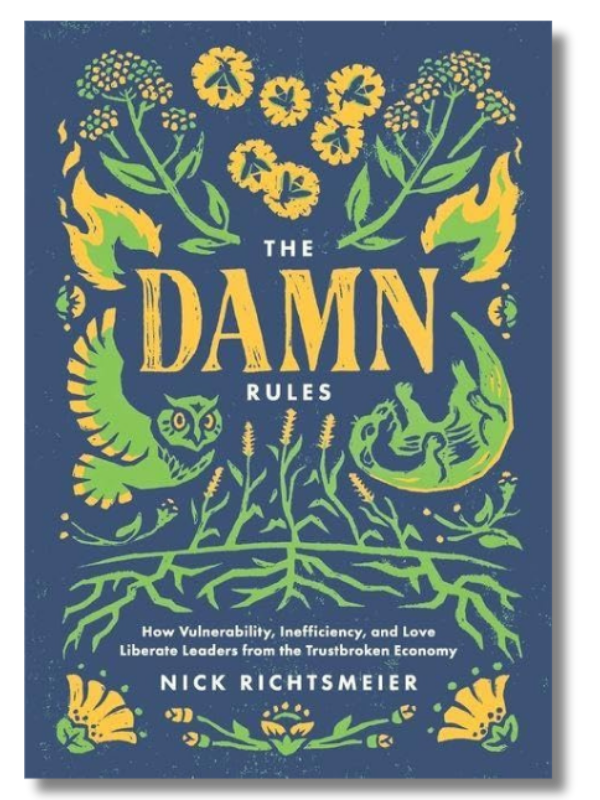
A provocative and insightful exploration of trust, leadership, and a better way to play the business game
The Damn Rules by Nick Richtsmeier is a refreshing, down-to-earth book about the opposing mental models we use to approach business, leadership, and careers. Richtsmeier calls these mental models the “extractive game” and the “expansive game.” The extractive game centralizes and consolidates value, creating coercive relationships, while the expansive game builds interdependent systems that regenerate and distribute value through trust and collaboration.
His goal is to explain the rules of the expansive game and show why they run counter to much of contemporary business practice, yet can produce healthier and more sustainable outcomes. He calls them the “Damn Rules” partly because “Give-a-Damn Rules” was too much of a mouthful, but mainly because of the reaction they are intended to provoke: “Damn. I knew I knew that.”
The book begins by asking why so many people feel exhausted, anxious, and trapped in their work. Richtsmeier argues that we have accepted the rules of an extractive economic game without recognizing that they are rules, not immutable laws. His Monopoly analogy makes this especially clear. He recalls playing the game with his grandfather, who would remind him after a loss, “These are the rules of the game you chose. If you don’t like the rules, play a different game.” He connects this childhood lesson to the story of Elizabeth Magie, creator of The Landlord’s Game, which originally contained both an extractive version, in which players accumulated wealth at one another’s expense, and a “Prosperity” version, in which everyone could benefit from wealth creation.
From there, Richtsmeier argues that the rules governing business shape outcomes more powerfully than the intentions or character of the people playing the game. Even good people can reproduce unhealthy systems when the incentives around them reward extraction. His alternative is the expansive game, which seeks to multiply value, relationships, opportunities, and well-being rather than concentrating them in the hands of a few.
The book then introduces seven Damn Rules: No One’s Paying Attention; It Was Never About You; The Problem Is the Problem; The Customer Is Wrong; The Competition Is Your Friend; The Villains Are in the Building; and Love Is the Strategy. Each rule addresses a vulnerability that can pull leaders and organizations toward extraction and pairs it with a trust-building practice that moves them toward expansion.
One of the book’s greatest strengths is its writing. For a business book, The Damn Rules is remarkably story-driven. Richtsmeier draws from his own career, including his experience leaving a lucrative executive position after years of overwork, as well as stories from the leaders and organizations he has worked with. His account of leaving corporate life is particularly effective because he does not present it as a neat success story. He openly describes uncertainty, vulnerability, failure, and the difficulty of stepping away from a system that had rewarded him professionally yet exhausted him.
The ideas themselves are also thought-provoking because they challenge familiar business assumptions.
For example, Rule #1, “No One’s Paying Attention,” questions the obsession with capturing attention through digital marketing and encourages businesses to focus on what people are actually doing rather than chasing vanity metrics. Rule #2. “It Was Never About You” challenges founder-centric thinking, arguing that a venture should not revolve around the founder’s ego or self-importance. Instead, leaders must learn to decenter themselves and create organizations that can thrive beyond them. These ideas sound almost obvious once Richtsmeier explains them. They are compelling because they expose assumptions that have become so normalized that we rarely stop to question them.
My main criticism is that the book occasionally tries to carry too many ideas at once. The author’s strong opinions and conversational style are part of its charm, but they can sometimes distract from the central argument, particularly for readers looking for a more straightforward business framework.
Overall, The Damn Rules is an enjoyable and intellectually stimulating read. Richtsmeier succeeds in putting words to frustrations that many people experience in modern work but struggle to articulate. More importantly, he does not stop at criticizing the extractive game. He offers a different way of thinking about leadership and business, one grounded in vulnerability, curiosity, trust, community, and care. I would recommend it particularly to entrepreneurs, founders, managers, consultants, and anyone questioning whether success in business has to come at the expense of people and relationships.




What did you think?