

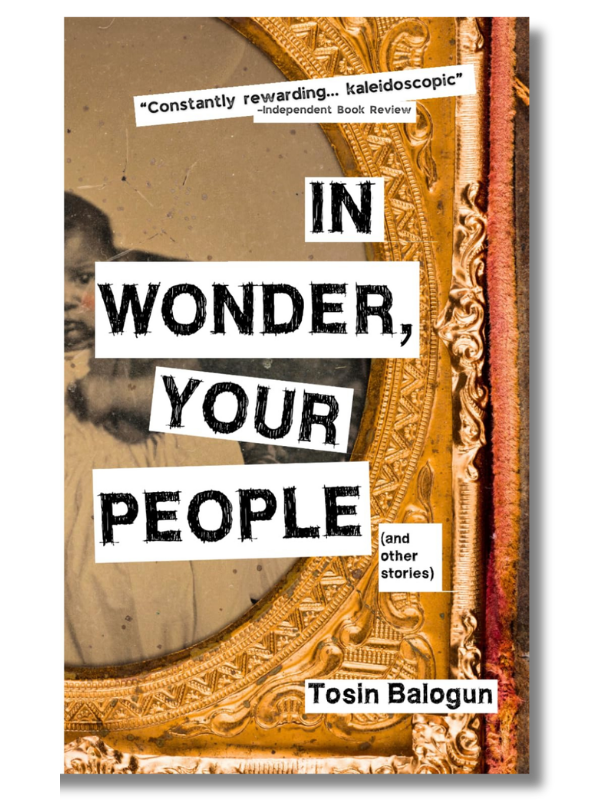
A tantalizing Nigerian-flavored collection that baffles and entices with its inventive blending of the fantastical and the everyday
The stories comprising In Wonder, Your People, aside from some recurring names and locations, have little in common with each other. However, one element consistently emerges: a wistfulness often stemming from regret—not from characters wallowing in it but rather from facing it, honing in on a moment and an impression significant to them.
Take the title story, in which a father picks up his son from school, driving him through Ibadan’s urban gauntlet to get home to his gated community. It expresses a grass-is-greener-on-the-other-side nationalistic ruefulness, perhaps planting a subconscious seed of class distinction within his son.
“. . . it was everything Mr. Gbenga wished Nigeria could be . . . As if the DNA of his pitiful Nigeria had been mercifully wiped clean . . . he liked to imagine that when they passed through the gate of The Wonder Estate, they had moved through a portal of some kind and ended up in Scotland or Canada or some other strand of the fabled ‘abroad.’ Leaving the estate always depressed him, grounded him.”
This elided passage doesn’t do justice to what is, despite its brevity, a touchingly deep piece deserving its place as the title story. It’s also the most conventionally realistic. From this, others surround it, sprouting like a wild untended plant in a sprawling mix of voices, perspectives, and subject matter.
Except for the prose itself, which is refined and far from untended. What sprawls is imaginative context. There is little holding the author back from unleashing his creativity into the mystical, absurd, surreal, and more. A wife who has become a house. A song as a lifelong observer and commenter as a boy becomes a man. A girl’s road trip with her past selves as fellow passengers.
It can be challenging to orientate oneself. On those occasions it’s best not to try too hard; it’s best to let the carefully crafted words do their work. These stories retain a poignancy that keeps them humanly relatable thanks to a McLuhanesque depth one can glean from considering the meaning (manner) as working in concert with the message (text).
This is a slim volume in which two stories take up nearly thirty percent, leaving not much room for the other nineteen. They may be lean but are just satiating enough. The precision of the economic prose gives them palpable vitality, with frequent impactful observations such as in the opening story: “I was nothing to her, but I was something with her.” Or others more casual yet still concise, as from “The Brightest Thing (In the Universe):”
“I think it might be a lie, when we imagine that love is stronger than hate. Love is weak. I knew my father loved me. I have never once doubted it, but when he would hit me, the love was powerless to stop him.”
As with any collection, not every entry is for all tastes. A couple venture into subjects such as onanism and self-castration, albeit with a light enough touch to not be prurient. Also, the penultimate pair feel underdeveloped, and for this reader don’t stand up as well to the others. Happily, everything ends on a terrific note with the existentially exceptional “Here I Am, Here I Am.”
In Wonder, Your People may be slender, but it punches above its weight. It’s a strong collection that can be at times perplexing but constantly rewarding in an almost kaleidoscopic way.



What did you think?