

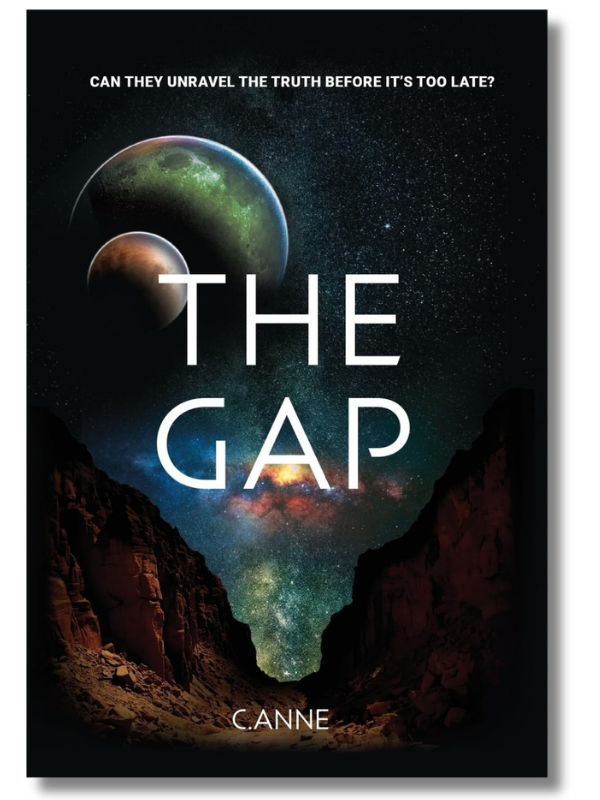
A tense exploration of loyalty, courage, and the human cost of living on opposite sides of an inherited divide
C. Anne’s The Gap presents a world divided by both geography and history. Two communities exist side by side yet remain separated by deep mistrust and a mysterious boundary known as the Gap. Though the physical distance between them is small, generations of fear and misunderstanding have made the divide nearly impossible to cross.
The story begins in Arden Village, where we meet Astraea Elms, a young Sentinel determined to prove herself worthy of protecting her people. Astraea is driven by fierce loyalty to her family and a strong ambition to join the ranks of the adult Sentinels. However, her greatest obstacle is also the man she respects most: her father, the First Sentinel, who refuses to allow her to take on greater responsibilities.
Later, the narrative introduces Jas Marceillo, heir to the leadership of Syong City, a technologically advanced society across the Gap. Raised to protect the city from the so-called “Gappers,” Jas has been taught to view Arden Village and its people as hostile outsiders.
The novel follows Astraea’s desperate journey after her younger brother Tarek is captured. Believing he has been taken to Syong City and may soon be killed, Astraea embarks on a dangerous mission across the Gap. Since no one who crosses into Syong City ever returns, her journey quickly becomes a life-or-death struggle for both her family and her community.
The story unfolds through alternating first-person perspectives, allowing readers to experience the conflict from both sides of the Gap.
Astraea’s narrative reveals her as intense, determined, and emotionally driven. Her thoughts constantly move between two powerful motivations: protecting her beloved brother and proving herself as a capable Sentinel. She views her father as a loving but frustrating obstacle to her ambitions, her aunt as a source of comfort, and her friends as both allies and rivals, pushing her toward excellence.
When Tarek disappears, Astraea’s true nature emerges. Overcome with grief but unwilling to surrender to fear, she throws herself fully into the search for him, determined to face whatever dangers await beyond the Gap. She’s an inspiring lead with strength and smarts aplenty.
From childhood, Jas has been trained for leadership, receiving an education shaped by advanced technology, strategic discipline, and martial training. When he encounters Astraea, he is immediately intrigued. She is unlike anyone he has known: fierce, independent, and shaped by a completely different world. Their meeting challenges both of their assumptions about the communities they represent. Bringing them together is where the novel’s threads begin to pulsate.
The Gap’s opening scene is nothing short of powerful. It’s clear that Astraea is intensely protective of Tarek, so when something happens to him, the narrative’s personal stakes skyrocket. She’s a protector and a warrior—the perfect person to get her brother back.
Astraea’s character is what gives the book its backbone. She is passionate, stubborn, and courageous, but also deeply human. Her internal conflicts with her father and her responsibilities as a Sentinel make her relatable and believable. And then when you contrast her fiery personality with Jas’s calculated and controlled demeanor, it injects a natural tension that pulls you constantly through their scenes together.
The worldbuilding set forth here is rich and full. Arden Village is closely connected to its nature, placing emphasis on cooperation and tradition, while Syong City reflects technological advancement and centralized authority. This contrast reinforces the novel’s central conflict and highlights the broader question of how different visions of progress shape human societies.
While the novel maintains a smooth pace throughout most of the story, the final third feels somewhat rushed compared to the earlier sections. The first two-thirds carefully build the world, characters, and emotional stakes, but readers may wish the final events were given more space to develop and resolve.
In the end, The Gap is an engaging science fiction novel that adeptly explores themes of fear, misunderstanding, and the possibility of reconciliation between divided communities. There’s a shared humanity here; no matter if they’re dealing with their traditional or advanced society, the characters struggle with the same emotions: loyalty, fear, ambition, and compassion. The story avoids portraying either community as entirely right or wrong. Both sides believe they are acting to protect themselves, shaped by incomplete knowledge and generations of mistrust. This moral complexity encourages readers to reflect on how easily conflict can arise when communication between societies breaks down. But in the end, we think maybe the deepest divides can be bridged, as long as someone is brave enough to cross the Gap.
For readers who enjoy science fiction that blends action, character development, and thoughtful worldbuilding, The Gap is an easy choice.


What did you think?