

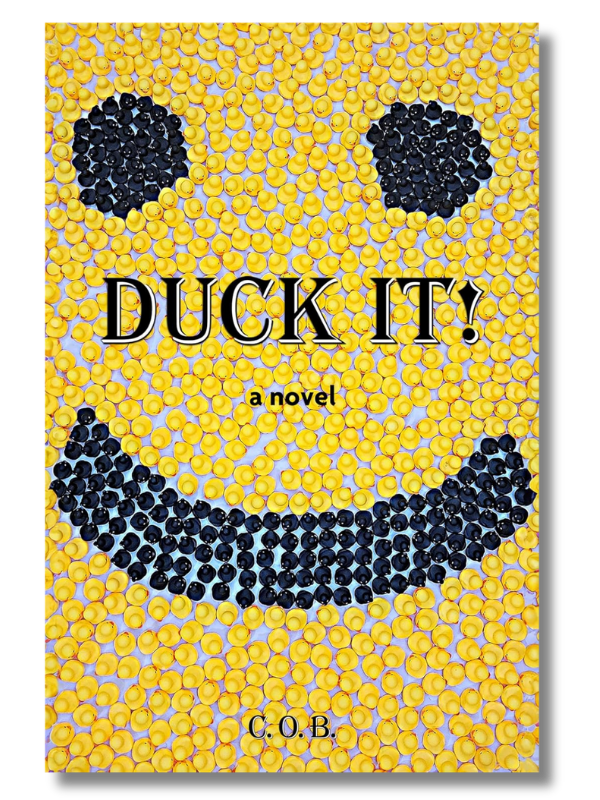
Content warnings: frequent strong language, implied/depicted suicide; deceased children; references to sex
A grimly funny apocalypse travelogue with real heart under the grime
C.O.B.’s Duck It! is a profane, funny, and surprisingly tender post-apocalyptic road journal that treats the end of the world less like a bang and more like a whimper.
Set in 2035 after successive waves of the “PAN-R” virus have hollowed out society, the novel follows Lionel Romero, a 35-year-old Floridian leaving home, not because he’s hopeful of finding something better elsewhere, but because staying has numbed him, and he figures it’s better than nothing.
Lionel documents the trip in dated journal-like entries and roadside confessions, establishing a narrative that reads like someone telling a story to only themselves because there’s no one else around to hear it.
Lionel’s voice is the driving force of the novel; self-lacerating and unexpectedly observant, he constantly swerves between crude comedy and frank grief. The opening pages establish him as someone born into a life they didn’t choose. Groomed to inherit his father’s landscaping business, he’s resentful of the heat, the labor, and the class optics of mowing rich people’s lawns, as well as the thoughts that resentment planted in him.
By establishing a fated backstory, C.O.B. frames the apocalypse as both catastrophe and grotesque liberation. Lionel is free. He can finally live his own life, but only because nearly everyone else is dead. That contradiction haunts the narrative and is the most interesting tension in the book.
The central quest is outwardly simple: Lionel drives north from Fort Lauderdale toward the Midwest, puttering along in a stolen electric golf cart truck (a “GCT”) because the roads are clogged with the abandoned vehicles of the dead. Plus, electricity is easier to scavenge than gas. The tiny, almost absurd vehicle becomes an overarching metaphor for the book’s worldview: in a world of collapsed systems, Lionel survives through adaptability and weird practicality.
The episodic structure also lets the novel repeatedly reset tension, from the eerie quiet of empty highways to the shock of encountering bodies and the moral questions that follow. One early sequence, involving a dead family in a roadside SUV and Lionel’s reaction to what he finds, signals that this book is willing to go emotionally hard when it chooses.
As Lionel moves through this deadened America, he occasionally collides with other survivors, including two young men, Aden and Liam, who invite him to an “Apocalypse After-Party” on an island, a concept that is both ridiculous and brutally logical: if death is inevitable, why not treat survival as one long, defiant celebration? These encounters help prevent the novel from feeling too much like a single-note monologue, and they illuminate Lionel’s fundamental conflict: he claims he’s best alone, but he keeps getting snagged by the human need for connection. A later section deepens this through Lionel’s memories of Effie, the girlfriend who taught him how to feel (and what it meant to lose that feeling again).
Stylistically, the book is unfiltered by design: heavy profanity, direct address, long digressive riffs, and a conversational cadence that often reads like stand-up comedy in a confession booth. When it works, it gives the novel immediacy and a distinctive personality. When it doesn’t, the narration can over-explain or circle a point too many times, which may test readers who prefer tighter pacing. Still, the voice is the product here, and it’s consistent enough that even the digressions feel like character rather than authorial drift.
Readers who like voice-driven, episodic speculative fiction (especially with a dark-comic, diaristic edge) will want to stay with Lionel for the ride. The book’s best trick is making the end of the world feel less like spectacle and more like an ongoing moral hangover, with occasional flashes of grace.


What did you think?