


“How Do You Develop a Reading Habit at Home?”
by Joe Walters
Is it too late for you to make a habit out of reading?
Maybe you haven’t cracked open a book in a while. Maybe you just can’t seem to finish the one you started. Maybe you feel so bogged down by how the heavy the world is that it feels like too much work to pick one up.
But you’ve made it to this blog post, so I’m thinking you’d like to make a change.
And good news: that’s the first step.
If you want to make a habit out of reading, you are not too late to get started.
Let’s take a look at the reality of 2021’s attention landscape, or, in other words, your available sea of distractions:
- Your phone
- Your computer
- Your TV
- Your kids
- Your housekeeping
- Your spouse
- Your things
- Your things
- Your things
So, how do you really make the time to become a reader?
Well…
I was asked recently to contribute to a blog post called, “Top Tips for Book Lovers Q & A: Advice from the Experts.” (Check out that blog post if you haven’t clicked it yet. There’s all sorts of great advice in there.) The question they asked me was this:
“How do you create a reading habit at home?”
And. It. Was. TOUGH.
I obviously want everybody to read more. Reading has transformed my life in an insane number of ways, and I couldn’t be more thankful that it’s a thing I’ve made a habit of doing.
But every situation is different. Every life is different. Every reading mind is different. I could tell you to throw your phone out the window (which I will) and tell you to read different genres at once because your tastes/times will differ from moment to moment (which I will), but damn, man—reading is about gifting yourself time and that’s pretty much it.
A thing about free time is that it’s yours to do what you want with it. And you won’t always have a lot of it. So all I’m proposing here is for you to make reading an option.
(If you want to.)
Let’s get started.
Here are 5 tips for how to develop a reading habit at home:
#1. Separate yourself from your phone
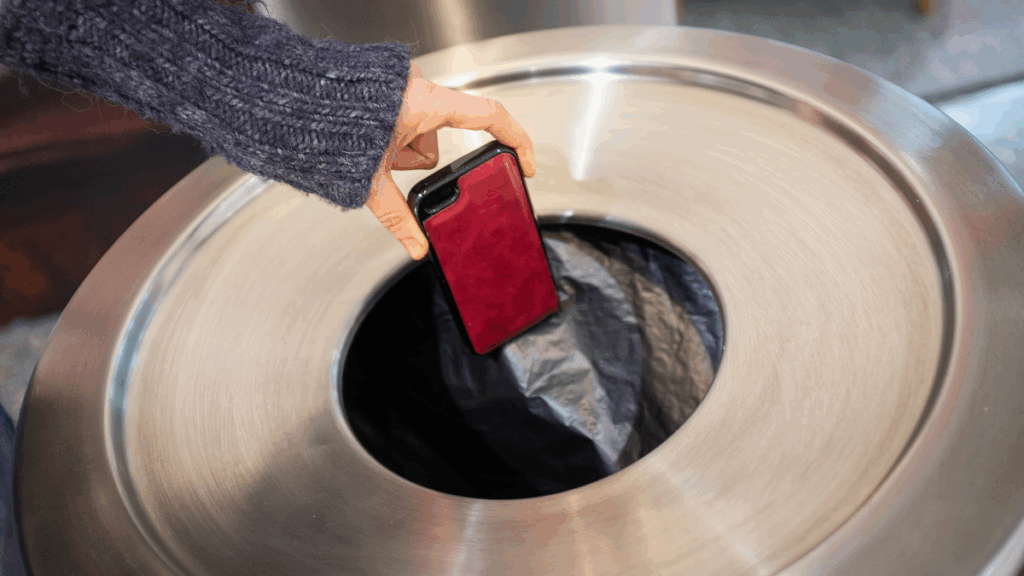
I don’t know your lifestyle, but I do know that most of you have access to instant gratification that you can choose over reading.
Twitter. Instagram. Facebook. YouTube. Reddit. Netflix. It’s difficult to stay away when we feel like we might miss something.
I’m NOT telling you to stop that.
It’s pretty damn hard, and I’ll be the first to admit I don’t do as well as I’d like to. But for reading time, I have learned to do a much better job of leaving the internet behind.
When cracking open a book, I implore you to separate yourself from the internet. Leave it on the other side of the room. Go outside and don’t bring the phone with you. Go in a different room.
When it’s away from you, it requires an extra walk-of-shame-style task for you to give yourself that brain break you tell yourself you need at the end of another paragraph, section, or chapter break. If you need the dictionary, get your phone (or a dictionary, obviously) and just promise me you’ll be back as soon as you can.
But separating yourself from the internet is easier said than done.
For me, I gave myself scroll breaks all the time even though I kinda-sorta-all-the-way-didn’t-like how social media operated. I did it anyway. I didn’t have any notifications while I was away, or I had ones that I didn’t need to know immediately. There are obviously exceptions to the rule, but most days, whatever it is that happened on your phone, social media account, or email (if anything at all) while you were reading, could most likely wait for you to finish that chapter.
You’d be amazed at how much you can move forward in a book when you keep reading the words in front of you instead of the ones on your screen.
#2. Read a variety of different types of books at the same time

This one may sound a little loopy if you’re not already a “reader,” but trust me, you’re not always going to want to dive into a big meaty chapter if you don’t have the time for it.
Sometimes, you’re going to want to dip your toe in regardless of if you’re able to finish the chapter or not.
This is where nonfiction comes in handy for me. It’s often easy to dive into nonfiction books without the commitment of a full chapter. It’s also easier to stop in the middle of a paragraph and resume it without having to reread too much the next time I pick it up.
Because of this, I like to have a slew of different style books at the ready.
Here’s a little list of the books that I was reading on the day I started this blog post:

- What Storm, What Thunder by Myriam J.A. Chancy – Literary Fiction – Novel. This one has big meaty paragraphs of artful prose and big content about an earthquake in Haiti. It’s excellent and I’m really in awe of Chancy’s prose, but it’s also not something that I dive into when I have a small window. This is my longer stretch of free time book.
- Refuse to Be Done by Matt Bell – Nonfiction – Publishing/Writing. This is my pick up and read during a short window book. I read a lot in my field of writing/publishing. You may or may not be in that field with me. Regardless, this one works almost like self-help & educational books, with short sections within sections, headers, subheadings, and easy-to-read prose. I’m never worried when I pick this up that, if house duty calls in some form or another, I can’t put this book down without having wasted my productive reading time.
- Best Microfiction 2021 edited by Meg Pokrass – Short Fiction Anthology. Is this a great bathroom book because I can finish a few very short stories while sitting on the toilet? Yes. Am I going to talk more about sitting on the toilet? No, goodbye.
- From Book to Bestseller by Penny Sansevieri – Nonfiction – Publishing/Writing. This is my current Kindle before-bed read. I am a book marketer for Sunbury Press, and I’m always on the search for new ways to get books into readers’ hands. And this book has been helpful and smooth so far. And it’s easy to fall asleep with my non-blue-light Kindle. If I tried to read one of my paperbacks/hardcovers at night, I’d have to make the choice to turn the light off, which could wake me up. All I have to do with a Kindle is keep reading until I nod off and it falls on my face.
- Runaways by Michael J. Seidlinger – Humor – Novella. Sometimes I get a short book that I want to read right away but also want to make sure it lasts beyond a couple sessions, so I don’t make it my primary fiction read. This novella is about a writer who struggles with distractions and intersperses funny tweets about the struggles throughout. As you might be able to guess, I vibed with it pretty hard. I’d read a few pages before something else or in exchange of something else, depending on my mood.
So…stay flexible! And give yourself an excuse to buy different books and/or grab a few extra books from the library next time you’re in. It might just help you create that habit to have the variety.
#3. Try out different formats (like eBooks & audiobooks)

Book snobs suck. They’ll tell you it’s not reading if you can’t feel the pages, that ebooks & audiobooks don’t count. It is my firm belief that this opinion is a bad one and that these people need a swift kick in the pants. If you don’t feel comfortable kicking them, don’t call me, because I also won’t kick them, but hey, maybe somebody will.
Listen up: You can read however you want. And if you experiment with different formats, you may just find a way where you can finish more books and be smarter because of it.
Let’s tackle eReaders first.
I used to hate on them. I even remember back in college saying the corniest thing I could think of: “Yeah, but you can’t smell the pages on an eReader.” I also said that I couldn’t annotate the books and that I couldn’t share the books I loved with other people. Here’s why I now believe all of those answers suck:
- You can still smell the pages of physical books if you’re into that kind of thing. It just won’t be all of your books. And trust me when I say—you don’t need to smell all of your books, especially the used ones.
- You can absolutely annotate your books in an eReader. I have a Kindle, and I can make notes of sections I love and even search to find those pieces later. It’s a legitimately more efficient way to do it.
- Do you really like sharing books with other people? How often do you get it back? How often do people actually read it? With how often you hope to give books away, just read it on your eReader first (if that’s what you end up doing), and if you think you want to give it to someone, just get them the physical book or recommend it to them. This shouldn’t stop you from taking advantage of the last bullet point…
- eBooks are cheaper! If you read three books for the price of one hardcover, you go to prove the point that the more books you read, the smarter you become. It’s about the words, not the format.
But probably my favorite thing about eBooks is that I can read them to go to sleep by. They have their own light (and some of them aren’t LED for those whose eyes are sensitive like mine) and instead of scrolling or watching dumb stuff on the internet, you can read something you don’t have to finish in big chunks (like nonfiction) as you’re going to sleep, and it can actually help the ZZZZZs arrive.
And lastly, audiobooks rule, especially for nonfiction. They can be narrated by some really terrific voice actors (sometimes even the authors themselves), and it can feel like a podcast or like you’re sitting there hanging out with them while you’re doing dishes, vacuuming, holding your baby with one hand and patting their butt with the other.
Again, if you’re getting the vibe at all from this post yet—making a habit is all about making reading easier on yourself. Expanding your format options is a great way to do that.
Fun Fact: Audible offers a free trial if you want to give audiobooks a shot!
#4. Stop reading books that aren’t inspiring you

This is a controversial take and everyone’s opinion is different, so if you see what I’m saying and think, “Joe, kindly kick yourself in the pants,” that’s fine, but hear me out:
A thing about books is that they take the same amount of time to read whether you don’t like it at all or if it changes your life forever.
So give that book you bought a shot. No doubt. Maybe even keep reading on if you still have hope for it moving forward. But when you feel uninterested to return to it, don’t return to it. You could be reading something that actually alters your worldview for the better, and you can always return to that book you gave up on later if you really want to.
There is one caveat though: you have to finish some books. I’m confident you will if you keep making time for it, but if you are someone whose habit has become reading the first chapter and then abandoning your last ten books, well then maybe you need to finish that next one that you’re digging. You’d be surprised at how awesome books are when you get the chance to see the full picture.
#5. Be patient with yourself

I get paid to read, and I’m still slow at it. Some brains just work that way. And you better believe that when you jump into reading after not having done it in a while, you’re going to move through the pages slowly and you might have to reread some things.
You know what you should do in that case?
Go slow.
Recognize that all you can do is read one word after the other.
As long as you aim to understand what’s on the page and not just move through it to get it done, you’re going to exit this reading experience one book stronger than when you came in.
In the end…
You can make reading as romantic as you want (favorite couch, favorite coffee, favorite candle, whatever) or you can pull out your book or Kindle without the romance—to just give yourself the permission to read.
Any way you do it (or don’t do it), books are going to be there when you’re ready for them. Don’t beat yourself up if it’s not part of your routine now or tomorrow or in January. Your time is yours. I want only for you to do whatever you want with it.
What are the biggest distractions that stop you from developing a reading habit at home? Let me know your answers in the comments ?
About the Author

Joe Walters is the founder and editor-in-chief of Independent Book Review and a book marketing specialist at Sunbury Press. When he’s not doing editorial, promoting, or reviewing work, he’s working on his novel and trusting the process.
Thank you for reading “How Do You Develop a Reading Habit at Home?” by Joe Walters! If you liked what you read, please spend some more time with us at the links below.


What did you think?