

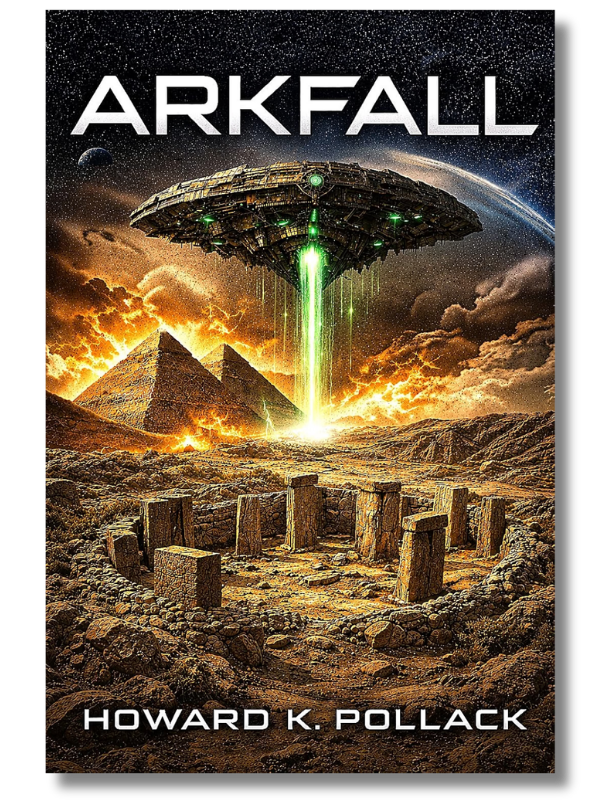
Can individual choice rewrite the cosmic script?
Howard K. Pollack’s Arkfall, the sequel to The Ark of the First Gods, opens with a striking declaration: “Space is never silent.” It is the kind of line that immediately signals the scale of what is to come—in this case, the answer to an existential question: What happens when a person is given the power to alter the trajectory of history?
Clearly, Pollack is not interested in a modest corner of the universe or a small technological puzzle. Instead, his worldbuilding is cosmic, metaphysical, and deeply entwined with speculative ideas about time, history, and the architecture of reality. Arkfall is anchored by a man whose decision disrupts the very structure of recorded history.
“And at the heart of it—one name. Adam Freeman.”
It begins in the aftermath of that decision. Adam Freeman, the series’ reluctant protagonist, has already altered the course of a war that was supposed to shape the destiny of civilizations. He intervened in a conflict between ancient extraterrestrial powers by seizing a mythical object known as the Ark of the First Gods.
His act halted a cataclysmic war that had been unfolding for ten thousand years—an event that various cosmic forces believed was necessary to preserve the proper sequence of history. From the perspective of those powers, Adam has not saved the universe; rather, he has broken it.
Pollack frames this premise with a particularly intriguing conceit: the idea that time itself follows a pre-written pattern preserved in something called the Akashic Record.
In fact, it is stated with ominous clarity that “the Akashic Record has fractured. The sequence is wrong. Time has strayed.”
This concept gives the story a philosophical edge. Arkfall is not only about alien threats and futuristic technology but also about determinism—namely, whether history must follow a prescribed path or whether individual choice can rewrite the cosmic script. Of course, having the power to do the latter is not necessarily enviable.
The antagonists who enforce the overarching script are the Xirelions, a civilization introduced with almost mythic grandeur. Pollack describes their arrival in eerie terms: a vessel emerging in the outer solar system, “more like an idea, sharpened to a blade. A cathedral of void-metal and impossible geometry.”
This description neatly captures the tone Pollack adopts when dealing with advanced alien species. Rather than treating them as merely technologically superior, he frames them as beings whose understanding of reality itself borders on the incomprehensible to humans and other lesser species.
The Xirelions see Adam Freeman as an anomaly to be corrected. To them, he is not a hero but “a rogue variable” who has interfered with the calibration of the universe. The war he has prevented—between the Greys and the Anunnaki—was meant to burn through civilizations and reset the cosmic balance. Adam’s intervention has thrown that process into chaos.
This tension between cosmic inevitability and human agency drives events in Arkfall. Adam is not portrayed as a flawless savior. Indeed, one of the more appealing aspects is how exhausted and uncertain he often seems. These small details humanize a character who might otherwise feel dwarfed by interstellar forces.
Grey operative Zyra Cain functions as an effective counterbalance to Adam’s uncertainty. Where he is introspective and burdened by the weight of his decisions, she is pragmatic and skeptical, frequently questioning the motives of every faction involved. Their relationship anchors the story emotionally.
Pollack handles the mixture of high-concept science fiction and character-driven drama with enthusiasm. Much of the narrative energy comes from the sense that Adam is navigating a reality far larger than he ever intended to confront, repeatedly returning to the idea that he has become the focal point of events far beyond his understanding.
Pollack explores multiple factions, alien histories, and cosmic technologies, gradually revealing a universe layered with ancient rivalries and secret architectures of power. The Ark itself becomes an especially intriguing symbol. It is not simply a weapon or artifact but a device capable of altering reality on a fundamental level.
It is not an alien machine or weapon but something more elusive—a consciousness or, at least, an interface with one. As the story develops, it becomes clear that the Ark does not command events but reveal possibilities. “ But the choice… is his.”
Events are suggestive of a universe shaped by cycles of conflict and renewal, where wars serve as mechanisms that keep history aligned with the grand design encoded by the Builders. In this sense, Adam’s earlier decision to stop the war is treated as something profoundly disruptive. As the Xirelions see it, the war was “not just conflict—it was calibration.”
What keeps Arkfall from drifting entirely into abstract cosmic speculation is the persistent emotional weight placed on Adam’s choice. Pollack repeatedly returns to the questions underlying the series: What if the destruction of civilizations is considered necessary by those who control the universe? What happens when someone refuses to accept that logic?
These issues are pushed further as the scale of the threat becomes clearer. The Xirelions are not merely seeking revenge; they intend to restore the timeline by reigniting the war Adam stopped. Their logic is ruthless and chillingly methodical. If history must unfold exactly as written, then Adam must either undo his intervention or be removed from existence.
Pollack expresses this philosophy in stark, declarative terms that lend the story a prophetic quality. At one point, the cosmic observers watching Adam declare “History […] was not meant to be rewritten. It was meant to play out exactly as encoded.” This statement captures the ideological conflict driving Arkfall.
As the book accelerates toward its climax, the tension between the two views of the universe—predestination versus defiance—becomes increasingly dramatic. Adam is forced to confront the full implications of what he has done. He has saved lives, certainly, but he may also have destabilized the structure of time itself.
The universe he inhabits is filled with colossal ships, ancient artifacts, and entities that communicate through thought rather than speech. There is a constant sense of cosmic unease. The stars themselves appear to react to the unfolding disruption: “The stars above Earth trembled, imperceptible to the human eye.”
This striking image reinforces the idea that Adam’s actions have rippled across the fabric of reality. This echoes with the warning that “Power doesn’t corrupt. Fear does,” thereby crystallizing Arkfall’s underlying message about the dual nature and inherent danger of responsibility.
While the story sometimes verges heavily into exposition—not uncommon in high- concept science fiction—it is largely because Pollack is juggling an ambitious mythology. The book involves multiple alien species, planetary histories, and speculative theories about time and consciousness.
Yet Pollack’s enthusiasm for these ideas is infectious. He clearly enjoys exploring the implications of his universe, and that imaginative energy carries the narrative momentum through the more complex passages, where the novel evolves into a meditation on the power of individual choice.
In that sense, Arkfall fits comfortably within the tradition of science fiction that treats humanity as both fragile and uniquely disruptive. The universe Pollack describes is ancient and structured, governed by cosmic forces that believe everything must happen according to a plan. Adam represents the opposite principle: unpredictability.
Whether he has saved the universe or broken it is the question hanging over the entire book. Pollack wisely refuses to reduce matters to a simple answer, instead reveling in the unsettling scale of the dilemma. Arkfall explores the deepest aspects of time and history, but it remains the story of one person who refuses to accept that destruction is inevitable.




What did you think?