

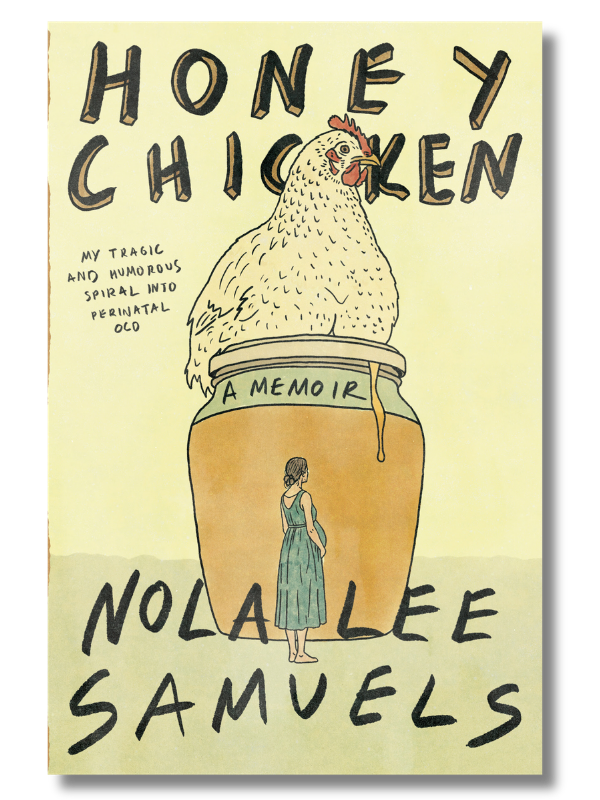
A timely reminder to mothers everywhere: you are not alone.
They say motherhood is meant to be joyful. Complicated, yes, and often times stressful, but ultimately rewarding. But for many mothers, the period just after giving birth features far more anxiety, fear, and emotional struggle than anyone prepared them for.
In her debut memoir, Honey Chicken, Nola Lee Samuels adeptly explores the complicated intersection of love and fear as well as the resulting postpartum depression and obsessive compulsive disorder (OCD) that became a defining feature in her early experiences of motherhood.
Through conversational and confessional diary entries, Samuels guides readers through her entire experience: from the exciting, early days of her first pregnancy; to the trenches of intrusive thoughts; and to the light on the other side, where she can embrace her two sons, her family, and most importantly, herself.
Though the topics addressed in Honey Chicken are heavy and intense, Samuels writes with conversational candor that makes for an engaging and accessible read, even as she tackles experiences that are often difficult to articulate—let alone share publicly. Her self-deprecating humor is particularly well placed, offering levity without undermining the seriousness of her struggles. And more than simply making a heavy subject easier to digest, this humor keeps the narrative grounded in the realities of family life. Rather than allowing herself to become self-righteous in her struggles and villainizing those who might not understand, Samuels examines her own experiences with a sense of reassurance in the face of uncertainty.
More importantly, Honey Chicken contributes to a conversation that deserves far more space than it is often given. Samuels captures the unsettling convergence of anxiety and love, eloquently illustrating how the very instinct to keep one’s children safe can become distorted by mental illness. Her experiences also demonstrate how postpartum struggles extend beyond the individual, placing considerable strain on a marriage—and indeed, an entire family unit. In a culture that so often idealizes motherhood—and more often asks mothers to repress their own emotions and accept a lack of care—there is real value in making room for stories that complicate that picture.
At times, however, the window into Samuels’ internal world feels somewhat removed from the experiences themselves. The narrative often recounts difficult periods followed by resolve to make a positive change, and that positive change is exemplified; but the reader is not always granted the privilege of witnessing the process. Samuels’ reflections on the marital struggles following her first preganncy, for instance, culminate in a reassuring account of recommitment and perseverance, but offer less insight into the uncertainty and emotional labor required to get there.
Similarly, the discussion of recovery sometimes feels more like a summary of progress rather than an exploration of its cycles and setbacks. This reflective distance is understandable in a memoir that clearly serves as catharsis for its author and as encouragement and reassurance to readers who may be going through similar experiences; but it can also create distance between the reader and the very experiences the book seeks to illuminate and destigmatize. For readers who appreciate a lighter, more retrospective approach to difficult subject matter, this may be less of a drawback.
Still, there is incredible value in the perspective Samuels offers, particularly in a culture that continues to place mothers on a pedestal and expects them to keep their footing all on their own.
Honey Chicken reminds us that intrusive thoughts are not a measure of a parent’s love, and that the instinct to protect can become frighteningly difficult to navigate when filtered through mental illness. By making space for the contradictions of motherhood, Samuels reminds us that loving one’s children and struggling to care for oneself are not mutually exclusive, and that no parent should have to navigate that tension alone.







What did you think?