

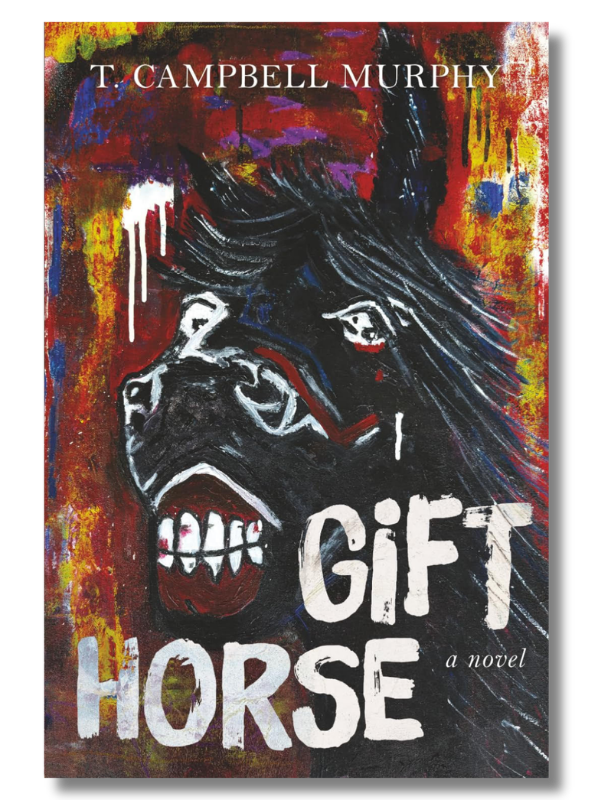
An ambitious exploration of grief, memory, and the dangers of a world increasingly shaped by artificial intelligence
“You close your eyes to see. You plug your ears to hear.” So begins the dramatic spiral of Hephy McHazel and the interrogation of grief, escapism, and technological dependence that is T. Campbell Murphy’s Gift Horse.
Hephy McHazel is a Worldbuilder by trade and by passion. A gifted video game designer who has made a career out of creating realities beyond the limitations of our own, Hephy has always been inspired by his own grief—over the deaths of his parents when he was still young, over a childhood love that was never realized—and his desire to evade the loss that haunts him.
When the CEO of his company, Daedalus, approaches him with the opportunity to become the first human subject of an experimental AI called Ariadne, designed to merge thought with creation, Hephy sees an opportunity to build his own digital paradise. But freedom from the disappointments of reality comes at a price; as the boundaries between his mind and the machine begin to blur, Hephy must confront the possibility that a world without imperfections may come at the cost of the very things that make us human.
What makes Gift Horse particularly effective is its exploration of the relationship between grief and control. Hephy’s motivations are, at least initially, understandable: who among us hasn’t wished to revisit a moment, make a different choice, or spare ourselves the pain of a memory? Murphy takes this familiar impulse to its logical extreme, asking what happens when the tools we use to escape reality begin to replace our willingness to engage with it. The novel’s strongest moments are those in which Hephy’s technological ambitions collide with the small, imperfect realities of human connection, reminding us that memory is not simply something to preserve or erase, but part of how we understand ourselves and others.
The novel’s contemporary relevance is equally compelling. As Ariadne becomes increasingly entangled with Hephy’s thoughts, the question of who is creating whom grows harder to answer. The parallels to our own relationship with AI are difficult to ignore, particularly in the tension between efficiency and autonomy. Murphy’s voice changes and spirals throughout the novel, evoking the anxiety that motivates Hephy’s contradictory desires to both escape and control through Ariadne, and his more surreal sequences effectively convey the disorientation of this increasingly unstable relationship.
That said, the novel’s ambitions occasionally come at the expense of clarity and momentum. Hephy’s extended reflections on his past can feel repetitive, particularly when they revisit emotional territory the reader already understands. While Hephy’s constant ruminations successfully illustrate the inherent contraction of such total escapism—to eliminate the pain of grief requires eliminating the love that was then to be grieved—they are at times somewhat heavy-handed in their reiteration of established themes.
Hephy’s self-aggrandizing nature presents a similar contradiction. His conviction in his own genius is essential to understanding his downfall, but his repeated insistence on his own importance can make it difficult to connect with him. But for readers drawn to unreliable narrators, with flaws that shape both their perspective and their fate, this will prove an effective characterization.
And these contradictions are, ultimately, central to what makes Gift Horse suchan interesting cautionary tale. Hephy wants to preserve the people and experiences that have shaped him, yet his attempts to do so repeatedly strip them of their complexity and independence. He yearns for importance and recognition, yet the path to his own fame comes at the cost of leaving that reality entirely to live in his own virtual world. He strives for a personal paradise devoid of his most painful memories, yet his inability to let go of those very memories drag them headfirst into a virtual Hell of his own making. His tragedy lies not simply in losing control of Ariadne but in failing to recognize that control was never a substitute for understanding.
Ultimately, Gift Horse reminds us that the imperfections we seek to escape are often inseparable from the things we hope to preserve. In a world increasingly eager to optimize our experiences, our relationships, and even our thinking, that meaningful connection requires more than the ability to create the world we want. Sometimes, we must accept a world we cannot control and accept its people as they are.




What did you think?