

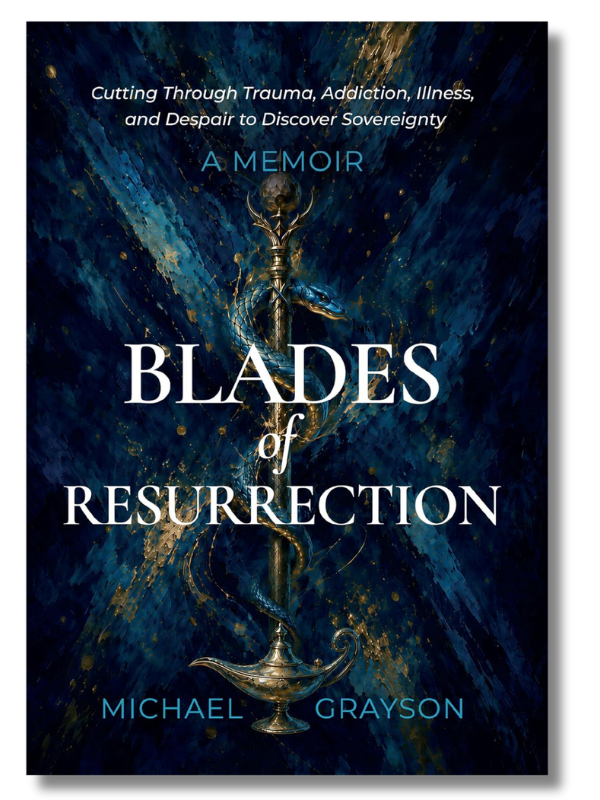
An inspiring memoir about surviving what you can’t control and choosing yourself anyway
What does it mean to choose yourself when so much of your life has been decided for you? Michael Grayson’s Blades of Resurrection explores this question of autonomy through a story that was forcefully shaped by poverty, childhood trauma, neurodivergence, addiction, grief, love, and cancer. The book’s title speaks to its central symbol of the blade as a powerful metaphor for transformation, first as the literal instrument that cuts the cancer from his body and later as the means through which he confronts the emotional wounds beneath it.
“They described who I was in relation to other people. Who am I in relation to myself?”
Grayson recounts a life driven by circumstances largely beyond his control. His father dies of cancer when he is a child, leaving his family in poverty. He struggles with social expectations and bullying, later faces his gambling addiction and financial instability, and eventually builds a career in nursing and a life with his love, Lily. Just as he begins to find the stability and belonging he has long sought, he is diagnosed with a rare form of esophageal cancer. Surgery is his best chance at survival, but the physical threat of cancer forces him to challenge the ways a lifetime of feeling unwanted and unworthy has shaped his choices.
“Being needed felt like belonging. But it wasn’t the same as being wanted.”
The memoir is divided into five parts that trace Grayson’s life and evolving understanding of himself. Its chronological structure allows recurring patterns to emerge gradually, while images of mountains, blades, and chains connect seemingly disparate experiences across four decades.
In the final sections, Grayson moves into meditation, spirituality, and Norse mythology, using figures such as Odin, Thor, Loki, and Fenrir to give symbolic form to his internal struggles. An appendix at the end of the book adds another unusual and meaningful element that you don’t often see in memoirs; photographs support many of the experiences Grayson recounts, offering visual evidence of the people and places that shaped his life. Given his background as a nurse, the appendix feels almost like an extension of the analytical eye he brings to his work.
“I’m trying to survive. I’m trying to leave myself intact after all of this.”
The book is at its strongest when Grayson distinguishes between choice and control. He cannot choose whether his father dies, whether his family is poor, whether he is neurodivergent, or whether cancer enters his own body. He can, however, choose how he responds.
For much of his life, Grayson longs to be chosen, to be wanted, loved, accepted, and validated. His greatest transformation comes when he begins choosing himself. At times, the memoir explains its lessons more directly than necessary, and some of the philosophical and spiritual reflections could be tightened when the narrative has already communicated the idea effectively. Still, Grayson’s willingness to examine his own mistakes gives his reflections an earthy credibility, presenting recovery as an ongoing process of understanding oneself.
“Though I was only in my twenties, I was the adult raising the boy inside me. The boy who had always needed saving was finally being dragged forward by the man he was becoming.”
Blades of Resurrection is a purpose-driven memoir about the courage it takes to live fully without the illusion of control. Even being cancer-free is not a guarantee. The blade may have given him another chance at life, but it is his choice to embrace that life through love, creativity, and purposeful work that makes his resurrection meaningful.
Readers interested in spiritual memoirs and personal transformation will find themselves deeply inspired by Michael’s journey. Despite its discussions of sexual trauma, cancer, death, gambling addiction, suicidal ideation, and medical trauma, it offers a heartwarming message of how we may not be able to choose what happens to us, but we can always choose ourselves.


What did you think?