

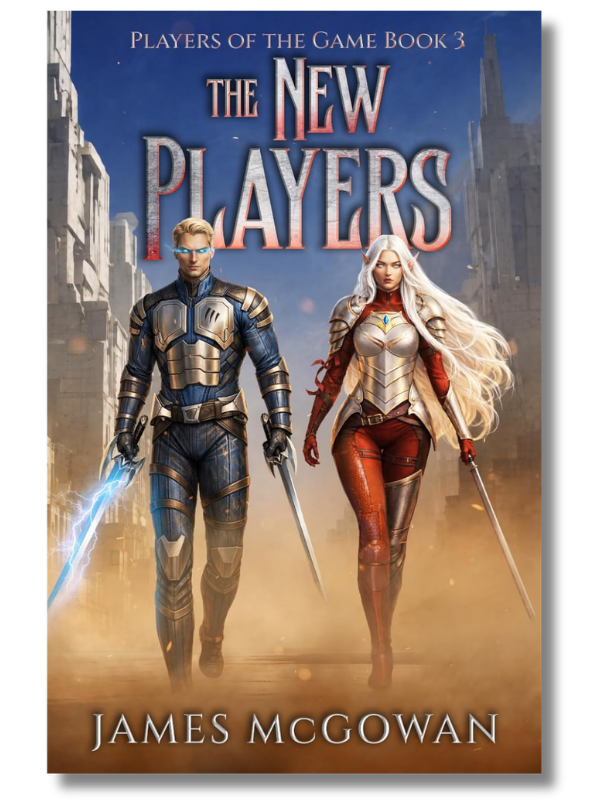
An energetic and fresh installment about a battle-hardened team geared to stop a sentient disease turning people into monsters
Shifting from Ashe and his Brigands to a new set of people fighting on an entirely different front, The New Players moves beyond events in the previous two books of the Players of the Game series.
Ed Burnhelt (grandson of the legendary Bennet Burnhelt) and Harry Mang, the embattled Fort Master of Findenton, confront a resurgent Kliost outbreak. This new strain of the ancient plant-based disease is no longer airborne. It’s now a sweetener smuggled through black markets. And it turns unsuspecting victims into grey-skinned monsters, trapping them under the control of the goddess Hekati.
These new protagonists are refreshing and re-energize the series. Haunted by his mother’s death and carrying the weight of his family’s legacy, Ed is a compelling protagonist. Faced with the loss of the one person who eased the burden created by his family’s endless problems, he constantly struggles to choose between vengeance and responsibility.
Harry Mang, meanwhile, grounds the story in grim pragmatism. His journey from loyal Alliance officer to defector is believable, and his relationship with his old friend Meve provides warmth against the book’s bleakness. When Harry dons the Grey Jack armor (a suit belonging to a spree killer he killed years ago), it shows how far he’s willing to go to save his city. He isn’t suddenly turned into a perfect rebel who has always secretly hated the system. He clearly still cares about the people he is supposed to protect, even when his loyalty to the institution protecting them becomes harder to justify.
The Kliost itself is genuinely chilling, and the horrors Harry encounters at Rebecca’s hospice are deeply disturbing. Later on, there’s an even more disturbing picture of what the infection can become: “Dozens of women’s top halves writhed upon hourglass-shaped organisms with other humanoid forms within their transparent membranes. Pulsating, vine-like conduits pumped the fully gestated humanoid forms into crystalline stalagmites on the level above.”
The conflict in this series is evidently much bigger than any single battle. In all this chaos, threats aren’t just defeated. Growth happens. Usually, they emerge with new alliances, responsibilities, questions, and in some cases, very different ideas about who they can actually trust.
The battles are constantly immersive under McGowan’s pen, as Ed’s super-speed perception provides visceral combat descriptions. Then the attack on the Kliost garden in the Stretch, with Ed slicing through Jianna’s clones at hypersonic speed while the Hydra’s serpents writhe around him, is simply electrifying. It is extremely satisfying how multiple threads align in the final battle in Findenton, where Harry, Ed, and Xax unite against Hekati’s forces. The highly visual nature of the prose is particularly useful during combat. The prose can sometimes over-describe actions, though.
There’s a fresh batch of characters to keep track of here with a lot of moving pieces: new factions, species, mythology terms. More historical events, locations, and weapons are introduced frequently, sometimes before the previous batch digests. The action scenes move quickly, but some parts also move a bit slowly, especially Ed’s investigation in Lan Thedin, which tends to drag. Alternating between Ed’s perspective and Harry’s means each storyline gets interrupted just as it starts becoming familiar. And by the time the two plots finally align in Findenton, it has already taken quite a while to happen. So while the final battle is satisfying, it feels a bit rushed, as though there’s relatively little space left for the convergence of the two stories to breathe after such a long buildup.
The way seemingly unrelated problems eventually reveal themselves to be pieces of a single strategy is quite impressive. And as the story and series progresses, it becomes increasingly clear how different problems are connected by Corsis’s use of distraction. This creates a satisfying retrospective quality.
The worldbuilding remains one of McGowan’s biggest strengths. From the fleshy-mancy experiments to the increasingly grotesque creatures produced from them, the Kliost is a real problem. People being transformed into monsters gives the threat a completely different quality from the more straightforward battles elsewhere in the series. It’s creepier that the danger is already inside the city. Worse, most people don’t even know what is happening to them.
Lucky for us, there are characters who can be standing in the middle of a massacre and still make ridiculous comments. This humor helps keep things from sinking into absolute misery. One of the most enjoyable parts of this volume remains the dialogue. The characters have noticeably different voices, with Fernallus and Xax providing much-needed irreverence when the story becomes overwhelmingly grim.
As the Game keeps getting stranger, it’s becoming more apparent that the rules may not be nearly as stable as they once seemed. The New Players is an increasingly worthwhile installment of this Players of the Game series.



What did you think?