

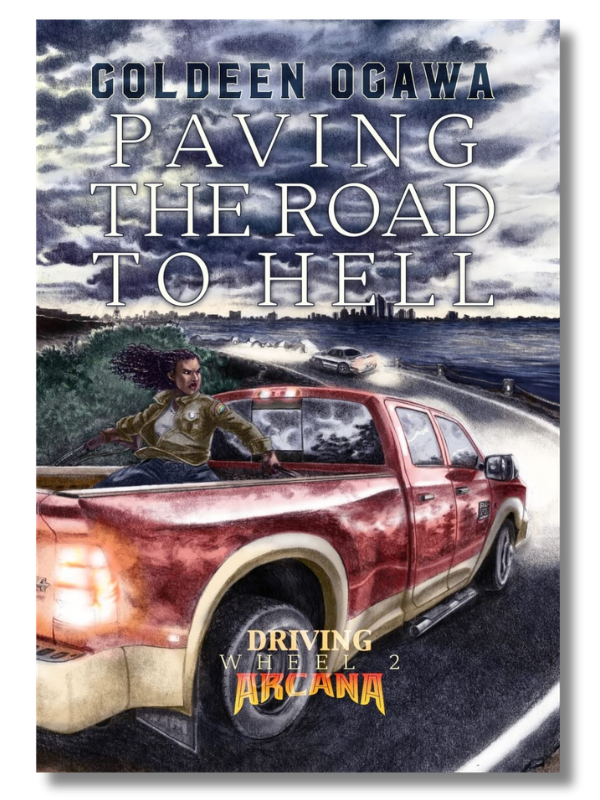
Paving the Road to Hell is what happens when monster hunting gets a research grant, a custom camper, and one dangerously curious woman who keeps mistaking red flags for field data.
Goldeen Ogawa’s second installment in the Driving Arcana series puts Jill Hamilton, Clara Nordstern, and Selene Shields back on the road after By Moon and Star, though “back on the road” undersells the scale of Jill’s latest decision. Her late boyfriend’s red Dodge Ram, Arcana, now hauls Cougar, a custom gooseneck camper equipped with an exam space, freezer storage, microscopes, a mini chem lab, and a bathroom that doubles as a darkroom. “He’s for research,” Jill says, with the bright confidence of someone who has not fully accepted that the supernatural does not care about grant funding, lab protocol, or personal safety.
That friction gives the book its spark. Jill wants to study the impossible. Clara and Selene have survived long enough to know that the impossible often resents being studied. Clara, pale, bald, and sword-bearing, moves through the story with the grim authority of someone who knows too many old names and trusts very few of them. Selene Shields, armed with a shotgun named Freddie and a spectacularly low tolerance for foolishness, brings the dry humor and tactical suspicion. Together, the three women are less a smooth team than a rolling argument with weapons, which is much more entertaining.
Ogawa is best when the supernatural refuses to behave like a clean assignment. The early Tulsa case—involving Sharon Gilkey, her son Marvin, and the leafy skeletal being Marvin calls Green—is eerie without being simple. Green is all wooden bones, vines, blossoms, and eyes “like stars at the bottom of a deep well,” but the real tension comes from the human mess around it: a lonely child, a terrified mother, a creature that may be dangerous, misunderstood, or both. Ogawa lets that uncertainty breathe. The result is not a tidy monster-of-the-week setup, but something stranger and more emotionally barbed.
The book’s episodic structure works because each case adds another crack to the trio’s assumptions. In “Out of Space,” when the threat appears unnervingly human, Selene’s line, “We don’t hunt humans,” lands with the weight of a rule being tested in real time.
That is where Paving the Road to Hell gets interesting: not in asking whether monsters exist, but in asking what counts as a monster once the world has gone sideways. The danger here is not always fangs, vines, or ancient magic. Sometimes it is grief, greed, fear, obsession, or the very human impulse to control what should have been left alone.
For readers coming into Wheel 2 with only the essentials from the first book, Ogawa offers enough context to keep the ride steady without pausing to hand out a mythology pamphlet. There are past wounds, recurring names, and larger supernatural aftershocks already in motion, but the emotional through-line is clear: Jill wants answers, Clara wants caution, and Selene wants everyone to stop making interesting decisions within driving distance of disaster.
What keeps the novel from getting bogged down in lore is its wit. Ogawa can move from a plant-boned figure in a suburban kitchen to RV security, magical taxonomy, or Selene’s exhausted commentary without deflating the menace. The humor is not a cute garnish. It is survival gear. These women are funny because panic is inefficient, and there is always another ward to check, road to take, or impossible thing trying to crawl through the cracks.
Smart, strange, and pleasingly prickly, Paving the Road to Hell is contemporary dark fantasy for readers who like their heroines difficult and their monsters morally inconvenient. It has wheels, bite, and enough reckless curiosity to make every bad idea feel worth investigating.








What did you think?