

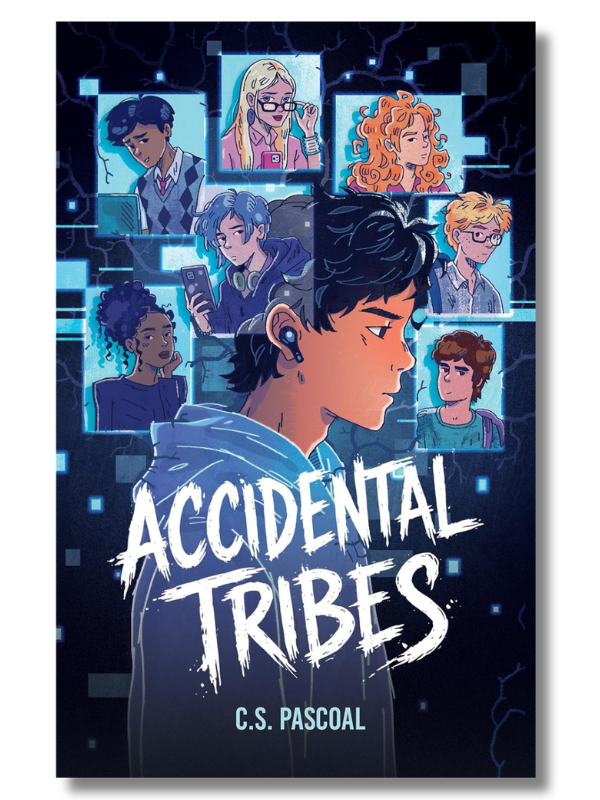
School punishment turns suspenseful social experiment in this twisty tale of hope for humanity.
Accidental Tribes is a dark, modern twist on The Breakfast Club, about teens growing up in an AI vibe-coding internet age. Kids whose dreams of a better life—now, and in the future—are built in a reality where school environments and personal ambitions are entwined with their lives online. This is a doomed social experiment masquerading as benevolent punishment, concealing a sinister plot of corruption and greed. It’s an indictment of the state of the modern education system and a call for compassion toward the teenagers who can’t escape it.
“The story of eight children confined to a secluded classroom called Solitaria,” Accidental Tribes drops these students into an impossible situation: You’ve been caught in the act by the Director of our school. Participate in this social experiment, or you will be expelled and possibly sent to prison for the school rules (and social cues) you so creatively broke.
The Unlucky 8’s crimes include but are not limited to: “Use of protected school records to rank students and animals. Organization of unauthorized gatherings in restricted school areas. Building an unending gaming network that reproduces itself like a virus. Filming children without consent for public humiliation.” That last one is about mega-influencer Patty, who runs The Zoo, an anonymous TikTok account rating her schoolmates’ outfits, recorded in school hallways with her camouflaged smart glasses. “Within weeks, the system outgrew her, as it was designed to do. She thought she was the creator. Like her subjects in The Zoo, she was merely another piece of content.”
Accidental Tribes’ narrator is an adult who once went to the school herself, someone intimately familiar with the school leadership’s history of corruption. Now working as the student advisor, she convinces the Director not to pursue legal action and instead allows the students to participate in a social experiment where she will monitor them on a camera feed at all times. “Their parents knew. Most of them signed the consent form without reading it, which tells you how desperate they were for any solution that spared their children.”
Each of the eight students struggles with their identity, their family environment, their life online, and their capabilities at school in different ways. “I watched the temperature of the room shift. How fast they went from prey to predators… Jamie was scanning faces the way she read code, searching for the line that didn’t belong.” The stress of Solitaria’s isolation, the forced collaboration with students they would otherwise avoid at all costs, and the do-or-die stakes eventually make way for the students to rally together, leaning on their various classmates’ annoying but strategically helpful skills and strengths.
Group work is never a smooth ride, though, and the experiment brings longheld resentments to the surface: “Two of the youngest had been in the same group project, until one framed his partner as a slacker. Someone leaked a tasteless meme of another’s yearbook photo that outlived the semester, and one of the girls was the reason the other sat solo at lunch.” There’s a focus on cyberbullying, an alarming scene where the police storm the school, and a key storyline about a teenager living with a terminal illness that no one at school knew about.
Though the suspense never lets up and the cliffhanger ending carries into an upcoming sequel—We’ve got a murderer to find! A betrayal to avenge!—this daring punishment forces the students to confess truths and to come of age in very online, hopecore breakthroughs. “In Room 359, somehow, eight of us made a home out of a punishment. A tribe.”
Fans of highschool-set mysteries, politically tapped-in tech thrillers, and The Wilds (for its twisty thriller-mystery plot and shocking reveals) will race through this page-turner, breathless and low-key tensed, deeply absorbed in unraveling the true story of the Unlikely 8: “Eight kids who succeeded not for being clever but for being foolish enough to give each other just one more try.”
The narrator’s perspective is a captivating one. An adult avoiding contact with the kids she would otherwise have gone out of her way to help, now monitoring the experiment through a constant video feed in a secluded room of her own. Her insights are especially profound and remarkable because she’s been an advisor at this school for ten years. “Here’s what no member of our faculty could bring themselves to admit: our teenagers were online building friendships, status, dreams, and entire careers in public, while we were circling the same answer: Ban it. That disconnect left a dangerous gap in a world with no undo button.”
Accidental Tribes is about more than the experiment; it’s about how the experiment completely falls apart in ways the advisor couldn’t have foreseen and has absolutely no control over. We know it collapses into chaos right from the start, which keeps us on our toes wondering how it devolves into such a sensational mess, constantly guessing what the-straw-that-breaks-the-camel’s-back tragedy could be.
Author C.S. Pascoal offers sharp commentary on the power and the pain that comes with growing up so thoroughly saturated in online culture. There’s genuine compassion in the narrator’s understanding that the internet is inescapable for these kids, at a time when they’re still navigating what it means to be human. “Nowadays, you need to manage friendships, school, identity, and status here, yes, but also online, each world holding its own set of distinctive rules and values.”
The narrator understands that giving kids “agency sparks what consumption never does. It sparks imagination,” with a front-row seat to how debilitating access to particular AI tools can be for young people with true creative potential.
When the Director is suddenly arrested on the school premises in front of everyone, “police sirens [flooding] every room in the building,” she leaves the experiment—and the entire school—in limbo. “We’re still being marked ‘excused from class,’” the Unlucky 8 notice. “The Director’s override is running. Have they forgotten us?”
“The Director was in jail, presumably concerned with larger matters than the rude NFTs Antoni had created of her.” But she would be replaced, and the students’ record remained, so they continue with their plan to present an idea so creative and brilliant that the new Director would have no choice but to overlook their history and reinstate them as students, the slate wiped clean. Even the narrator, who planned this experiment with good intentions, is surprised to see the students motivate and encourage each other. It’s all very Breakfast Club: “For once, Room 359 didn’t feel like punishment. It felt invincible.”
And that’s only the beginning! This story delivers shocking, chilling twists on information we hadn’t even considered questioning. Between the truth about how the experiment was born, who instigated the Director’s arrest, and why the students’ wrongdoings came to light in the first place… Accidental Tribes is filled with thrilling reveals we never see coming. I’m on the edge of my seat just imagining what will come to light in the next book.



What did you think?