

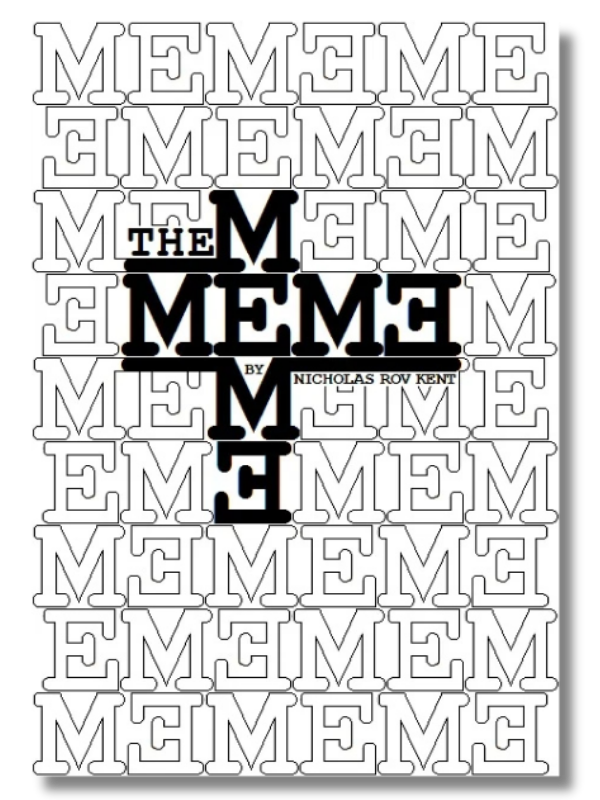
What happens when belief becomes humanity’s most dangerous technology?
The Meme by Nicholas Rov Kent is a deliberately destabilizing intellectual experiment—in novel form. It may not be a traditional narrative, but it is speculative fiction that blends dystopian futurism, political philosophy, metafiction, and social satire. To call the book unconventional would be understating the matter.
Structured as a sequence of interconnected narratives, confessions, manifestos, and speculative testimonies, The Meme is a collection of ideological thought experiments masquerading as fiction. Throughout, author Nicholas Rov Kent repeatedly asks this central question: What happens when ideas become the most powerful force on Earth?
The opening chapters immediately establish the novel’s startling scale. In the not too distant future, the “Meme War” gives rise to a world in which wealth inequality is violently corrected through a cascading campaign of fear directed at the ultra-rich, triggering global redistribution on an unprecedented scale.
Kent describes the “rat race to the bottom,” where “Money was doled out like playing cards and thrown around like confetti.” It is a bold premise, but what gives it weight is Kent’s refusal to treat it as mere fantasy. Instead, he interrogates the terrifying fragility of the economic structures modern society assumes to be permanent.
The writing is dense, highly stylized, and deliberately maximalist. Kent has a fondness for grand rhetorical flourishes, philosophical digressions, and labyrinthine sentence construction. At times, this can make the reading experience demanding, but it also lends the book a strangely hypnotic quality.
The novel’s most fascinating quality is arguably its fearlessness. Very few writers would attempt to fuse internet culture, revolutionary political theory, and speculative apocalyptic fiction into a single conceptual framework, yet The Meme repeatedly pushes toward precisely that collision point.
In a particularly memorable passage, Kent describes how “the paradigm had demanded far too much from far too many, delivered far too much to far too few, and far too little to far too many for far, far too long.” This neatly captures the novel’s central obsession with systems of imbalance and their eventual collapse.
Yet for all its grand societal theorizing, the most compelling moments of The Meme concern strange, intimate acts of faith. For instance, the sections concerning the “John Frum Movement” shift gears dramatically. Here, Kent reimagines the cargo cult phenomenon of the South Pacific as an exploration of belief, sacrifice, and cultural encounter.
The conceit is audacious: a disillusioned American military officer deliberately chooses to become the mythical figure awaited by believers on Tanna Island, devoting his life to fulfilling their prophecy. “I simply could not fathom the ridicule upon derision being heaped on this particular religion.”
The emotional sincerity of these sections is surprising. The declaration “I AM JOHN FRUM! F-R-U-M! I COME FROM AMERICA! I BRING YOU CARGO!” is obviously absurd, but beneath the surrealism lies something unexpectedly moving regarding devotion, identity, and self-erasure in service of an ideal larger than oneself.
In fact, Kent consistently demonstrates a fascination with the way human beings construct meaning. Religion, capitalism, nationalism, internet virality—throughout The Meme, these systems are treated as variations on the same fundamental mechanism: collective belief made real through shared participation.
One line captures this beautifully: “Once this message gets out of its bottle, there is absolutely no way to put it back.” It feels less like dialogue and more like the novel quietly explaining its own existence. In this regard, Kent is not especially interested in subtlety, nor does he appear concerned with conventional pacing or characterization. Characters often function more as vehicles for philosophical exploration than psychologically rounded individuals, and the density of the text can prove tiring over long stretches. Of course, the book is not primarily concerned with plot mechanics or traditional character arcs, so this is not so much a critique as a reflection of the potential reading experience.
Instead, The Meme operates almost as an exercise in radical imagination—an attempt to dramatize how fragile and confusing the structures underpinning civilization may actually be when confronted by sufficiently contagious ideas. “Even the most unhinged of ideas occasionally works the charm.”
One of the strongest recurring themes is the dangerous relation between thought and action. Kent repeatedly suggests that history is shaped less by institutions than by singular ideas spreading unpredictably through collective consciousness: “all it took to bring down the entire house of cards was one dangerous idea capsulised in an artless photograph.”
That sentiment lingers long after the book ends.
What makes The Meme so intriguing is not whether you agree with its politics, philosophy, or worldview but the sheer audacity of its intellectual ambition. It is fiction as provocation: confrontational, excessive, occasionally maddening, but undeniably original. Kent has produced something genuinely strange, and that strangeness conveys genuine vision.
The Meme will not be for everyone. It demands patience, concentration, and willingness to engage with work that prioritizes ideas over comfort. But when it comes to speculative fiction that challenges rather than reassures, it is a fascinating and deeply unconventional work. As Kent notes, “You become whatever you reflect on… for it too reflects upon you.”



What did you think?