

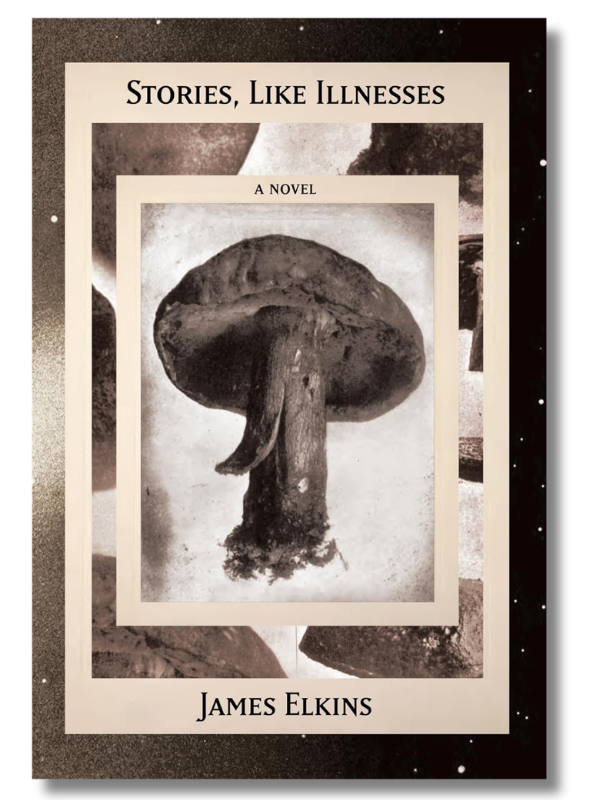
Microscopes, mushrooms, and music collide in an epic meditation on memory, loss, and obsession.
As our memories falter and the physical remnants of our past disappear, what—or who—remains of the people we once were? James Elkins’s Stories, Like Illnesses confronts this question in a sprawling, palimpsestic experimental epic that invites a dizzying existential crisis, provided readers have the attention required to navigate its protagonist’s labyrinthine consciousness and the energy to reckon with its meditations on memory, loss, and obsession.
At the center of Stories, Like Illnesses is Dr. Samuel Emmer, a biologist living an unassuming life in Guelph, Ontario, working as a water inspector and educator while struggling to navigate an increasingly complicated yet lonely network of relationships. His family and acquaintances harbor peculiar fixations, retreating into intellectual, professional, or pseudoscientific pursuits rather than confronting the disappointing realities of their lives head on.
Samuel’s coworker and romantic interest, Rosie, becomes consumed by the purported healing properties of crystals, while his mother’s twin obsessions with mushrooms and astronomy offer ties to a past she can never recover. Samuel eventually comes to the sobering realization that his mother’s scientific pursuits “didn’t give her pleasure the way I’d imagined. They were drugs to manage her pain.” Samuel, too, retreats into microscopes and, later, music, using these tools to grapple indirectly with his estrangement from his wife and daughter and his increasingly distant relationships with his brothers, Alec and Tee.
Samuel’s students are no exception. Among the novel’s greatest pleasures are Elkins’ sharply observed portraits of Dr. Emmer’s eclectic student body, particularly the enthusiastic but naïve Vipesh and provocative Viperine, whose eccentricities verge on caricature but will feel familiar to anyone who has encountered the peculiar combination of intellectual ambition and social obliviousness that defines many college classrooms. Yet the same obsessive attention to detail that makes these characters so entertaining can also test the reader’s patience. Extended digressions into snail sex, dysentery, and parasitic earwigs overstay their welcome, making an already meandering narrative feel, at times, unwieldy. Although these detours reflect Samuel’s (and his students’) restless curiosities and avoidant behaviors, they compound the demands of an already densely layered narrative.
Cutting through the excess, Stories, Like Illnesses ultimately offers startling moments of recognition that make this epic a worthwhile investment. Toward the beginning of the narrative, Samuel observes that “a person’s childhood can be further away than we are from ancient Egypt.” This quietly devastating recognition invites readers to consider not only their estrangement from their earlier selves but from the people in our lives who gradually fade from memory and the unique fixations through which we attempt to fill the void they leave behind.


What did you think?