

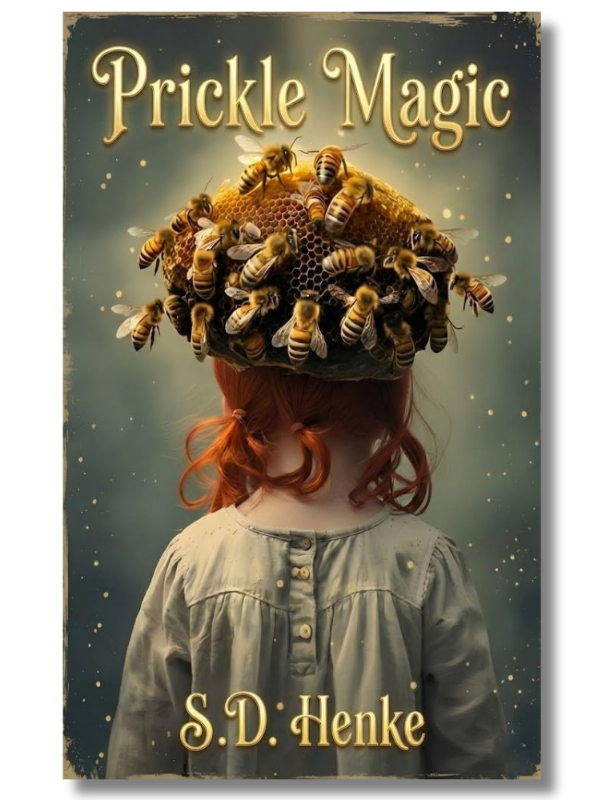
A lyrical coming-of-age novel about discovering your inner magic and using it to heal a broken world
Prickle Magic by S.D. Henke is the story of sisters finding their way back to each other within the sunlit fields of Honey Hill Farms and, through that connection, discovering the magic that’s hidden there.
Angela’s family needs a reset. Her father’s on a long deployment, her mother’s coming apart at the seams, and her sister Ava has become a surly teenager, unwilling to confide in Angela the way she used to. Yes, a reset will do the trick, and Honey Hill, a farm owned by their Memaw, is the perfect place.
“I’m struck by how much space there is here. The kind that feels alive under your feet in ridges pushing and layers pulling, where sheets of rock shift deep down below.”
Honey Hill has secrets of its own; the honeybees dance in the farm’s hives, leaving their own kind of magic hanging in the air. As Angela explores more of the farm, she gets drawn into the mystery of the bees it houses and the story of what happened to her Memaw’s cousin, a young girl named Polli, who had a special connection to these magical bees.
“Them Bees mark the face of Time
and Choice
is our voice
so, we better get a move on
right quick”
Prickle Magic is lush in its imagery. Honey is described in sweet, delectable detail, bees dance off the page, and the scent of flower petals hangs thick in the air. Henke does a remarkable job of making the reader feel connected to the setting of Honey Hill through atmosphere alone.
Told in two time periods, the novel oscillates between Angela’s story, set in the present day, told in rich descriptive prose, and Polli’s story, set in the 1960s, told in free verse poetry. Both these girls want to unify their respective communities: Polli by tackling the social unrest present in the 1960s and Angela by reconnecting with her sister, Memaw, and the land she’s found herself on.
The magic that connects these two girls feels as whimsical as a bee’s “waggle dance,” hazy in a way that lends to the dreamlike tone of the novel. Polli’s determination that the “Prickle,” bee magic, can change the world, and Angela’s determination to fix her family are two sides of the same coin, inexorably linked through time.
“The flavor sends a spark from my tongue, straight up to the crown of my head and back down to the tips of my toes, wild, sweet, and electric.”
While Prickle Magic is gorgeously written, it can occasionally pull up short on its characters and motivations. Besides being a moody teenager, it’s unclear why Ava is lashing out at her sister. Angela says that her family feels frayed but never talks about how this affects her or how she’s going to work to change it. Polli, with her crown of bees, says she’s going to unite the world through honey and Prickle magic, but we never see her doing so. There ‘s an opportunity to talk about the unifying movements going on in the 1960s through the character of Polli: the civil rights movement as well as the hippie movement. But Polli never comes into contact with any of these movements, nor does she talk about any of these ideals, leaving her giving lip service to the nebulous idea of unity, without doing anything to work toward it.
Prickle Magic is a beautiful book. The rich, atmospheric tone and the generous scene setting transport the reader to a honey-scented world. The inclusion of poetry serves to differentiate Angela’s reality from Polli’s and is a great way to introduce young readers to stories told in verse. This is a creatively wonderful novel for any young reader who enjoys speculative fiction.


What did you think?