

A powerful memoir about family, identity, and the lifelong search for belonging
Crushed Azaleas is a deeply reflective memoir in which Amal Moulik revisits his childhood and adolescence as the son of an Indian diplomat. Growing up across Japan, India, the United Kingdom, and Italy, Moulik experienced a life of constant movement and cultural exposure. Yet beneath the privilege of diplomatic life lays a home marked by emotional distance, authoritarian parenting, and quiet suffering.
At the center of the memoir are Amal, his commanding father (“Baba”), his gentle but increasingly withdrawn mother (“Ma”), and the many people who shaped his understanding of identity, belonging, faith, and love. Rather than presenting a chronological autobiography, Moulik seeks to understand how scattered memories, painful experiences, and moments of beauty formed the person he eventually became. The result is less a record of events than an exploration of memory, identity, forgiveness, and reconciliation.
The memoir unfolds through a series of short vignettes, each focusing on a particular memory rather than following a continuous narrative. These fragments gradually build a portrait of Amal’s childhood as he moves from country to country following his father’s diplomatic career.
Throughout these episodes, Amal grapples with questions of identity, religion, friendship, and belonging while trying to navigate an emotionally unpredictable household. His father’s relentless pursuit of status, authority, and control creates an environment where appearances often matter more than affection. Meanwhile, his mother’s quiet endurance keeps the family together, even as it gradually costs her own emotional well-being.
Alongside these family dynamics are childhood encounters with racism, cultural misunderstanding, grief, loneliness, and moments of wonder. Whether describing earthquakes in Japan, discovering different religious traditions in England, or adapting to new cultures, Moulik presents childhood through the eyes of a curious observer trying to make sense of an often confusing world. Later on, the memoir increasingly shifts toward adolescence, where these early experiences begin shaping his growing independence and his evolving relationship with his father.
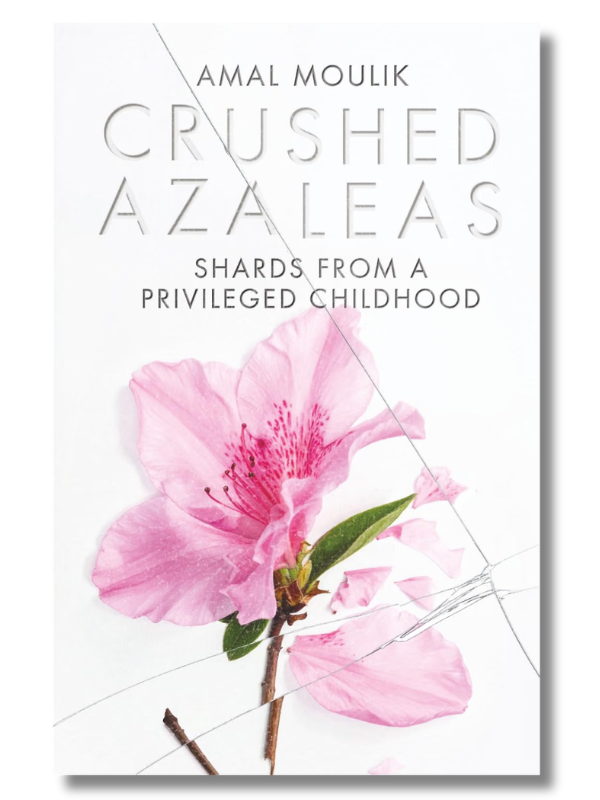
The title Crushed Azaleas comes from one defining act of rebellion. After enduring years of casual humiliation and emotional control, Amal destroys his father’s prized azalea flowers, an act that symbolizes his refusal to remain silent. In many ways, the memoir itself feels like a continuation of that moment: not an act of revenge but a thoughtful reclaiming of his own story.
The greatest strength of Crushed Azaleas is its honesty. Moulik neither idealizes or condemns his family. Instead, he writes with remarkable emotional maturity, allowing readers to understand each person without reducing them to heroes or villains.
His father is perhaps the book’s most compelling figure. Baba is intelligent, disciplined, ambitious, and often deeply intimidating. His declaration that he prefers “power” because it is “the final expression of civilization” perfectly captures the philosophy that governs both his professional life and his parenting. Rather than portraying him as simply abusive, Moulik shows how this worldview shaped nearly every family interaction, making the emotional consequences even more powerful.
His mother provides an equally moving contrast. Her quiet sacrifices and growing depression are never sensationalized, making her suffering feel all the more heartbreaking. Only later does Amal recognize how much she carried in silence and how often he overlooked her pain as a child.
The memoir’s episodic structure is another significant success. Writing in short vignettes mirrors the nature of memory itself. Since Amal’s childhood was constantly interrupted by relocations, schools, languages, and cultures, the fragmented format feels entirely natural. Each chapter functions like a carefully preserved memory that gradually contributes to a larger emotional picture.
Moulik is also an exceptional description writer. His prose has a quiet musicality that reflects his lifelong love of music, creating vivid scenes that immerse the reader without becoming overly ornate. His descriptions are rich enough to transport readers while remaining grounded in the perspective of a child.
Perhaps most impressive is the compassion with which Moulik revisits painful experiences. His reflections on Ram’s death, his mother’s mental illness, and his complicated relationship with his father reveal a writer seeking understanding rather than blame. His acknowledgment of his family’s privilege and its blind spots also gives the memoir remarkable balance, preventing it from becoming self-pitying.
There is very little to dislike about Crushed Azaleas, although readers expecting a traditional memoir with a strong narrative arc may find the vignette structure occasionally limiting. Because each chapter stands largely on its own, the emotional momentum sometimes pauses before building again, making the memoir feel episodic. Some readers may wish for stronger transitions between periods of Amal’s life. However, this fragmentation also mirrors the instability of his childhood and ultimately serves the memoir’s central themes.
Crushed Azaleas is ultimately a memoir about memory, identity, and reconciliation. What stays with you most is the emotional contradiction at the heart of Amal’s privileged upbringing: a child surrounded by extraordinary opportunities yet feeling unseen and misunderstood.
I would gladly recommend this book to readers who enjoy literary memoirs, reflective autobiographical writing, and stories that explore family dynamics, cultural identity, and emotional resilience. It is a thoughtful, beautifully written work that rewards patient readers, leaving behind not dramatic revelations but a lingering appreciation for how childhood memories continue to shape the people we become.


What did you think?