

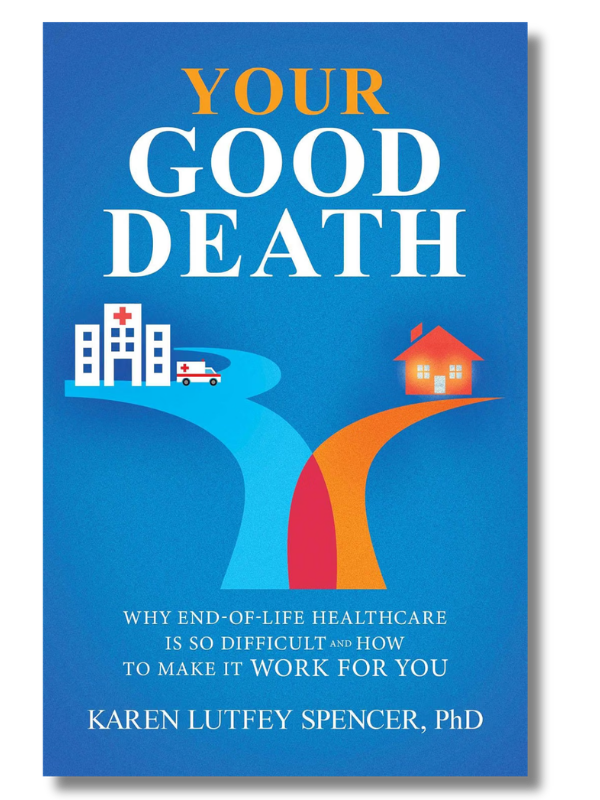
A compassionate exploration of death, healthcare, and the choices that shape our final chapter
Death is something we all know is coming, yet most of us give it remarkably little thought until circumstances force us to. In Your Good Death, medical sociologist Karen Lutfey Spencer examines why end-of-life healthcare can be so difficult to navigate and what patients and families can do to make the experience more aligned with their wishes.
Drawing on interviews with patients, families, caregivers, clinicians, hospice and palliative-care providers, and end-of-life doulas, Spencer explores the many forces that shape decisions at the end of life. Her goal is not to prescribe what a “good death” should look like, but to equip readers with the knowledge and questions they need to determine what it means for them.
The book begins by challenging the assumption that patients simply need to make better choices. Spencer shows how healthcare systems, insurance structures, medical culture, financial incentives, and communication gaps can significantly limit those choices. She explains the differences between curative care, palliative care, and hospice, while examining issues including the “terrible choice,” the medicalization of death, and the tendency of the American healthcare system to prioritize treatment even when treatment may no longer align with a patient’s goals.
The book then moves from the systemic to the personal. Spencer introduces readers to patients and families whose experiences reveal how these structures play out in real life. Later chapters explore palliative care, hospice, caregiving, end-of-life doulas, and practical strategies for getting more of the care a patient actually wants.
One of the book’s greatest strengths is its storytelling. Spencer combines sociological analysis with deeply personal accounts, making complex healthcare dynamics easier to understand and much harder to dismiss as someone else’s problem.
Lilly Mason, a woman living with advanced cancer, illustrates how patients can remain uncertain about their options even after years of interacting with the healthcare system. Louise Canton, meanwhile, demonstrates the enormous burden that can fall on family caregivers when multiple relatives require care simultaneously. Spencer’s own experience caring for her mother adds another dimension to the book, particularly her struggle to navigate the changing relationship between being a daughter and becoming a caregiver.
I particularly appreciated Spencer’s discussion of palliative care. Through clinicians such as Dr. Turner, she presents palliative care not simply as something associated with dying, but as a resource for navigating illness, communicating with specialists, understanding options, and aligning treatment with what matters to the patient. She redefines “hope” to mean ensuring patients are comfortable, completing important tasks, seeing a loved one, or preserving something meaningful.
Another strength is the book’s practical structure. Spencer ends chapters with key takeaways and questions that encourage readers to apply what they have learned to their own circumstances. Rather than simply explaining why the system fails patients, she gives readers strategies for communicating their wishes, seeking appropriate care, and preparing for a crisis.
This can be a difficult book to read, not because of the writing, but because of the subject. I found myself stopping frequently to think about my own family and questions I had never considered asking. But that discomfort is part of what makes the book effective. Spencer wants us to understand that planning for death should not begin when someone is already at the end of life.
Your Good Death is a thoughtful, compassionate, and sometimes uncomfortable book. I recommend it to people with aging parents, caregivers, healthcare professionals, people who work with older adults, and, frankly, anyone who intends to grow old. It reminds us that preparing for death is not about expecting the worst. It is about understanding our options, communicating what matters to us, and giving ourselves and our loved ones a better chance of navigating the final chapter with intention.





What did you think?