

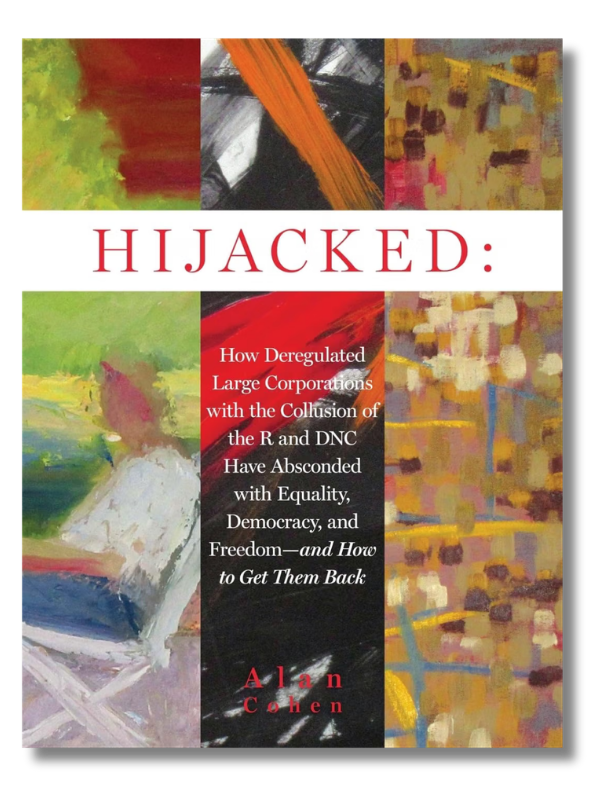
An exhaustive, useful study into how corporations have appropriated many aspects of the American government and how people can reclaim their power
Alan Cohen is a Capitalist who believes in a government that does its utmost to help its citizens. That shouldn’t be a big ask. But this compelling book is passionately born out of frustration with a rigged and unjust system.
As one presidential administration succeeds another, the inequality gap only seems to widen despite the Democrat or Republican President citing tax cuts as benefiting most if not all Americans.
The one beneficiary of tax policies over the previous four-plus decades has been the upper crust of society, the storied 1%. In history, oligarchies have managed to seize property and money from the public with the aid of corrupt rulers. In the United States, while the existence of an oligarchy can be argued about, a corporatocracy seems more apparent.
The influence of corporations on government policies seems undeniable, whether it be the “Citizens United” ruling in 2010 or the endless tax incentives they are provided. In 2020 while Mom & Pop stores were forced to close during the COVID-19 pandemic, big box chains remained open and reaped the benefits. Large corporations are held to a loftier standard despite not contributing to the common good overall, whether engaging in unethical business practice or outright illegality. While some politicians call out the predatory and rapacious practices of certain financial institutions or shopping chains, other politicians benefit from donations made by these same corrupt institutions.
Regulatory agencies were created to protect the public, whether the Environmental Protection Agency looking out for the public health or the Food and Drug Administration ensuring the safety of the products that the people consume.
While seen as a force for the good, large corporations believe there is too much regulation and often lobby for policies that will provide them enough slack to operate in the manner they see fit. Cohen does a particularly strong job covering this subject, sharing that in the 1980s, deregulation of the Savings & Loan industry resulted in unsavory and illicit practices. This resulted in the failure of thousands of S&Ls and a massive bailout in the 1990s. Easing of regulations later enabled the proliferation of “Too Big to Fail” institutions in the 1990s-2000s whose near collapse threatened to cripple the global economy.
The two main political parties in the United States are divided by various ideological differences, yet their embracing of corporate welfare and other ingratiating behavior toward big business is a unifying factor. While economic theorists in the past held that “The invisible hand” moved markets, it is increasingly seen that the hand of government can be seen guiding things along. There is no escaping the sense of disillusionment and righteous indignation that author Alan Cohen feels, as it is apparent from the beginning of this insightful work. The voters who in previous elections felt an aura of excitement around a particular candidate will find common ground with Cohen, a Bernie Sanders backer who was dispirited by the Democratic National Committee’s thwarting of the Sanders campaign in 2016.
Alan Cohen’s arguments for checks on the absurd power wielded by corporations are cogent and are firmly grounded in investigative and scholarly works. Cohen’s myth-busting of various administrations (Reagan, Obama) are both revelatory and colorful. The frustrations of reformist administrations such as Dennis Kucinich’s in Cleveland illustrate how monolithic corporations push back when challenged, especially when it comes to profits. It’s incredibly important to have a strong, studied political mind like Cohen’s on this subject.
While there are many reasons to be cynical about the status quo, Alan Cohen believes in change through activist politics, a third-party approach that can generate a groundswell of support and be independent of compromising corporate interests. Hijacked is an informed treatise on a captive government that provides a wealth of information and critical insight into understanding our imperfect government.








What did you think?