

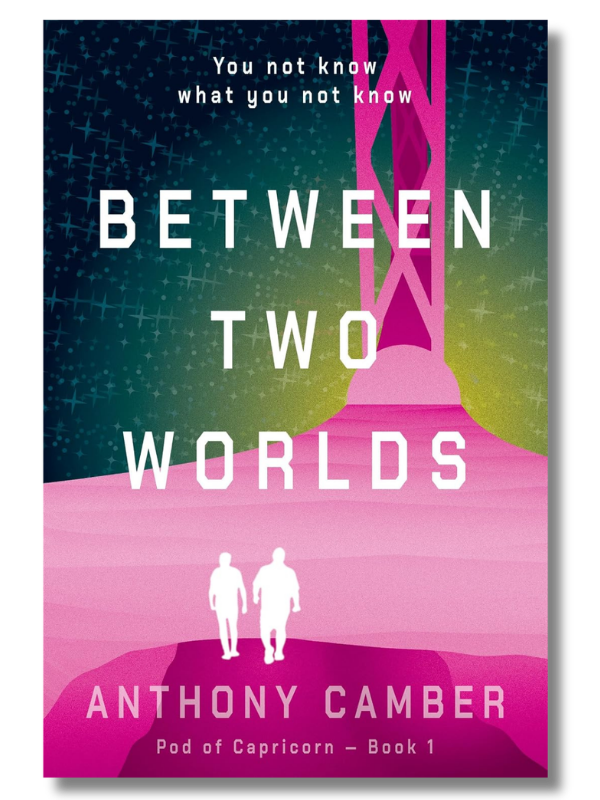
Queer students venture into the dystopian unknown to find their friend who mysteriously disappeared in this book of lyrical dialects, secrets, and suspense.
Between Two Worlds is a coming-of-age story about Pod, a queer student whose crush on a mysterious boy throws his life into chaos—in ways that must be untangled to understand. “[Quasar,] he running from evrun, I reckon.” I smile. “It how he built those thighs.” Quasar suddenly shows up in Pod’s class, wooing the protagonist with shockingly expensive stationery and his high-voltage smile. He says he’s from a far away town but won’t give specifics and doesn’t seem bothered that Pod doesn’t believe his story, his skepticism becoming an inside joke between them. The story has tense layers of secrets waiting to be uncovered, and a high-stakes ‘Is Pod going to survive, or make this all so much worse?’ energy, but there’s an authentic, youthful sense of humor here, too. I held my breath in anticipation of reveals and laughed out loud at the jokes.
The night that Quasar agrees to come over for dinner to meet Pod’s housemates, the closest thing he has to family (whose reaction will determine if they hook up in his bunk and move on, or potentially start something real and romantic together) is the night Skylight, Pod’s bunkmate, suddenly disappears. Everyone assumes he left to join the Wolves, a violent army on a mission to rule their land. Pod tries to ignore the grief and betrayal he feels, but between the quiet of his bedroom without Skylight and the noisy thoughts of not understanding why he left, Pod can’t stay. He ventures out into the wide world —a place entirely unknown to him, as a poor but sheltered student who hasn’t yet experienced the world or people outside his local area in any real way—to find Skylight.
His nonbinary friend Forest (Pod uses they/them pronouns for Forest throughout) joins this spontaneous, rule-breaking adventure, offering sweet supportiveness and a healthy dose of grounding reality to Pod, who would not have made it an hour without being robbed, tricked and attacked if he’d gone solo as he planned. The two stumble into Quasar along the way, who admits that he followed them and insists on joining to help because he’s the only one who has traveled before. But Quasar isn’t introduced as “the guy who gonna tumble my life” for nothing; Quasar’s secrets put Pod in more danger than his naivety ever could.
Readers interested in life under surveillance and dystopian societies on the brink of unraveling (like Hugh Howey’s Silo novels and their AppleTV+ adaptation) will enjoy how author Anthony Camber writes Pod’s relationship with C-dog, the all-seeing AI in the sky. Between Two Worlds’ characters personify the AI and struggle to break its rules even when they know it can’t see them (“I reckon C-dog, he hates me already and if he sees me pee in a field he gonna spark my dick to dust.”) which is most entertaining when they play with the boundaries of what the AI can do for them—to mostly unsuccessful results, but it’s fun to watch them try. Life under C-dog’s constant watch reminded me of the Netflix series Omniscient, particularly in the way people behave differently (or don’t) when they know C-dog can’t see them.
When C-dog suddenly goes offline and starts to glitch, (“No data,” C-dog replies. “He go to Hunniton?” “No data.” “I saw him in Hunniton,” Henela Socket says. “He escaped a tack.” C-dog, he thinks. “No data.”) it’s unsettling to everyone. Citizens are unable to navigate criminal activity without the ‘objective’ eye declaring order and truth: “Maybe the system, it down still. Maybe it ent never coming back,” Pod thinks to himself. “A jolt of yes hits me, fading to truth: much as we hate him, we screwed screwed minus C-dog.” That feeling escalates when C-dog comes back online with gaps in his memory and suspiciously limited data on what’s happened in the past few days. There’s a clue somewhere in what C-dog knows about where Pod’s been and which rules he’s broken, but Pod doesn’t have the time, headspace, or life experience he needs to figure it out. He’s racing to piece information together so that he can survive and save his friends right now.
This story is told in what Anthony Camber describes in his author’s note as “a constructed dialect of contemporary British English, dropping and changing words and phrases while staying readable. Different, yet familiar. Ungrammatical by today’s standards. But today’s standards don’t apply to Capricorn.” I was excited to read this dialect, but it reads rather close to Black British English, a vernacular mix of pidgin and patois, without clarifying or acknowledging the dialect’s innate Blackness. It’s worth noting that there are references to different races in this world, and they all talk in this dialect the same way Pod does.
That said, the vernacular is soaked in story-specific terms that make for a highly engaging reading experience. The more I read, the deeper into this spiraling adventure Pod finds himself, the more I found that the lyrical storytelling had set itself to the beat of my heart. I grew attached to the rhythm of the story and its fierce, intriguing characters, and felt a growing reluctance to let it go when it ended. (Readers who are unfamiliar with the metric system would benefit from a quick look at a chart; knowing that terms like ‘a cem,’ ‘half a kim’, or ‘ten ems’ refer to a centimeter, half a kilometer, and ten meters certainly helped contextualize the dialogue.)
“Quasar, he warned it ent safe. Forest said Quasar, he shows muscle enough to help. And me, I let some guy, built of three strung sticks and tongue, thief my pack.” Pod doesn’t know how C-dog works in different areas, can’t tell when he’s being manipulated by a stranger, or when to lie for his personal safety, so his coming-of-age character arc is strong. The author brilliantly infuses his story with the heady mix of young love and lust, which is especially powerful when Pod recognises the responsibility of holding someone’s heart into your hand even if you didn’t know they had feelings for you.
Pod navigates the emotional whiplash of Quasar’s behaviour turning from telling Pod flirty half-truths in class to a strict ‘just trust me and do as I say’ attitude on the road. Fear that he’s the reason Skylight left combines with confusion about his best friend running away to join the Wolf army: “Maybe he went cos he not happy. Folk do that.” “Not Skylight. He woulda told if he not happy. You sure noby with him dragging him out?” Along the way, we meet tricksters, thieves, runaways, and elites who control armies. Who is telling the truth about who they are and what they want, and why do they all keep chasing Pod?
Between Two Worlds concludes with a stunning cliffhanger, taking the reader from an urgent sense of needing to “learn if [redacted character] a spy, or if he a fool in service of a spy” to an entirely new reality that doesn’t satisfy our need for answers, but certainly has us craving the next book, which I definitely will pick up to find out the truth behind the mysterious characters and the wide new world that opens up.




What did you think?