

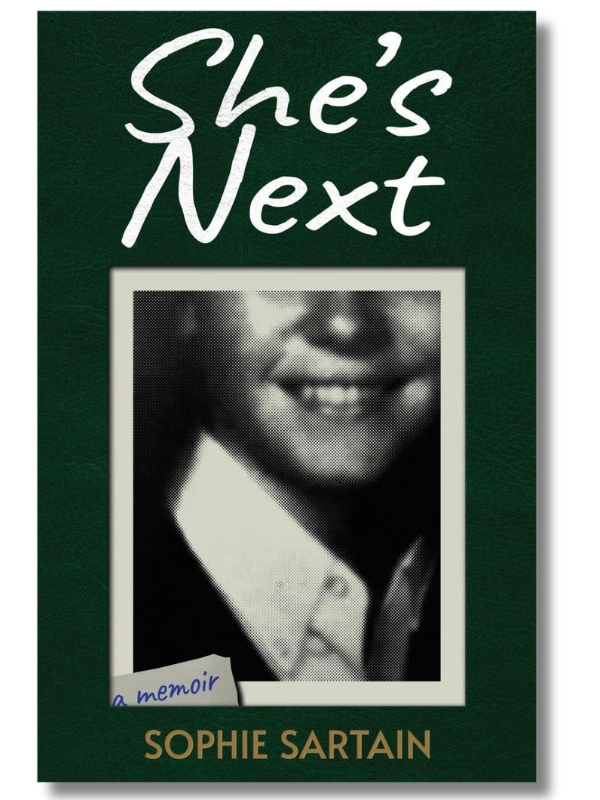
A heartbreaking but hopeful memoir of pain and reclamation in the wake of a female predator’s calculated abuse
Documentary filmmaker Sophie Sartain’s memoir, She’s Next, impressed me so much that it’s going to be difficult to list its successes without sounding disingenuous. But stick with me. This thing is worth it.
The subject matter alone warrants praise for its courage and honesty, but it’s Sartain’s steady hand on the narrative wheel, her frank self-investigation, and her capacity for self-reflection that elevates She’s Next from compelling personal recollection to grounded resource that I would gladly recommend to survivors of similarly abusive power dynamics.
Sartain is generous with her perspective and compassionate with her opinions. She is also admirably frank in how she struggled to legitimize her own abuse, caught as she was by self-recrimination, guilt and other long-term effects of predator grooming and manipulation. “Could I forgive her, and what was I forgiving, a love affair gone bad or sexual abuse? I had been sixteen, almost the age of consent. Was it criminal or just incredibly sad.” Her willingness to put her reflections on the page validates the self-doubt that can often accompany survivorship.
Sophie Sartain was a high achieving, athletic sixteen-year-old when she met Cissy Lewis, the new English teacher at her private all-girl’s school in a wealthy North Dallas. Over the course of a year, “Miss Lewis” charmed, manipulated, and groomed Sartain and other “special girls” into being her devotees—a power imbalance that would continue even after Sartain’s relationship with her became sexual.
“I’d never done it before. I was a worshipful acolyte too intimidated to ask her basic personal questions about herself. I still called her “Miss Lewis” and wondered how I could possibly make the leap to ‘Cissy.’”
Over the course of a year, Miss Lewis groomed and slowly ensnared Sartain until she was desperate to be one the “crème de la crème.” “Cissy rewarded her disciples with long, demonstrative hugs. Full-body hugs. Boundary-crossing hugs. She adored her special girls.” No longer a well-balanced high school kid, Sartain was effectively indoctrinated. She now longed to be one of Miss Lewis’s “special girls,” a moniker that may drip with sinister implication now but which held little threat in the aggressively straight south of the 1980s.
One of the particular strengths of She’s Next is Sartain’s consistent contextualization of the cultural place and time that was the backdrop of her abusive relationship with Cissy Lewis. It was dangerous to be an uncloseted lesbian in the mid-80s, especially one who worked in education. Sartain notes with compassion that Cissy could not have been open about her relationship to any female partner given “the fear that gay teachers might ‘recruit’ children into homosexuality.”
The risk was even greater in Dallas, Texas, where having a gay daughter could have ruined Sartain’s father’s business. This context worked against Sartain as a young woman as it allowed a predator to operate with impunity simply because she was preying upon victims of the same sex. It also made it nearly impossible for Sartain’s parents, teachers, or friends to intervene—it was unthinkable that a female teacher would cross that line with a female student, and even if it occurred to anyone, the implied homosexuality would be too awkward to address.
Sartain divides She’s Next into three parts, organizing both chronological events and her struggle to process the aftershocks. The structure and pacing form a strong foundation for Sartain’s measured “showing” of the abuse and its effects.
Young writers are famously advised to “show and not tell,” but it’s rare to see it done so consistently effectively in a narrative this painfully personal. Sartain recounts moments of sexual impropriety, emotional and financial manipulation and terrific cruelty on Miss Lewis’s part through concrete events and letters. She describes events and disorientation.
“Did we enjoy a friendly dinner with her parents? I can’t remember. All I know is that by the end of the night, Cissy wanted nothing to do with me.”
Sartain is generous in telling the reader how she felt, but she does so in relation to a concrete and elucidating moments, a choice that makes the memoir difficult to put down. “My tears infuriated her and had to be suppressed.” Sartain’s sensitive illustrations of emotion make her a deeply relatable narrator.
Sartain spends a great deal of time in the unforgiving grey area of hindsight, which makes She’s Next an admirably complex read. She is frank with her self-doubt—a doubt that, paired with shame and homophobia, kept her silent for thirty years. Meeting Cissy Lewis in mid-life only makes her doubt her experiences as a young woman. “I was thrown off by her sweetness and self-deprecating humor. This wasn’t the person I remembered.”
It takes another exposure to Lewis’s charm to feel justified in saying that she had been taken advantage of by a predator. “It was the same boundary-crossing hug from three decades earlier, and it threw me off […] I felt my personality start to drain away.” Sartain’s courage in working through her self-doubt on the page is one of the elements that makes She’s Next a powerful and ratifying account of survivorship.
She’s Next carries the weight of thirty years of pain and hard-fought perspective with terrific grace. As a memoirist, Sartain weaves pain and self-reflection with a journalist’s objectivity to produce a work that is both deeply affecting and hopeful. It is possible to face your abuser and emerge, over time, into a recovered self.




What did you think?