

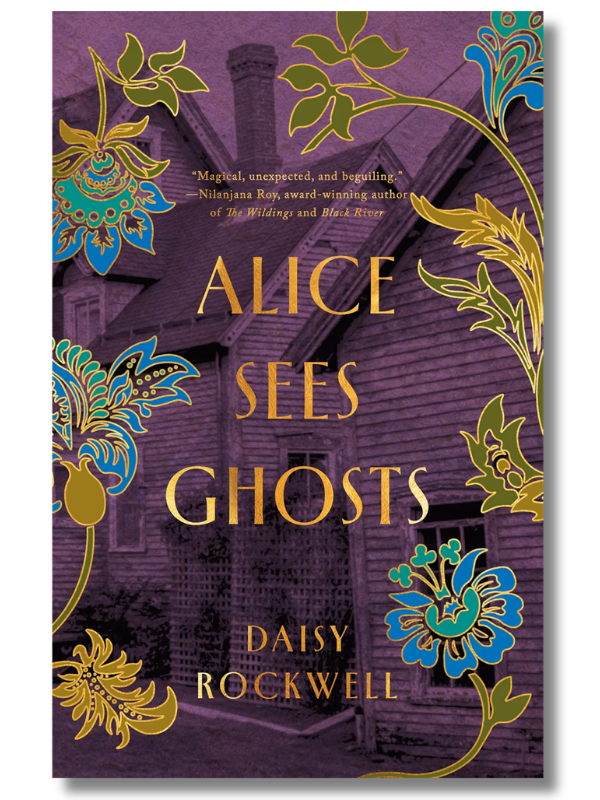
A multigenerational, multi-continental family saga that beautifully illustrates how home and the heart are one and the same
Alice’s grandmother is dying, and Alice cannot speak of it—literally. This is how Alice Sees Ghosts by Daisy Rockwell opens: at an end. Alice has returned to the family home, Lilac Hill, to say goodbye to Nanette, but the recent chaos in her life, plus her anticipated grief, have rendered her speechless. Her mother, Clare, is unwell as ever, and to complicate matters further, at night she’s inundated with dreams of parties she’s never attended. And all of that is before the ghost of her grandfather appears to her with a mysterious message.
“She felt, in those days of Nanette’s decline, she was there to say goodbye to the house as much as she was to say goodbye to her grandmother.”
Lilac Hill, Nanette’s ancestral home, is where the family would gather together, but it has been a long time since Alice was in one room with Nanette, her mother, her aunt, and her three uncles. It has been a long time since her family has felt like a family. Nanette and Alice’s grandfather barely spoke while he was alive, and even after Alice starts speaking again, she barely does so with Clare. Luckily, Alice also has Ronit, her psychiatrist-turned-fiancee, who finds her whimsical view of the world endearing, if slightly frustrating.
“Why did [Ronit] always have to bring up probability and reality with [Alice]? It never came to any good.”
Ronit has always felt like the odd one out, a man born in Kolkata, India, but who lives in WASPy New England. His experience becomes invaluable to cracking open the mystery of Alice’s family history, though, when Alice’s ghost-grandfather points her in the direction of India. There, he and Alice find yet another family home—Cosmos Cottage—and slowly untangle the web of secrets, lies, and deceit that has plagued her family for generations. There, they get answers Alice isn’t quite ready for but is compelled to act on nonetheless. When they return to the United States, to Lilac Hill, Alice finally has the answers she needs to try and heal her family—but she also has a very different definition of family in mind.
“So the ghost is gone and now the house is haunted by the living?”
What follows is a heartfelt undertaking of empathy, curiosity, and discovery, as Alice chases down threads of history, seeking out family members estranged and unknown. Both she and Ronit—and, by design, the reader—are forced not only to reckon with what it means to belong to another person but also what it means to walk away from that belonging. They are forced to reconcile whether or not one truly can go home again.
Much of the novel’s potency comes from Rockwell’s refusal to flatten her characters out. They are complex creations, with hopes and hurts that they nurture and neglect. Their motivations are at times questionable, but in incredibly human and relatable ways. Any reader will be able to find slivers, if not outright reflections, of themselves in the pages. The complicating factor of such a large cast, however, is fleshing out full arcs for everyone, and Alice Sees Ghosts does fall prey to that.
Despite some missed opportunities for further connection within the narrative and characters who walk off the page never to return, this cyclical story turns back to its origins in an incredibly satisfying way. The final message is one of hope—especially hope found in darkness. Ultimately, Alice Sees Ghosts is a narrative that shows the reader that, even through grief and betrayal, the flames of love can never truly be extinguished.



What did you think?