

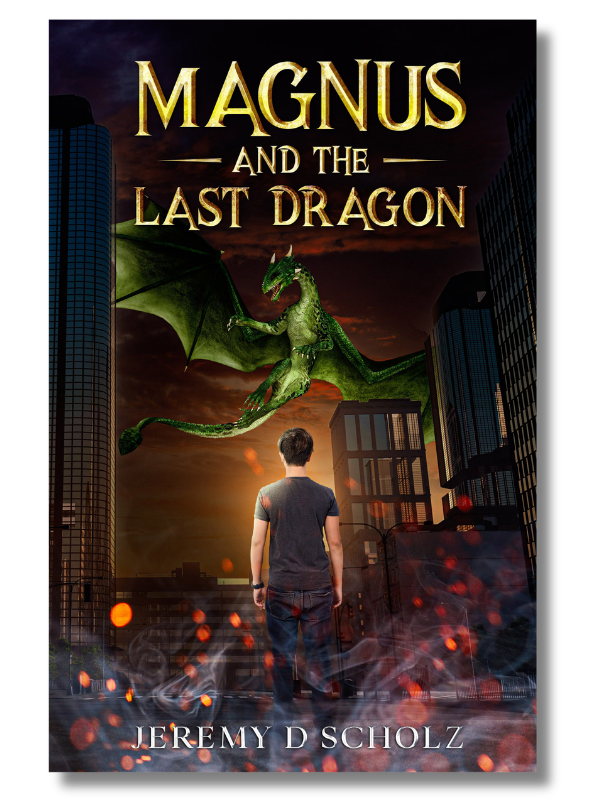
A big-hearted fantasy adventure about belonging, self-acceptance, and what makes a home worth protecting
Jeremy D. Scholz’s Magnus and the Last Dragon follows fourteen-year-old Magnus, a foster kid who’s never felt like he belongs. At six-foot-two, he’s nearly impossible to overlook, yet somehow, he still feels invisible. His foster family cares for him, but the house never quite feels like his, so Magnus has learned to make himself small and quiet and hope he can simply blend in.
Then he starts seeing things other people don’t.
First, Magnus notices a strange little man near the school bike racks that no one else seems to see. The man tells him he’s a gnome and gives him a dire warning that “the Order” must never learn that Magnus can see the creatures who should be invisible to ordinary people. Suddenly, all the odd things Magnus has been dismissing as his imagination or his mind playing games become much harder to explain away.
With his friend Mallory by his side, Magnus is pulled into a covert world filled with gnomes, brownies, centaurs, giants, sprites, and other beings trying to stay out of the Order’s reach. What begins as a strange new ability to see and communicate with what others can’t becomes a hunt, and Magnus starts to suspect that his connection to these creatures may have something to do with his own missing history.
Magnus has spent his life trying not to be a burden. He moves his body to try to take up less room. He stays quiet and tries to avoid being noticed because being noticed means taking the risk of becoming a problem. For a kid who’s physically impossible to miss, he’s become good at disappearing.
The creatures in this other world see something special in Magnus long before he does, a kind of recognition he hasn’t found elsewhere. They know what it’s like not to belong. The brownies were driven from the human homes they once helped support. B3 lost both of his parents. That kind of displacement is all too familiar to Magnus, and his kinship with them feels immediate because he already knows what it’s like to wonder where, or even if, you belong.
Best friends Magnus and Mallory understand each other because neither has a secure sense of home. Magnus has no memory of his parents and has spent most of his life in foster care. Mallory lost her parents in a plane crash and has since been passed among relatives and family friends. Neither has to explain what it feels like to wonder how long they’ll be allowed to stay.
The farther Magnus gets from the ordinary world, the more complicated the hidden one becomes. The river sprites are beautiful but dangerous. The centaurs’ watch is relentless, repeatedly gauging Magnus’s reaction when someone more vulnerable is in need. Each community has unique rules and fears, just as each community has its own reasons to distrust outsiders. B3 becomes a long-needed protector for Magnus, as his history echoes Magnus’s more closely than either of them could imagine.
The adventure and action rev up once the Order starts hunting them openly. Magnus and Mallory get chased through the city, hidden by brownies, nearly killed by river sprites, rescued by B3, and eventually taken in by a centaur herd. Those encounters widen the story without losing sight of the book’s center: every new refuge asks whether he’s someone worth protecting, and whether he can believe he belongs there.
Magnus and Mallory protect each other, hurt each other, get jealous, and keep choosing to stay. He’s quick to guard her from danger, but slower to listen when she tells him something feels wrong.
At its heart, this is a book about belonging, and the idea of belonging runs through nearly every part of the novel. Magnus wonders about the parents he can’t remember. Mallory fears being passed along again. B3 and others are each carrying inherited losses. Entire communities have survived only by hiding.
Again and again, Magnus meets people and creatures who know what it means to lose a home or wonder whether they’ll ever have one again. As the mythology opens up, some of the quieter scenes land harder than the lore. Magnus and Mallory talking, arguing, or trying to repair what they’ve hurt often have greater impact than another revelation about the Order.
Readers who like hidden worlds, curious creatures, and stories about finding a place to belong have plenty to latch onto here. Magnus and the Last Dragon knows how exhausting it can be to spend your life trying not to take up too much room. Magnus doesn’t need to grow into someone else to earn his place. He has to stop treating his own existence as something that requires permission.






What did you think?