

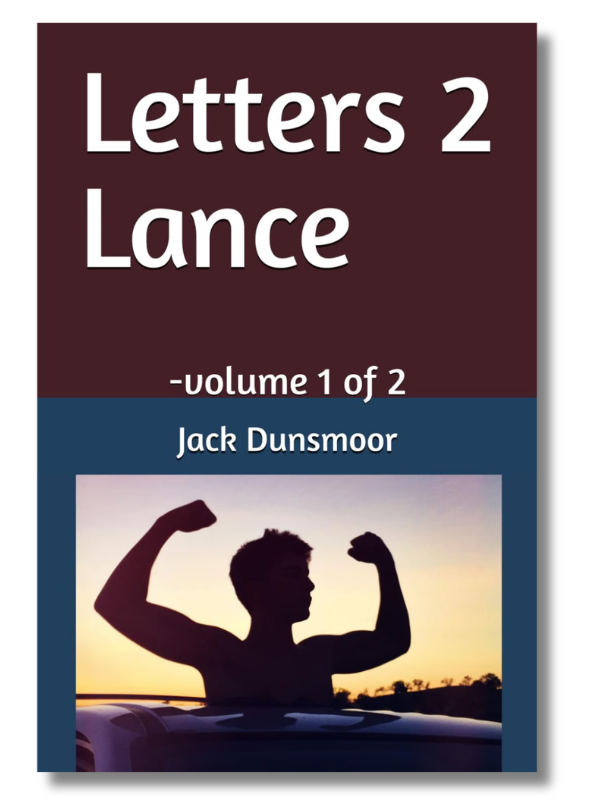
A celebration of curiosity, conversation, and the joy of learning
There are books that tell stories, books that present arguments, and books that document lives. Letters 2 Lance occupies a rather more unusual space. Across two substantial volumes, Jack Dunsmoor constructs an extended correspondence that is at once memoir, travelogue, reading journal, historical reflection, philosophical conversation, and educational project.
The two volumes are not simply collections of letters or conventional memoirs. Instead, they document a sustained dialogue—sometimes literal, sometimes imagined—between Dunsmoor and YouTube creator LanceTheDriver, “my favorite virtual friend,” which serves as a framework for exploring a lifetime of memories, ideas, and aspirations.
The unusual structure may initially take some adjustment. Dunsmoor’s reflections wander between subjects with the same spontaneity as a long conversation between friends. Yet it soon becomes apparent that this is precisely the point. The book doesn’t attempt to tell a linear story. It attempts to capture the workings of an inquisitive mind.
Dunsmoor’s letters are filled with encouragement, practical advice, and genuine admiration for the younger man who inspired the project. “You can do this, Lance!” becomes far more than a throwaway line—it encapsulates the spirit of the entire book. Dunsmoor is eager to share knowledge accumulated through experience with Lance.
However, he often broadens the conversation to include those who may be searching for direction in their own lives. At one point he explains that his newsletter was created “with the intention of helping gay kids at-risk,” a statement that neatly summarizes the humanitarian impulse underpinning the book.
His interests are wide-ranging—books, history, politics, travel, classic cars, motorcycles, film, LGBTQ+ history, and education all receive attention—but they are united by a sincere desire to encourage curiosity and empathy. As a result, one of the book’s greatest strengths is its authenticity.
Dunsmoor never attempts to present himself as a flawless narrator or to preach from a position of authority. For example, in Volume 1, he openly discusses financial insecurity, repeated house moves, caring for his elderly mother, creative frustrations, and the uncertainties of trying to establish himself as a writer later in life.
His description of living through “frequent bouts of despair, but not depression” while wondering what might happen to him next is affecting precisely because it avoids melodrama. The honesty of such passages gives Letters to Lance considerable emotional weight. Family relationships also provide some of the most moving moments.
The chapter in Volume 1 describing his mother’s dementia, repeated relocations, and eventual death introduces emotional depth that contrasts with the lighter topics. Rather than becoming sentimental, these passages demonstrate the practical realities of caregiving while illustrating how grief became a catalyst for Dunsmoor’s writing career.
Books function almost as additional characters throughout Letters 2 Lance. Dunsmoor is an enthusiastic reader, and his passion for literature is infectious. References to memoirs, biographies, histories, political tomes, and travel writing appear on almost every page, often accompanied by recommendations and reflections on what he has learned.
Dunsmoor’s lifelong reading habit and enthusiasm for the written word have led him to develop an unusually inclusive approach to intellectualism. Rather than displaying knowledge for its own sake, he constantly seeks connections between ideas, authors, and lived experiences.
His love for research is similarly clear. Whether discussing university options for Lance, scholarship opportunities, or LGBTQ+-friendly campuses, he approaches each topic with remarkable diligence. “I’d be happy to help, since I love to research,” he remarks, and that is clearly no exaggeration.
The epistolary format also produces an unusual sense of intimacy. Even though Lance rarely appears directly, his presence is felt throughout. The letters become less about expecting replies than about establishing dialogue as a way of thinking. They allow Dunsmoor to organize memories while addressing broader questions of identity, purpose, and legacy.
If Volume 1 has weaknesses, they stem from its commitment to Dunsmoor’s truth. He writes exactly as he thinks, following tangents whenever they arise. Topics frequently branch into new subjects before circling back again several pages later. The result is undeniably creative, but it can occasionally feel repetitive or digressive.
Similarly, the sheer density of references can sometimes overwhelm. As Dunsmoor is keen on so many subjects, discussions of books, websites, historical figures, and educational resources can interrupt emotional developments. Yet even these digressions reveal something important about the author: his insatiable curiosity.
Stylistically, the writing has an engaging conversational quality that suits the letter format well. It often feels as though Dunsmoor is speaking directly rather than writing for publication. There is never any doubt that what is written are the genuine thoughts of the person writing them.
Hence, reading Volume 1 is like spending time with an endlessly curious and well-read person whose greatest pleasure is encouraging others to pursue their ambitions. When Dunsmoor says he hopes “to find a way to do something productive [and] to help the greater good,” it feels like summary of the entire project.
Yet, rather than merely continuing the conversation begun in Volume 1, Dunsmoor broadens his horizons in Volume 2, pursuing an even more ambitious scope. The result is another intellectually generous collection of essays and letters to Lance that celebrate curiosity, lifelong learning, and the joy of making unexpected connections.
The sense of engagement comes from Dunsmoor’s refusal to recognize disciplinary boundaries. A discussion of the Emancipation Proclamation leads naturally to James Madison and the origins of the United States Constitution before branching into biography, political philosophy, and reflections on democratic government.
Elsewhere, Shakespeare, neuroscience, cinema, and modern politics coexist comfortably within the same intellectual landscape. Dunsmoor has an enviable gift for recognizing the interesting aspects of pretty much everything and showing how apparently unrelated subjects illuminate one another. He is, above all else, an enthusiastic teacher.
Early in Volume 2, after recommending biographies of James Madison, he explains to Lance, “I’m really doing this to encourage you to read as much as possible, for any inspiration & insight you might be able to muster for your own future prospects!” This sentence conveys a worthy and ambitious mission statement.
The chapters are again not intended merely to inform. They are designed to inspire further reading, deeper thinking, and independent exploration. What distinguishes Dunsmoor from many essayists is his unmistakable enthusiasm. There is no sense that he is showing off the breadth of his reading.
Instead, there is the impression of listening to an endlessly curious friend who cannot wait to share another fascinating discovery. Whether discussing overlooked historical figures, forgotten films, or contemporary biographies, he writes with the excitement of someone who still finds wonder in learning.
Film recommendations continue to punctuate the correspondence, adding another dimension to the reading experience. Dunsmoor’s enthusiasm for Kenneth Branagh’s All Is True—“another good movie I saw & liked so much, I actually watched again the next night!”—is particularly engaging.
In Dunsmoor’s world, education extends well beyond books. Good films, documentaries, conversations, and works of art all become part of the same lifelong curriculum. Every chapter introduces another author worth reading, another historical episode worth investigating, or another forgotten life worthy of rediscovery.
Volume 2 also demonstrates impressive historical range. Dunsmoor’s interests include constitutional history, the American Civil War, civil rights, European history, literature, psychology, philosophy, and scientific discovery, but the chapters rarely feel like disconnected essays.
Rather, recurring themes gradually emerge as the chapters, letters, and supporting materials progress: intellectual honesty, compassion, democracy, justice, and the importance of preserving historical memory. These ideas provide coherence to the book’s otherwise freewheeling structure.
The conversational tone remains a strength in Volume 2. Dunsmoor allows digressions, jokes, and personal observations to interrupt more serious discussions. This informality makes even dense historical material surprisingly approachable. There is never a feeling of being lectured; rather, there is still a sense of participating in an ongoing dialogue.
Another notable strength is Dunsmoor’s optimism. While some chapters discuss war, injustice, and political division, he consistently returns to the belief that education offers the best means of understanding both the past and the present. His faith in books, scholarship, and thoughtful discussion is inspiring.
That said, Volume 2 shares some of the structural issues of Volume 1. Chapters frequently move through several different subjects before arriving at their conclusion, and the sheer abundance of recommendations can sometimes feel overwhelming. There are occasions when a little more editorial restraint might have sharpened the overall impact.
However, those apparent weaknesses are inseparable from the book’s charm. Dunsmoor’s associative style reflects the way genuine curiosity functions. Few people learn in perfectly ordered sequences. One discovery inevitably prompts another, creating an ever-expanding web of ideas.
In an age increasingly dominated by abbreviated online exchanges and decreasing attention spans, Dunsmoor offers something refreshingly old-fashioned: thoughtful correspondence that values patience, reflection, and intellectual generosity. Letters 2 Lance encourages slowing down, questioning assumptions, and rediscovering the pleasure of learning.







What did you think?