

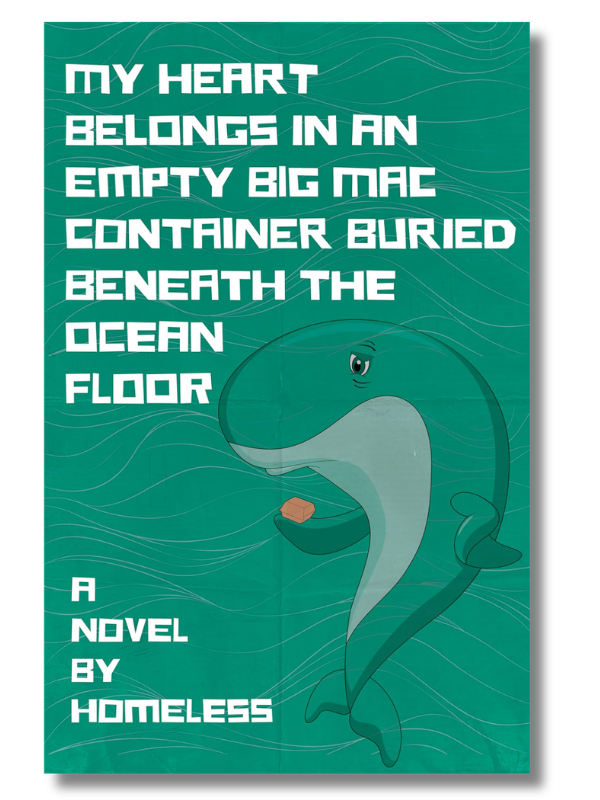
Surrealism and existentialism mix into a straightforward humor story which speaks to the problems of today.
One in five adults in the United States has been told by a healthcare professional that they have depression, according to the CDC, and the numbers keep worsening for the younger demographics. Depression will continue to find expression in stories for as long as it remains with us, which may well mean for as long as books are being written. My Heart Belongs In An Empty Big Mac Container Buried Beneath The Ocean Floor offers a valuable new portrait of depressive disorder and manages to keep despair at bay without resorting to unrealistic banalities and heavihandedness.
In the novel, Daniel is a young man at the end of his wits. We meet him floating on a boat accompanied by a sad looking blue whale. It is where he has ended up after a life full of dissatisfaction and disappointment, both his own and that of others with him.
In fact, sad looking blue whales have accompanied him for most of his life, avatars of the ever-present darkness in his mind. Is it darkness or emptiness, as the characters repeatedly tell us? And is Daniel to accept the emptiness or to finally bury his heart in a Big Mac container beneath the ocean floor, i.e. kill himself?
The Big Mac container, one of only a handful of speaking characters, stems from Daniel having his only place of solace be a Mcdonald’s, where he communes with people as beaten down as himself. The clever use of this anthropormorphic character showcases the deep originality and creativity with which the author operates from.
Another major character is Laura, Daniel’s ex-girlfriend, who we meet in the flashback chapters which alternate with Daniel’s present boating adventure in the sea of troubles. Their relationship comes across as realistic and endearing, all the more so for its failures.
Writing under the name Homeless, the author exhibits true understanding of the human experience in almost every paragraph of this book, not in a preaching tone but in an exploratory one. In discursive and playfully analytical prose, we see the working through of near universal concerns. Even though the results are not simplistically reassuring, the book’s attitude is overall deeply humanistic.
The descriptiveness of the writing is generally subdued, the most vivid exceptions being the lyrical paragraphs which often set the scene of a new chapter. These are made no less delightful for seeming a little contrived and a tiny bit out of place with the overall style. It should also be noted that the rule which wants all sex scenes in books to be awkward is dutifully followed here to a humorous degree.
The voice behind the page echoes with an originality akin to a more down-to-earth David Foster Wallace, aiming for quirky and profound and succeeding in both.







What did you think?