

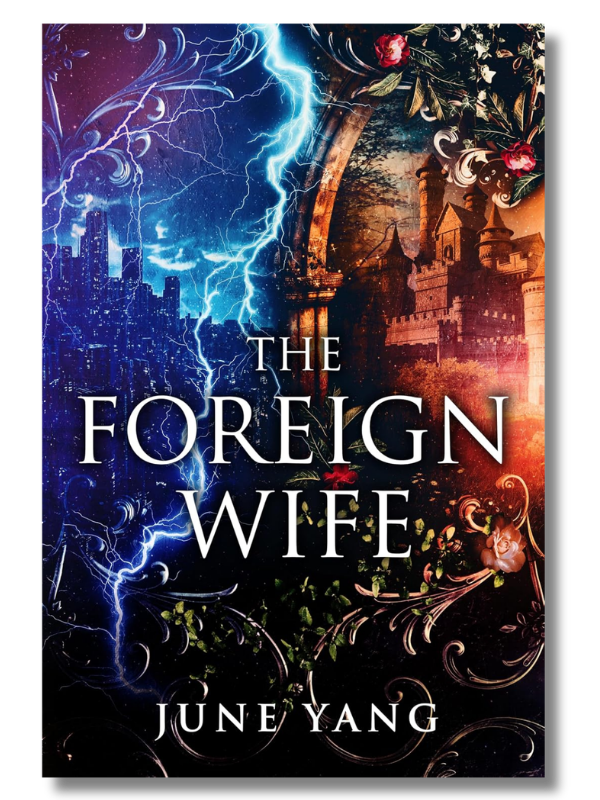
A twisted (and twisty!) traumantasy about the power of love under a tyrannical king’s violent, sex-centric rule
The Foreign Wife is a story about finding unexpectedly sweet, life-saving love that gives you hope and courage to defy a brutal regime. Author June Yang infuses this novel with breathtaking emotional reveals about the horrors in Typress, where a kingdom-wide culture of violence against women permeates every aspect of life, frequently shocking readers with its brutality. Multiple waves of trauma rip through the intimacy its characters build (in romance, brotherhood, rebellion, alliances, and friendship) when we least expect it, making readers breathlessly turn pages from its very first to very last word.
The story starts with a horrifying scene: LeeAnn drowsily exits the club where she was drugged, losing consciousness as she climbs into a cab with a driver who looks strangely familiar. We follow her kidnapper’s perspective as he carries “lifeless women” and lays them into steel boxes that transport them (alongside army weapons and modern medical birthing technology) into the kingdom through a magic portal at a secret location. “The women were carried into their rooms, and while still unconscious were fussed over by maidservants” who will “make presentable these brand new Foreign Wives of Typress.”
Foreign Wives “earn their freedom” by giving birth to a male heir, after which the king will “send you back across the portal so you may resume your old life.” As if it’s not horrifying enough, the kingdom informs LeeAnn that they know she and her fiancé, Ted, have been struggling to conceive (“The fertility issue here is not with you, my lady. Here at Typress, you will finally be able to embrace motherhood.”)
All of Typress’s princes were conceived and born under this system, including LeeAnn’s assigned husband, Prince Jochlan, who learns about her arrival when he returns from successfully conquering another village. Despite being a brilliant soldier who has been integral to their army’s success, his heart’s just not in it. He’s not into having a Foreign Wife either; LeeAnn is his first in the past five years: “You know how I feel about this,” Jochlan replies flatly when the king informs him.
“‘I demand your enthusiasm for our way of life, Jochlan.’
“‘I am grateful,’ Jochlan lied dutifully. ‘I cannot wait to meet my companion.’”
There’s not much to LeeAnn’s character outside of her role as a woman from outside Typress kingdom. We don’t know how she’s different from Foreign Wives before her (other than that Jochlan “had never in his life felt pulled towards anyone like this and he was not sure what to do”), but the story works because Jochlan is life-or-death desperate for change when LeeAnn arrives.
Jochlan’s feelings for LeeAnn inspire him to finally defy the kingdom’s norms, and his actions inspire others to do the same. Their intimacy is transformative for Jochlan:
“Before LeeAnn had entered his life, he was convinced that intimacy and duty were inseparable, and had survived by closing up his heart whenever he was physically close to someone else.”
LeeAnn is terrified, but so is everyone else in Typress—castle staff and princes alike. They live in a state of constant terror, stuck in survival-mode dissociation from a lifetime of trauma and an ever-present sense of impending doom. The soldiers self-harm, child brides attempt suicide; everyone is in “a feverish state of anxiety” where they must constantly prove their allegiance to the king. Brutal punishment awaits anyone who questions their way of life. “Do you simply do as you’re told?” LeeAnn asked. “Aye, if one wishes to survive in Typress.”
Jochlan is a consent-focused sexual partner who is passionate about LeeAnn’s pleasure and knows the violence he represents. They have frequent, sizzling hot sex, but it’s not the only sex LeeAnn has in the castle. Despite being assigned to Jochlan, LeeAnn is expected to sexually entertain and engage with any royal men who want her.
LeeAnn is assaulted by Jochlan’s cousin, who (in accordance with the king’s rules) feels entitled to every woman in the kingdom. She strikes a deal with the king himself: sex in exchange for freedom to roam the castle (“She was allowed outdoors for a daily walk in the garden, though she was barred from socializing with anyone she might accidentally meet”) which allows her to help a fellow Foreign Wife, who is secretly searching for a map back to the magic portal. And then there’s her performance for the king’s troops…
“The theatre was standing room only, and was filled with people on all three floors held back by railings. The spectators were all men and they were cheering her on, whistling and leering.”
Just when it feels like LeeAnn and Jochlan’s blossoming romance may defy their circumstances to find some kind of happiness, we learn about another horrifying kingdom ritual: Every month, “a prince and [a different prince’s] Foreign Wife would be selected at random to perform [sexual acts] for the troops.” The podium is a site of trauma for both Jochlan and LeeAnn’s assigned performance partner, Jovan; it’s another duty they perform in fear.
Jovan offers what kindness he can to help LeeAnn, promising that their performance “will be over in mere minutes.” He recommends that LeeAnn close her eyes and imagine she’s with someone she trusts. “She felt his lips on hers and she pretended that it was Ted, and it was the night after he had proposed to her.” Jovan thought of someone else, too: “Sam was a Typress guard who patrolled the landing outside Jovan’s bedchamber. He had beautiful eyes and a wonderful smile,” and years ago, he was sentenced to “an execution by gunfire” after reporting Jovan’s romantic interest in him, which Jovan was commanded to watch.
In Typress, even the king’s most prized heirs risk being publicly whipped for disobedience. But when LeeAnn is sent to the dungeon—shackled and starved, abandoned to scream for help in the darkness—Jochlan can’t find his way back to being the dutiful, dissociating prince he was before he met her. “LeeAnn had awakened parts of him that were asleep before. Her imprisonment broke something in him.”
Yang’s stunning worldbuilding offers readers opportunity for (and the expectation of) refreshing, progressive commentary on imperial rule, colonial expansion, and gender roles within the castle—especially with a never-ending cycle of independent, modern women who are trafficked in and out of the kingdom. We meet extraordinary Typress women who rebel as best they can, with kindness, knowledge sharing, and love for the children they raise: “I see beyond the limits of these walls. These are intelligent and spirited girls who will grow up to impact Xasia in ways I cannot imagine.”
Although, I did expect to see more of them after such a poignant introduction.
This novel could be a difficult read for anyone who is trying to conceive a child, has lost a child, been separated from their kids, or experienced an at-risk pregnancy or life-threatening birth experience. Typress’s royal children are raised in complete isolation, separated by gender and refused any parent-child relationship, hiding their father’s identity and banishing their mothers after giving birth.
Readers are frequently sucker-punched with devastatingly brief offhand remarks about the kingdom doctor’s work to prevent another baby’s death, with abandoned children and painful pregnancies happening in the background of Jochlan and LeeAnn’s life.
Fans of Outlander and its spinoff Blood of my Blood will enjoy this highly engaging page-turner, the first book in a planned trilogy. The Foreign Wife is filled with complicated emotions and shocking traditions. After this action-packed nail biter of an ending, readers will be ravenous for more of June Yang’s dramatic reveals, endearingly vulnerable Prince, and twisted kingdom culture in book two. I certainly am.





What did you think?