

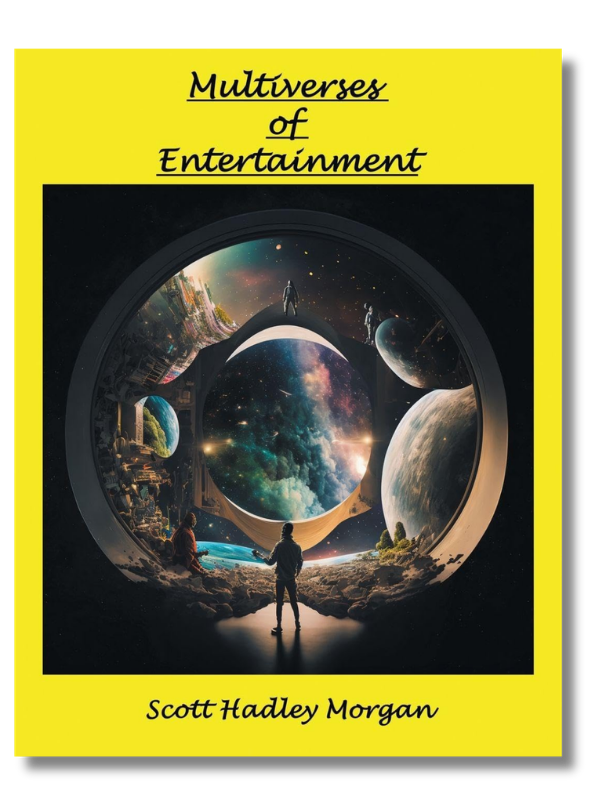
A provocative vision for saving filmmaking in the age of streaming, AI, and technological upheaval
Scott Hadley Morgan’s Multiverses of Entertainment is not a book that does things by halves. Part industry analysis, part technological manifesto, part philosophical treatise, and part ideological blueprint for rebuilding Hollywood, it sets out to answer a wide-ranging question: What happens to the art of filmmaking when an entertainment industry built around cinema collides with streaming, social media, gaming, artificial intelligence (AI), and a rapidly changing global marketplace?
Morgan’s answer is both ambitious and provocative.
Hollywood, he argues, has not simply fallen on hard times. It has lost sight of what made filmmaking important in the first place. “The Entertainment Industry died from self-inflicted wounds.” His alternative? An interconnected entertainment ecosystem in which films, technology, games, influencers, and audiences exist within a series of “Multiverses.”
Morgan’s central concern is the erosion of what he calls “The Power of Story.” For him, a successful film is about considerably more than content delivered to a consumer. Great filmmaking has the ability to make audiences laugh, cry, identify with characters, and ideally, become better versions of themselves.
The older Hollywood model may have been imperfect—Morgan certainly doesn’t shy away from its greed, corruption, and self-interest (“Hollywood isn’t just sick, it’s sick of itself”)—but it understood the value of artists and artistic collaboration in a way that today’s technology-driven entertainment companies generally do not.
His criticism of streaming is consequently much broader than the familiar complaint that there are simply too many mediocre programs available, although the thorny issue of ownership over digital media is not addressed. Morgan believes the economics of streaming have changed the creative priorities of the entertainment industry.
When success is measured primarily through data, engagement, and profitability, artistic quality becomes just another metric. “A hit film in theaters is ammunition in the war of attrition between Streaming platforms and Social Media Apps.” As such, how do you judge what is good? Is it even worth bothering?
Whether you accept every aspect of that argument or not, it is difficult to deny that Morgan identifies a genuine tension. The sheer volume of contemporary entertainment can make truly distinctive work harder to find, while the economics of production increasingly reward speed, quantity, and measurable audience behavior.
Morgan is particularly passionate about the threat posed by AI. His objection is not simply that AI may replace human jobs, although that possibility clearly concerns him. His deeper worry is that machine-generated storytelling risks reproducing the surface characteristics of successful stories without understanding the human experiences underlying them.
Morgan compares AI-generated films to “Spam or cheap wine:” they may contain recognizable ingredients but lack the taste necessary to make the finished product satisfying. Elsewhere, he argues that AI can assemble the pieces of a screenplay while missing the thing that makes those pieces meaningful to a human audience.
AI may know the rules of storytelling, but that is not necessarily the same as understanding why a story matters. This leads Morgan to one of his most interesting ideas: qualia, the subjective experience of perceiving and feeling something. For him, cinema works precisely because audiences do not merely observe films. They experience films both emotionally and physically. A machine can reproduce patterns, but can it reproduce the human response to a beautifully performed scene, a perfectly timed revelation, or a moment of genuine emotional truth? Morgan certainly does not believe so.
His alternative is the Event Horizon Film Studio and its Imagii Avatar technology. Multiverses of Entertainment describes the Imagii as a kind of “Sling Ring,” borrowing the metaphor from Doctor Strange, which is capable of opening portals between film, gaming, social media, and other forms of digital entertainment.
The concept is expansive: rather than treating a film as a finished product, Morgan wants to create an ecosystem around it in which audiences, actors, influencers, gamers, and investors can all participate. “The first-in will attain what is called “Brand Gold” for recognizing this preserves the wonderous gifts given to us human beings.”
The Imagii concept is where the book becomes most speculative. Morgan imagines interoperable avatars and interconnected applications forming an entertainment environment in which audiences can do far more than passively watch, describing the eventual technology as potentially as important as email.
That sense of scale is characteristic of the book. Morgan moves between filmmaking, physics, mathematics, economics, Eastern and Western philosophy, AI, and the history of Hollywood. Concepts such as Fourier transform, Nash equilibrium, Maxwell’s Demon, dark energy, and set theory become metaphors for explaining how entertainment systems function.
At times, this makes the book challenging. Morgan does not always pause to make his transitions easy, and his ideas occasionally arrive faster than they can be comfortably absorbed. The terminology can feel dense, particularly when scientific concepts are combined with his business and philosophical vocabulary.
Yet Morgan’s personal experience lends the book another dimension. He writes about his time in Hollywood, his work as a screenwriter and director, his dealings with agencies and studios, and his extensive engagement with Asian entertainment markets. His experiences in China inform substantial sections of the book.
These chapters are among the most commercially focused, offering a very different perspective from the philosophical discussions of art and technology. Morgan repeatedly argues that a better future requires investors, artists, and audiences to benefit from the same system rather than competing against one another.
His proposed solution is what he terms a new “Nash Equilibrium,” designed to reward actors and investors while encouraging better filmmaking. The practical recommendations include more time for production, stronger writing rooms, better casting processes, greater respect for cinematography and directing, and more equitable contracts.
But perhaps the most persuasive aspect of the book is that, beneath all the talk of multiverses and advanced technology, Morgan wants to return to something remarkably simple: human beings making meaningful stories for other human beings. “Films integrate so many arts the sheer creative energy turns it into the Phoenix of our age.”
His definition of directing captures that philosophy particularly well. “A Director simply brings out the best in people,” he writes, describing communication, trust, and inspiration as fundamental to the director’s role. This is a revealing statement because it shows that Morgan’s vision of the future is not actually anti-technology. It is anti-dehumanization.
That distinction matters. Some of Morgan’s predictions are presented with a confidence that may invite debate, and his political and cultural arguments are often emphatic rather than neutral. Those looking for a conventional, footnoted history of Hollywood will find this book a very different proposition.
But conventionality is not the point.
Multiverses of Entertainment is a book of ideas, and Morgan’s ideas are delivered with conviction. At its best, the book invites reconsideration of what entertainment is for. Is it merely a commodity competing for our attention or can it still be a cultural force capable of encouraging imagination, empathy, ambition, and moral reflection?
Morgan clearly believes the latter. Indeed, he goes further. He believes the future of filmmaking may depend upon rediscovering it. “Films shared in a theater among other human beings,” he argues, are among the best ways of counterbalancing the replacement of humanism with “data-ism.”
Morgan may not have all the answers, but he succeeds in something likely more valuable. He makes the future of entertainment feel like an issue worth arguing about. And in an age when so much entertainment is designed simply to keep us watching, there is something refreshing about a book insisting that stories should make us feel something too.







What did you think?