

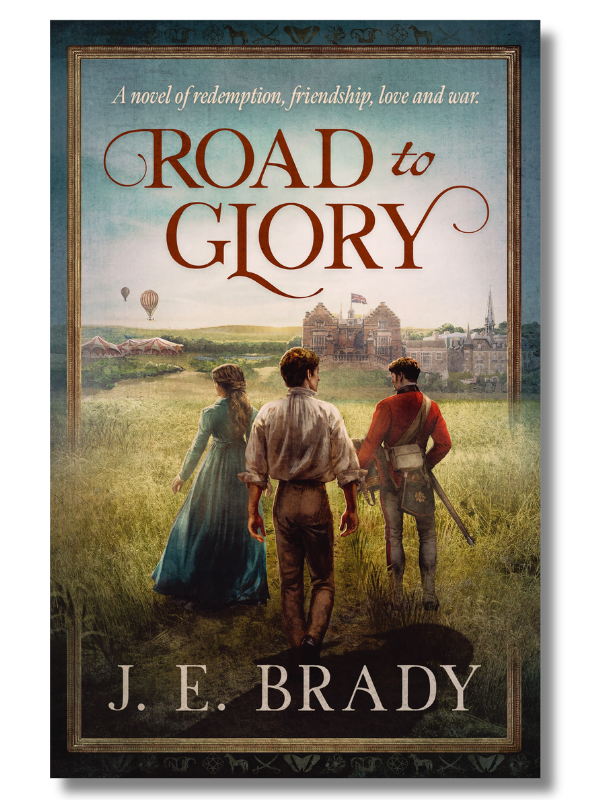
A trio of childhood friends navigate the cut-and-thrust of adolescence during the Napoleonic Wars in this richly fulfilling Regency-era Shakespeare adaptation.
Three childhood chums and their friends in 1814 England try to find their path in life during a tumultuous time of war against both Napoleon and America in Road to Glory by J.E. Brady.
In France, April 1814, Colonel Edward Talbot writes a letter to his wife, Lady Caroline, the momentous news of Napoleon Bonaparte’s abdication of power, all but signaling the end of the Napoleonic Wars with his banishment to the island of Elba.
But not even the return to Parliament and his quest to end the slave trade is enough to distract him from worrying thoughts of his sixteen-year-old son, David. David, a student at Harrow, does not follow in his father’s footsteps: he spends more time drinking, playing card games, and socializing with local ladies than preparing to follow the Colonel into politics. What can get the boy to take life—and his place in it—seriously?
This mix of episodic, comic, and Regency drama is a roman à clef that follows David and his friendships with Digby and Katie Perceval, twin brother and sister, along with an assortment of other colorful characters as the lads matriculate at Harrow College in the aftermath of Napoleon’s exile.
Interestingly, the story is loosely adapted from a William Shakespeare play (who can spot which one?), and many characters are modeled off the Bard’s own creations. Brady puts his own stamp on the narrative with his “Three Musketeer” friends coming together for fairs, balloon launches, dances, and—for the lads—a brutal nineteenth century version of Fight Club in their secret boxing society known as “Boxiana.” The atmosphere is so full it feels like you’re in it.
The crux of the story is with David and his frivolous teenage pursuits that threaten the good Talbot name. David is aware of his faults and meditates upon them in more quiet moments: “…the lack of will to fight for something in the manner of William Wilberforce or his father, he thought, was a terminal moral disease. It appeared he had contracted it.” The long, circuitous nature of the plot takes time to build, as David waits for his father’s return from France for the “talking to” he knows is coming. The novel covers the fifteen months after the end of the war and Napoleon’s escape from Elba in accurate, engaging fashion.
Brady finds more than enough content to fill this halcyon period of peace: David and Katie have eyes for each other, but it is a delicate dance that honors the mores of Regency-era relationships between men and women. Katie is a gifted violinist and seeks more from her life, searching for a music teacher who can take her skills to the next level, but she is aware of the constraints against her gender. “Her dream of becoming a travelling musician must feel always like a castle in the air in need of a foundation.”
Brady includes fascinating historical facts, such as the infamous Dartmoor Prison, where Katie and Lady Caroline go to visit American prisoners—while England is quit of Napoleon, it is still fighting the War of 1812 against its trans-Atlantic foes. To Katie, “it seemed unmade, not born of human effort but materializing of unnatural phenomena.”
As informative as it is engaging, readers will learn much about the zeitgeist of 1814 England, as well as the more finite details of life at Harrow School for students (upperclassmen were true bullies). David’s proclivities toward boxing, pranks, drinking, and oversleeping cause intriguing trouble between father and son; as the climactic meeting between them approaches, Colonel Talbot realizes “David was reaching the stage where either the disease must be healed or the tree must die.”
The story is most effective when not looking backward but forward, as Brady paints rich, authentic scenes with appropriate era dialogue and witty wordplay between David and his associates. It all leads to a satisfying ending that promises a new and exciting chapter in David’s future.
Rich in period detail, humor, and coming-of-age tension, Road to Glory rewards patient readers with a strong ending that makes David Talbot’s next chapter feel well worth anticipating.




What did you think?