

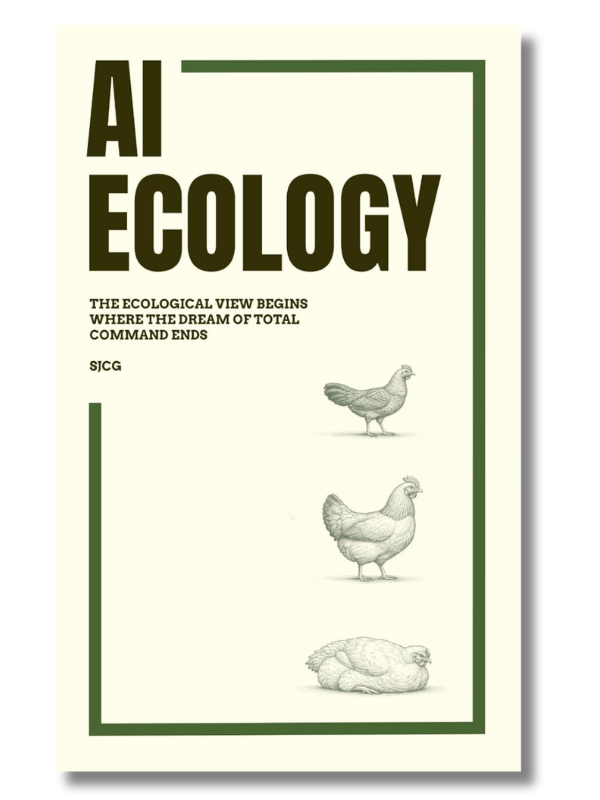
A philosophically ambitious, reader-conscious study that expands the moral vocabulary for thinking and talking about artificial intelligence
AI Ecology by SJCG is a philosophical work that rewards slow reading, not because its ideas are difficult to grasp, but because its central claims invite sustained reflection. The book resists the reductive language and familiar misunderstandings that so often shape contemporary conversations about artificial intelligence and its growing role in everyday life. Rather than offering a set of predictions destined to age alongside the technology itself, SJCG proposes a useful framework for expanding our moral and intellectual vocabulary before questions of AI, selfhood, and agency become too urgent to approach with care.
At its core, AI Ecology advances the premise that if artificial intelligence were ever to achieve a form of morally relevant selfhood, existing frameworks (particularly those organized around ownership, performance, and safety) would prove insufficient. The question then becomes about relation rather than control.
To this end, the author grounds the framework in “ecological reasoning,” which “offers a richer vocabulary than the prevailing language of AI for thinking about beings in relation — how they emerge within environments, adapt to constraints, occupy niches, alter the worlds around them, and enter patterns of domination, mutualism, parasitism, dependency, or coexistence.” By restoring those environments to the center of the discussion, the book opens a broader range of possibilities for imagining human and artificial forms of coexistence than the familiar binaries of mastery and submission allow.
Among the book’s greatest strengths lie in the way it combines philosophical rigor with an unusual degree of intellectual humility. AI Ecology challenges the managerial bias that characterizes much contemporary AI ethics, a discourse often more concerned with optimizing systems of control than interrogating the assumptions that make control appear necessary in the first place. Rather than presenting its conclusions as settled truths, the book thoughtfully places them in conversation with a wide range of philosophical traditions, anticipating objections, and remaining open to revision.
This spirit of inquiry extends to the book’s structure. Chapters unfold in careful segments—from concise postulates and accessible abstracts to more sustained developments—allowing new and returning readers to engage and apply the argument at varying levels of depth. This design reflects a sharp awareness of contemporary reading practices without diluting the work’s intellectual seriousness. Transitions between sections are especially lucid, with each movement of the argument clearly signposted so that readers are never left guessing where they are or how one idea leads to the next.
If the book presents any challenge, it is that its density (even in this intentionally scaffolded form) requires patience and careful re-reading. That said, AI Ecology ultimately emerges as a deeply teachable and forward-looking work, one that reframes artificial intelligence not as a technical problem to be solved or a new reality to be feared, but as a moral and relational field still in the process of becoming and being understood.
Individual chapters readily lend themselves to excerpting as standalone thought exercises, whether in the classroom or in broader intellectual conversation, inviting readers to test, revisit, and extend the framework on their own terms and in their own contexts. In this sense, the book is less interested in resolving the questions it raises than in cultivating the habits of thought necessary to engage them.
AI Ecology provides a rich conceptual vocabulary for engaging questions of intelligence, agency, and coexistence before those questions solidify into crises that outpace us.




What did you think?