

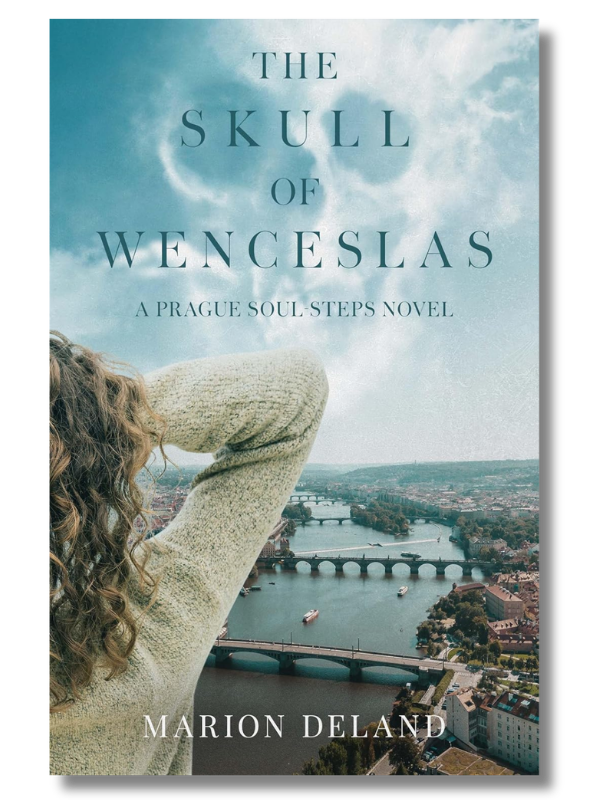
A warm, history-rich paranormal romance where the city of Prague becomes a haunted collaborator
Marion Deland’s The Skull of Wenceslas is the first book in the Prague Soul-Steps series. This novel follows Kat Schneider, a medieval literature scholar who travels from New York to Prague on what begins as a standard translation project. However, anything standard about this job quickly transforms into something much more eternal as Kat is pulled into Prague’s haunted past, where legends and history come alive and intertwine with the present.
Kat has spent most of her life hiding her gift, the Sight, which allows her to see ghosts and sense emotional traces most people miss. In Prague, that hidden gift becomes impossible to ignore. On her very first night in the city, she sees the ghosts of a knight and a lion patrolling the tower outside her window, and soon her work pulls her toward a threat tied to Czech history.
The real spell here is Prague itself. Deland gives the city weight and texture, from the Charles Bridge and Gothic towers to uneasy histories still pressed into the stone. The book walks through Prague with deep regard for its nuance: the streets, cafés, transit, dogs, food, language, and national memory in general are treated with care. The city has texture. Kat doesn’t simply arrive and understand it; she learns how to move through it. She gets lost. She mispronounces words. She works out tram etiquette, café customs, and the strange intimacy of a city where medieval architecture and modern life converge.
That attention to place is necessary to sell the book’s larger paranormal elements and give the narrative a foundation. Kat’s Sight and the ghosts it unveils work because the city feels deep-rooted enough to hold something otherworldly. “They were ghosts. I should have known,” Kat says after spotting the man and lion on the battlements. “Ghosts of a man and a lion, patrolling the battlements of an ancient Gothic tower.” It’s a clean promise: this will be a ghost story and history puzzle, but it will also be a book about how a place can make the impossible feel reasonable.
Kat is an appealing narrator because she’s smart without being airless. She can read medieval German, photograph and interpret an ancient manuscript, and think seriously about legend and translation, but Deland never turns her into a walking résumé. Kat’s a scholar, but not just a scholar. She is also jet-lagged, sarcastic, and occasionally vain about shoes. Kat’s tenderness is evident in her almost immediate devotion to Susie, the little dog who becomes one of the book’s most charming presences.
She’s also carrying the heavy weight of grief over her recently deceased Oma. As a child, Kat was mocked by other kids and doubted by adults when she talked about seeing ghosts. Only her Oma, the German grandmother who raised her after her parents died, seemed to understand. That history makes Kat’s secrecy more than a plot device. It gives her emotional weight. She hasn’t hidden the Sight because the plot needs her to; she’s hidden it because being disbelieved taught her to survive by appearing rational.
The relationships around Kat both structure and flesh out the novel. There’s Freddie, the friend who brings her to Prague. He’s loyal, funny, and open-hearted, with a romance of his own that gives his character more than sidekick duties. Mike, the client who owns the manuscript, brings necessary tension. His Czech and American roots make him a natural guide to the city, but his confidence can tip into over-explaining, which gives his chemistry with Kat a sharper edge. Queenie adds younger momentum through her art and her fierce interest in how Czech history gets remembered. Josef is an extra thread of mystery; his connection to Bruncvík feels personal long before Kat understands why. There is real chosen family energy in the character make-up.
The central romance between Kat and Mike builds around shared curiosity. They’re organically drawn to one another, but they also challenge each other’s assumptions about history, national identity, folklore, and responsibility. Their attraction works best when it stays tangled in the book’s larger questions. What does a legend owe the truth? What does a country need from its myths? What happens when the person translating an old story becomes part of it?
Deland is especially at home with the murky questions of story versus truth. During one conversation about Bruncvík, Josef asks Kat, “Do you want to tell a story or the truth?” This gets to the heart of the book. Kat is translating a manuscript, but more than that, she’s translating Prague itself: its official histories, folk tales, tourist legends, private griefs, and buried violence. The book understands that myths are not just fantasy. They are a way people protect memory, explain loss, and imagine rescue.
The plot moves from discovery into danger, with the looming St. Wenceslas Day threat giving the novel a clear deadline. The stakes grow naturally from the city’s symbolic life rather than feeling pasted on. The danger matters because Prague matters, and because the skull of Wenceslas is not just an object in the story. It represents continuity, identity, and the fragile line between reverence and exploitation.
There are places where the book could be tighter. Deland’s love for Prague is sincere, but some passages lean heavily into guidebook detail. The cultural and historical context is often interesting, yet the pacing occasionally slows while characters explain Czech customs, legends, politics, restaurants, transit, or architecture. Readers who love immersive travel writing will enjoy nearly all of this, however.
Readers looking for a sleeker paranormal romance may feel the central mystery pausing while Kat takes in one more view, meal, or historical explanation. The personal stakes are vivid; the external threat of the villain is effective, but sometimes more functional than psychologically surprising.
Still, The Skull of Wenceslas has a distinct appeal. It’s a paranormal romance for readers who want atmosphere, scholarship, history, and emotional steadiness more than gothic melodrama. The world creation is the central pleasure. Deland makes Prague feel enchanted without sanding off its modern complications. The book is affectionate, curious, and generous, with enough humor to keep the supernatural from becoming too solemn.
Readers who enjoy A Discovery of Witches by Deborah Harkness will enjoy Kat’s mix of scholarship, hidden power, and reluctant entry into a magical world. Fans of The Historian by Elizabeth Kostova will appreciate the manuscript work, European setting, and slow layering of history and menace. Readers who liked the folklore-rich historical warmth of The Golem and the Jinni by Helene Wecker may also respond to Deland’s interest in what happens when old stories walk into modern life.
The Skull of Wenceslas is a charming, deeply researched paranormal romance with a strong sense of place and a heroine whose gift finally finds the right city to answer it.


What did you think?