

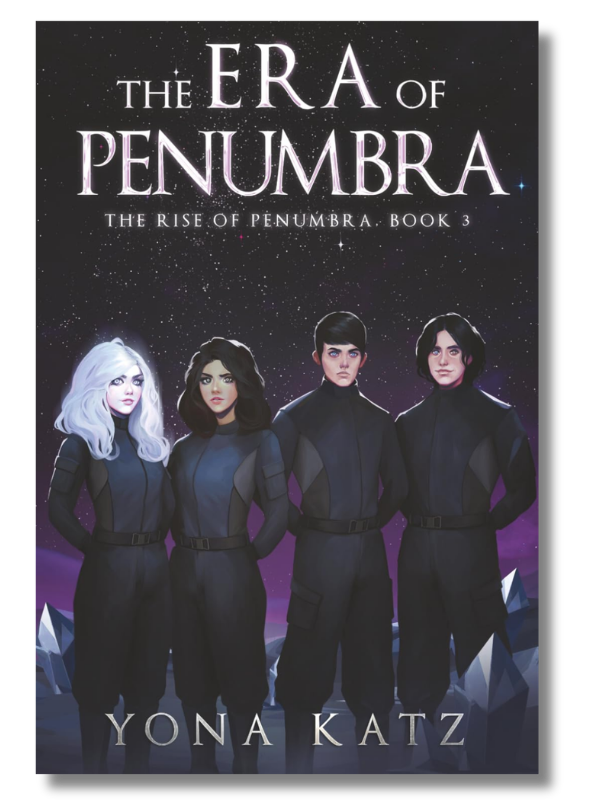
A quietly moving story shaped less by violent spectacle than by the deep-seated ache to be understood
“Once, long ago, I was in love. And I was loved.”
In The Era of Penumbra, the third title in Yona Katz’s The Rise of Penumbra series, certainty has begun to unravel for Asha, Yusra, Kadmiel, and Ranan. Faced with shifting alliances, looming war, and terrifying revelations, each is forced to confront something far more personal: love and the vulnerability that comes with it.
Taking place immediately after The Dark Mountain, Kadmiel is struggling with Ranan’s betrayal and his loyalty to Hosheh, the Dark Star, while Asha begins uncovering painful truths about the Stars and her own family. Though both understand that war between the Stars and Adama is approaching, neither truly understands what war demands. Unlike Asha and Kadmiel, Yusra understands that survival often leaves little room for innocence.
That understanding gives The Era of Penumbra a refreshingly introspective and vulnerable tone. While the previous books, The Valley of Stars and The Dark Mountain, leaned heavily into worldbuilding and conflict, Katz places relationships at the forefront here instead. Yusra’s realism grounds Asha’s idealism, while Ranan brings out an earnestness in Kadmiel that gives the novel emotional intimacy.
Of the relationships at the center of the novel, the one between Kadmiel and Ranan is easily the most complicated. Everything between them changed after Ranan left in The Dark Mountain, a betrayal that weighs on Kadmiel throughout much of the novel. Kadmiel wants the world to make sense in rigid certainties. Ranan continually complicates that. Kadmiel’s unresolved feelings leave him increasingly at odds with both Hosheh and himself, particularly as his discomfort with violence continues to grow. Though Ranan returns more wounded than before, he still finds Kadmiel easy to love.
For a series shaped by war and division, The Era of Penumbra is surprisingly gentle. That softness runs throughout the novel, from its LGBTQ relationships to the way Asha is slowly accepted within Mitkan despite representing everything its people were taught to fear. Even when characters remain divided by ideology, Katz still allows room for understanding and compassion. As a result, the novel never becomes emotionally cynical. The characters are still allowed to hope, and Katz treats that hope as something meaningful rather than naïve.
That same vulnerability reshapes Hosheh as well. In the earlier novels, the Dark Star often felt more like an idea than a person: distant, feared, and borderline overpowered. Here, Katz turns inward, focusing less on his power than the loneliness beneath it. The result is a villain who feels far more human than before—a successful turn in reader expectation.
The conclusion to The Rise of Penumbra series is more understated than one might expect given everything the fantasy series has built toward. Yet Katz’s focus remains firmly on the relationships at play, resulting in a surprising, satisfying twist. It’s one that feels impactful even if the ending arrives somewhat abruptly afterward.
And in a strange way, that quieter ending fits the series in a refreshing, meaningful way. The characters have matured, and so has the story itself. The Era of Penumbra is a moving final installment in an altogether successful fantasy series.




What did you think?