

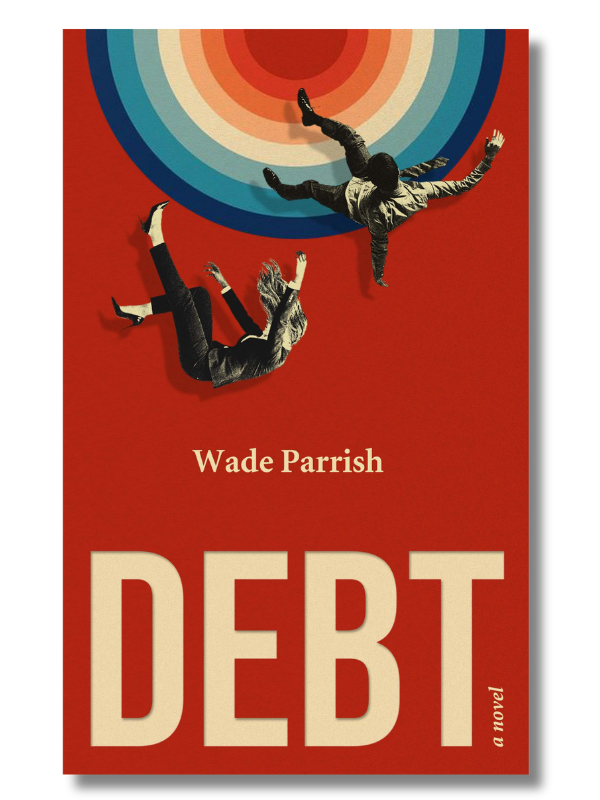
For sale: financial freedom. Price: everything.
How much of yourself would you trade to finally be free? And would it still feel like freedom when you get there? In Debt, Wade Parrish explores these questions and more through the actions and private thoughts of a high-achieving couple who would do anything to secure the life they’ve been picturing for years.
Bill and Kaelyn have it all: Harvard law degrees, jobs at prestigious firms, an apartment with a view of the Empire State Building, and marital bliss on the horizon. They also have half a million dollars in debt between them. Under the pressures of work demands, wedding planning, and financial instability, even their relationship is beginning to deteriorate by the day.
Unbeknownst to the other, Bill and Kaelyn both have one more thing going for them: a questionable—if not reprehensible—opportunity to get themselves out of the red. What unfolds is a “gift of the magi” of insidious proportions, wherein both parties secretly push the boundaries of their own morality to clear their debt and buy the life they’ve worked for at the cost of their own souls.
Debt is a conceptually ambitious novel, drawing on the technical language of contracts and legal documents to craft a narrative style that mirrors the legal world his characters inhabit. The repeated use of phrases like “(as defined herein),” along with other parenthetical insertions and structural quirks, creates a reading experience that feels intentionally clinical and detached—an effective reflection of the emotional compartmentalization required in both corporate law and, increasingly, in the characters’ personal lives.
Even more striking are the moments where sentences are struck through and replaced, offering a layered glimpse into competing thoughts and self-corrections. These stylistic choices vividly capture the idea that multiple truths can coexist, while also illustrating the often invisible ways people edit and police their own thinking. It’s less an outright analysis than an invitation for readers to sit with that discomfort. Though this formatting becomes less prominent as the story progresses, where it is prevalent, it’s executed with notable creativity.
The relatively short length and regular points of action throughout the narrative make this a quick read, while also illustrating the high pressures of Bill’s and Kaely’s work—creating an atmosphere of stress well aligned to the themes of the story. That said, Parrish does take his time in establishing context, delaying the arrival of the story’s central moral conflict.
While the narrative maintains a page-turning pace, the late materialization of the ethically fraught decisions that Bill and Kaelyn face—as well as the lack of tangible fallout from those decisions—may leave readers wishing for a deeper exploration of morality and justifiability than what is delivered.
Even so, Debt succeeds in delivering a thought-provoking meditation on modern pressures—financial, societal, and internal. It taps into a very real anxiety about the cost of “success” and the quiet ways people justify their choices when faced with overwhelming expectations. Parrish’s willingness to experiment with form and perspective sets the novel apart, and while not every element lands with equal weight, the core ideas linger.
Ultimately, Debt is less about the specifics of what Bill and Kaelyn do and more about why—and that question, uncomfortable as it is, feels both timely and worth considering.



What did you think?