

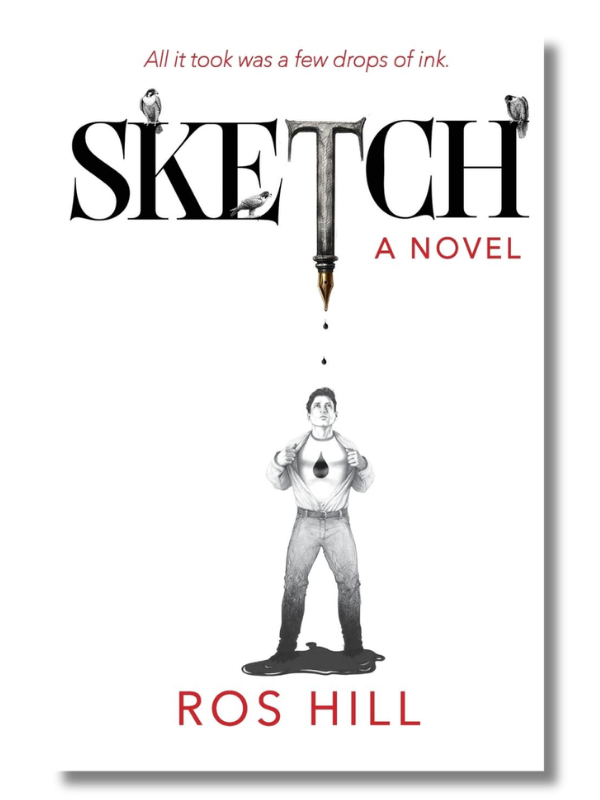
A fun fantasy about magic ink and a superhero’s fight to save the world from the evil Finger Gunman
It all begins in Ancient Egypt in 450 BC. Kepri, an artist chosen by the sun god Ra to possess magic ink, sees three falcons circling overhead, then six, then more, moving in a spiritual trance. When his bowl of ink begins to shake, he realizes Ra has anointed it. He tries his hand with the ink to see what happens, and after he draws a queen and wills her to live, Heba magically appears beside him. This is how Heba and her dog came to be as eternal beings: through the magic ink of an anointed artist.
Centuries later in the 1960s, Charles, an artist who posses the innate qualities necessary to will the magic of the ink, visits Egypt. While selling woven baskets in the market, Heba watches the artist closely to see if he shows signs of empathy and care. When Charles consoles a young girl who’s crying in the market alley, Heba realizes Charles might be the person she’s been waiting for—not only to create eternal beings with the ink but to create a superhero who will save the world from evil.
Pretending to be a French tourist, Finger Gunman shows who he is to Charles that day. As Charles questions why he acts so rudely to the young girl who broke her mother’s glass, Finger Gunman replies, “I will one day unleash a fury upon everything I detest. But since I’m confident you can’t wrap your brain around that, then I am certainly wasting my time talking to you.” Little does Finger Gunman know who exactly he’s talking to, the creator of a superhero who will fight against him.
After drawing a sketch about the young girl in her guestbook, Charles passes Heba’s test and is given the magic ink. With strict instructions to never tell another soul about the ink, even his pregnant girlfriend, he flies home to the United States, and there, he sits down to create a superhero.
Willing all his energy into the sketch—which is actually very little due to fatigue—Charles creates Sketch, who magically appears next to Charles as he’s sleeping. Sketch hears fireworks and mistakenly believes the explosions are from the Finger Gunman.
Propelled by magic to fight evil, Sketch runs to the explosions, only to find out they’re Fourth of July fireworks. Hilariously, in front of the police, he tries to fly while wearing his superhero costume, only to faceplant in the grass.
This discovery leads Sketch and Charles to question next steps: “So, what did happen to you?” asked Charles. “I did everything I was supposed to have done, specifically willing you to be a superhero, but you’re no different than me.”
Through trial and error, they learn that Charles can trace the lines of his drawing with magic ink, and Sketch gains his powers to have unnatural strength and the ability to fly.
Amazingly, when Charles flies to see his girlfriend in the hospital, the plane’s wing breaks. In a split-moment decision, Charles takes out his sketchpad and draws Sketch flying and holding up the airplane. Sketch knows instantly that he must save the plane, so he does: “The plane was spiraling toward the earth, nose down…with a broken wing, and the pilots said something lifted it up, leveled it, and took it in for a landing. But no one believed them. No one knew what to believe. The only thing the passengers knew for certain was that they survived.”
Even then, while Sketch is able to save an entire plane from crash landing, he inevitably can’t save Charles from a terrible accident. Charles passes away, and with him, Sketch’s powers are lost.
While Sketch continues to live—with ink through his veins instead of blood—he must start all over again if he wants to have his superhero powers. He bides his time, believing he will never again have powers, until one day in the early 2000s when he meets Sid, Charles’s grandson. And it’s from that point on that Sketch must try to regain his powers to fight Finger Gunman and save the world.
This would be a great choice for comic and mythology enthusiasts. It blends a serious story about good and evil with a light, humorous tone. The part where Charles constantly has to cover up for Sketch’s superhero abilities is funny, with this conversation in particular bringing a chuckle:
“‘Morning, David,” said Gordon, “How was your walk?’
“‘My walk?’ Sketch looked at Charles who stared at him with big eyes. “Yes. Charles said you were walking.’
“‘Oh, yes…sorry, misunderstood. Yes, I just got back.’
“‘How far did ya go?’
“‘To Missouri. Did you know the Saint Louis Arch is as wide as it is tall? And what a view!’”
Even then, some of the story can feel a little forced without true confrontation with Finger Gunman until past the halfway mark. A lot happens, including jumping thousands of years, with Heba and the magic ink; however, more is wanted in the first half of the story about Finger Gunman and the evil he’s stirring. It’s alluded to when Heba warns Charles, “He is of no good, thriving upon evil. When willing the superpowers into your drawing, you must also will the knowledge of the threatening existence of the Finger Gunman.”However, most of the first half is about Sketch finding his powers instead of bringing in that superhero/villain tension we’re looking for.
In the end, young adult readers have a lot to enjoy in this creative, mythologically rich superhero story.



What did you think?