

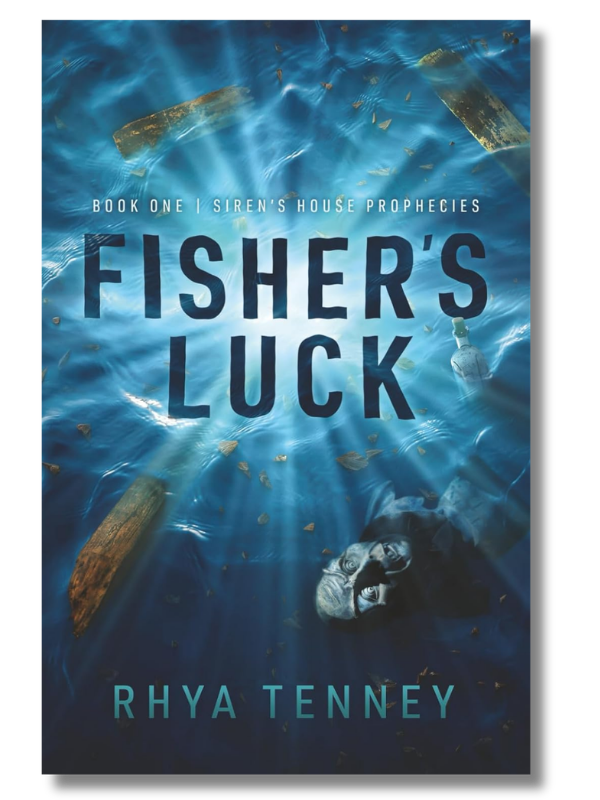
“Hauntings or hallucinations?” asks this surreal, sleepless mystery for fans of Caddo Lake, Bodies, and seaside towns swirling with paranormal activity
Fisher’s Luck is both dreamlike and doomed, a haunted woman’s history intertwined with her family’s haunted house. It’s the literary equivalent of watching a new episode of a familiar TV show and noticing that something’s off-kilter: You’re sure the characters must be in a dream, a flashback, or a fantasy, but you have to keep watching to find out.
Laurel has a long history of hallucinations and a traumatic childhood that her therapeutic hypnosis sessions are bringing to the surface. When she visits the mansion her family owns—and the beach where she nearly drowned as a child—for her cousin’s wedding, her hallucinations are suddenly amplified.
Set in a seaside town that cozy mystery readers will adore, Fisher’s Luck has beachcombing guild lore, generations of local gossip, and hidden pockets of paranormal activity everywhere Laurel turns. Readers are fully immersed in her unsteady sense of place, time, and truth, where nightmares bleed into the edges of reality, and strange things catch your eye and pull on your soul, but disappear when you turn around to look.
The family house, which operates as a bed-and-breakfast, is being assessed for paranormal activity when Laurel arrives. Her aunt is delightfully pragmatic about hiring the ghost-detecting team, hoping for a simple solution to banish whatever spirit is affecting their five-star review status. This is how Laurel learns that her memories of feeling watched in this house and seeing people in the windows of unoccupied rooms have been mirrored in reviews from guests who stayed at the property. Her aunt is alarmed, asking Laurel, “‘Why didn’t you say?’
“‘Would you have believed me?’”
It’s true, but not unkind to either party. Laurel’s family is remarkably comfortable discussing her hallucinations—without judgement or stigma. Fisher’s Luck is the most relatable depiction of a family that’s lovingly-familiar with long-term mental illness I’ve ever read. Author Rhya Tenney’s expertly-crafted eerie mood balances precariously alongside Laurel’s grip on reality as she juggles clues and conversations with ghosts to maintain a facade of normalcy.
But the situation is bigger than their haunted house; “the whole shoreline has erupted with paranormal activity.” As wedding plans progress, more guests report sleepless nights filled with nightmares, out-of-body experiences, and unidentifiable sounds in hallways.People all around town are disappearing, waking up with strange injuries, falling into comas and, by some “fantastical coincidence,” having the same dreams—though for some, they’re more like “adjoining nightmares.” There’s a vivid sense that things are falling apart in slow-motion, so beautiful and bizarre that everyone stops what they’re doing to watch. Dreamlike scenes drenched in sea motifs are made captivatingly complex by Laurel’s long history of hallucinations. Wall art from Laurel’s therapist’s office talks to her while she’s at the beach; mysterious spirits appear to Laurel with warnings, mistaking her for someone else; photos come to life as memories she can walk into and get lost inside.
“Laurel closed her eyes, counted to three, and opened them. Nothing had changed. So, not a dream. A hallucination, maybe? He wasn’t frightening her, so why not chat a bit? Find out what her mind was trying to warn her about—her mind, no doubt. “So, what is this warning?”
Laurel is comfortably detached from reality, but the paranormal activity has her suddenly wondering if her visions are hallucinations or hauntings. Could she be a Seer meeting spirits from other realms, or is her mental health simply fracturing? Quietly determined and losing sense of time and place, she feels compelled to correct the paranormal disharmony. If not to rescue the wedding ceremony, to understand the messages behind her hallucinations. Tenney reflects a deep understanding of (and compassion for) Laurel as an unreliable narrator. I frequently felt overwhelmed by waves of emotion about the care and consistency written into Laurel’s mental health troubles. Her internal dialogue is an endless sea of mental math to determine symptoms from reality. It’s an accurate, insightful representation of a coping method many readers will be familiar with.
“I almost drowned once,” she blurted, unsure why. “Right here.”
“I know,” he said. “I think that’s why my mind is conjuring you now.”
One of Fisher’s Luck’s most intriguing storylines follows a spirit who appears to Laurel but believes that she has appeared to him. He recognizes her as the girl who was rescued from drowning. He was on the beach that day, but there’s a deeper connection. Both characters have traumatic pasts (he was catastrophically struck by lightning as a child) that corrupted the reliability of their memories, making it difficult to navigate their shared history. The author strategically deploys shocking reveals like a well-timed wave, slowly building a sense of dread from a direction we aren’t even watching, knocking us off our feet and leaving us to tread water, gasping for air as we recalibrate reality.
Late in the novel, a sharp, unexpected turn takes this moody mystery into sci-fi conspiracy territory and feels slightly disconnected to the story, devoid of its dreamlike magic. Readers may be turned off by this twist (or, like me, find themselves losing interest in new characters), but Fisher’s Luck does return to itself with all the heart and intrigue we’ve come to love.
Fans of the time-loop murder-mystery show Bodies (especially if they liked its time-machine conspiracy twist) and missing-person thriller Caddo Lake will be captivated by Fisher’s Luck. It’s perfect for readers who can’t resist diving into haunted histories and can’t get enough of dark mysteries set by the sea. If you were entranced by the Dead Boy Detectives entering the nightmare memory-loop of a haunted family home and the representation of the mind as a physical place to unpack memories in The Flight Attendant or Locke & Key, you’ll love spending time with Laurel. This book is for readers who believe that a historically unreliable, potentially unhinged woman who trusts herself to save the day may actually be onto something—and would follow her to the edge of the world even if she isn’t.
Laurel finds her way back to the ominous beach setting of her cousin’s all-but-abandoned wedding, where Fisher’s Luck ends on a full-circle note that had my heart soaring and my fingers frantically typing to search for the sequel. There are intriguing unanswered layers to the problems Laurel solved and the lives she saved, but more than anything, I can’t wait to reunite with the strange, passionate misunderstood residents of this seaside town, who charmed me and captured my heart. Do yourself a favor and let the siren song of Fisher’s Luck lure you in.


What did you think?