

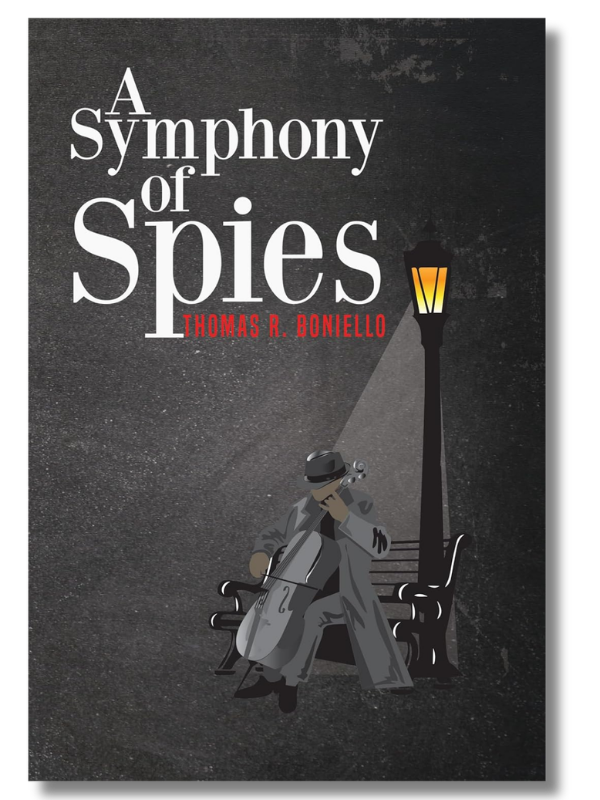
When a subatomic physicist with an unusual psychiatric condition tells one too many secrets, his college roommates face threats of espionage in this snappy take on spydom.
A friendship between three young men at an American college—one of them a renowned Russian cellist—leads to unforeseen and high-level international intrigue with the CIA in A Symphony of Spies by Thomas R. Boniello.
At The College of the Sentinels, freshman roommates Jefferson Nash and Slava Svyetnakov play cello in the school’s symphony, while awkward third wheel and “generational intellect” Drew Reid round out the trio of friends. Reid is a student in subatomic physics who also moonlights as a government intern working on a secret project. Only one problem: he cannot stop himself from sharing information that violates his non-disclosure agreement with the Feds. Suffering from a strange disorder called “limerence,” he overshares information about himself and others to build relationships.
Meanwhile, in Washington, D.C., CIA analyst Elizabeth Orr—who specializes in diagnosing international banking transactions and red-flagging passages of monies in and out of Russia—produces an illicit algorithm that her boss, CIA director William Kerrigan, understands can shift the playing field and end the flow of rubles into the U.S. to influence and interfere with the nation’s institutions. After all, “the battlefields of war had become electronic.”
One of these suspicious cash flows points to a Russian ex-NHL player coaching college students in Massachusetts, namely Svyetnakov and Reid. It becomes critical to stop Reid from divulging his knowledge and ingenious solutions around his top-secret semiconductor work from his friends. Nash becomes the hinge to handle Reid and keep his limerence from jeopardizing national security. What could go wrong?
Moving backward and forward through time, the story includes some fascinating if sometimes indecipherable geopolitical financial subterfuge and emphasizes symphonies, cellos, and musicians—a fresh note in a novel about espionage! Many characters have experience with instruments; one even finds that “the elongated necks and curved bodies of the suspended violins and violas spoke a sensual language…”
The paper trail of money tied into top-tier symphony instruments and the generational talent of Svyetnakov is an intriguing plot point, but some info dumps become too complicated to track. The frequent changes in point-of-view can feel confusing, especially when it becomes clear that Reid is telling his story to FBI agents. His claim that limerence allows him to share information of events and conversations outside of himself does not exactly pass the sniff test, however, and the reader must accept this dubious ability on faith.
Though the book dust jacket makes Reid the focus, it is Nash who plays the biggest part as his friend’s handler and confidante. He is somewhat infatuated with Svyetnakov—they share a bedroom in their college suite, which raises eyebrows—but this is portrayed as more of an aspirational connection, since Nash plays second cello to Svyetnakov’s first and learns from his friend that “to make the same error is to betray a problem bigger than yourself.”
While the relationship between Nash and his Russian prodigy friend includes a love triangle with a female musician, the reader doesn’t find out the real focus of Nash’s romantic attachment until the surprising conclusion. What does hold interest is the longer sections on the intelligence services and how it operates. Orr is a well-drawn character with quotable insights into the cloak-and-dagger world she belongs to: “In the opaque world of spycraft, [she] knew that clarity had value, and could be exchanged for indebtedness.”
It is the unusual marriage of music and spy vs. spy shenanigans that propels this narrative, posing the central question: “What was it about cellists that separated them from other musicians? A resilience? A reliability? A savoir-faire about them that made them natural go-to’s for a certain kind of espionage?”
A Symphony of Spies offers a whip-smart take on how music can hide the biggest secrets for those discerning enough to hear them.


What did you think?