

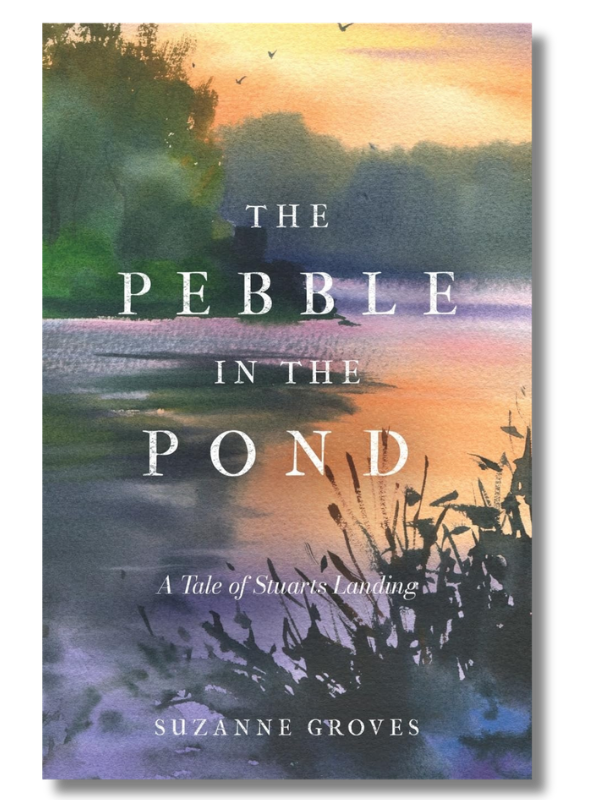
A nuanced exploration of love, loss, and the quiet resilience required to rebuild a life from fragments
The Pebble in the Pond tells the story of Miriam Llewelyn’s return journey to Stuarts Landing, a place where she has deep roots but doesn’t fully understand. Prompted by her grandfather’s dying wish, the story evolves into a rediscovery of love, family, and identities suppressed by grief.
On arrival in Stuarts Landing with her husband George, she quickly learns that her grandfather’s name is not well regarded in the town, forcing her to conceal her connection to him. From there, the story expands into the world of the women who shape Stuarts Landing, particularly the rivalry between Louise Caldwell and Bitsy Butler, and how these women subtly influence belonging, identity, and status.
The book is an exploration of what loyalty, friendship, courage, and identity look like when genuine sincerity meets carefully constructed social hierarchies.
When Miriam and George arrive in Stuarts Landing after losing their business and home, they have to start over with very little. Miriam looks for work and tries to integrate with the women of the town.
Bitsy Butler introduces her into this circle, though it quickly becomes clear that acceptance in Stuarts Landing is layered and conditional. Louise Caldwell, in particular, takes an interest in Miriam, not out of kindness, but because she sees how Miriam might be useful in maintaining her own social standing.
At the same time, Miriam begins to uncover pieces of her family’s past. A key turning point comes when she discovers a connection to Iris and Rose Webster, the two eccentric sisters who had earlier taken her in. This discovery begins to shift her understanding of her identity and her place in the town, even as the social tensions around her continue to build.
The characters in The Pebble In the Pond contribute greatly to an overall richness in atmosphere. Each character feels like they exist beyond the immediate story here. Miriam has immense strength. She is open, unassuming, and sincere, but not naive. Her steady nature allows her to navigate the unfamiliar and often hostile spaces without losing herself.
Louise Caldwell is another standout. Her need to maintain control and status, especially while dealing with her daughter Emma, adds layers to her character. She is not simply antagonistic; rather, she is driven by internalized pressure, expectation, and fear of losing her place.
Bitsy Butler brings a different kind of energy. She exists within the same social structure as Louise but is more flexible, more open, and sometimes unpredictable in her loyalties. Through the Webster sisters, the book begins to stretch across generations, showing how the past continues to shape the present.
And the dialogue surely helps with this characterization. Conversations feel natural but also carry real tension. Many scenes work as small, self-contained moments that reveal character, relationships, and underlying conflicts. The suspense is not loud or dramatic, but it is consistent. Questions are raised gradually, and even as the story progresses, it is not easy to predict.
Stuarts Landing is not just a backdrop; it shapes behavior, relationships, and even identity. Social expectations are deeply tied to place, and much of the tension in the book comes from how individuals either conform to or push against those expectations.
The Pebble In the Pond is an easy match for book clubs who are interested in relationships, reputation, and history in small towns. It’s a thoughtful, women-centered narrative that adeptly explores identity through family and social structures.




What did you think?