

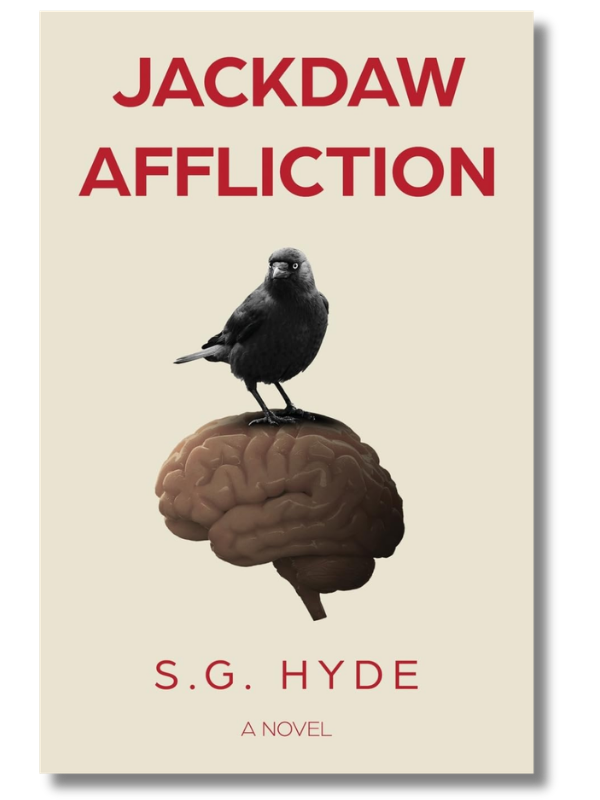
A deeply intimate novel—a devastating portrait of love, memory, family implosion, and all the good and bad we inherit
“Cycling is what I did. Part of my DNA. For years it was Becks and me together pedalling all over the land by the pond. Exploring fields down to Church Crookham, finding shacks and building sites. For her it all stopped when she got into her mid-teens, after the car incident. Not for me though, it’s always been my freedom. My thing.”
Jackdaw Affliction begins with Billy and his family in the small English town of Fleet. He and his sister, Becks, live a carefree childhood of bike rides and small adventure about town.
However, this slowly collapses in a series of traumatic events—their father’s drunken friend dies before their eyes as he’s playfully pushed around in a wheelbarrow; Becks is hit by a car on one of their bike rides, setting the stage for a break from the family and estrangement; shortly thereafter, their mother dies of a heart attack.
Billy’s own life takes shape when he moves to London, becomes a bike courier, and finds a partner in Cate. The emergence of a rare degenerative disease that his mother may have had, ataxia—first as fatigue and then a degenerative loss of mobility—reshapes Billy’s life and puts new strain on his relationships and sense of identity.
“They’d got it wrong. Nothing wrong here. Just a few migraines, auras, whatever. I’m fine. Always been fine.”
A sharp, observational voice carries the novel from start to finish with prose that renders Billy’s environments, mental state, and youthful excitement with equal skill. There’s a granular precision to how details accumulate and dialogue is rendered that brings emotional weight without heavy commentary.
Hugely significant scenes, such as Billy and his father discussing ataxia, are explored with crisp, unsentimental dialogue that captures the flow of speech while gesturing at a relationship’s churning depths. The structure of the novel takes full advantage of this linguistic prowess, moving through myriad sections that zoom in on specific moments and time periods. This allows for sharp juxtapositions and leapfrogging between significant events without dwelling on moments in between. Early on, the book moves quickly between a funeral, a house in mourning, a big move to London, and the discovery of a new group of friends—each subject gets its own section with the pace mirroring the headlong quality that youth often has.
“Waking up next to Cate, I had an enormous sense of peace and gratitude. After she returned from fixing a cup of tea, I had an overwhelming feeling of being neglected. ‘You were away too long. What the hell are you doing bashing around downstairs?’ The next day, the exact opposite. Waking up with hatred and murder in the heart, only for it to leave within an hour.”
The book uses music as a temporal marker as it moves forward, often titling sections with significant songs Billy is listening to in the period. While the songs themselves are not always described within a chapter, they create an additional layer of texture for the story, capturing a mood—such as Eminem’s “Stan”—or thematic event—such as The Clash’s “London Calling.”
Still, what comes through is how deeply the book is invested in Billy’s perspective. The fact that other characters’ standalone sections are rendered in the third person often makes these parts of the book feel like interludes, moments stolen from Billy’s perspective. They deepen the narrative and give a broader sense of the world Billy is moving through, but never feel quite as deeply illustrated or compelling as Billy’s sections. This is also a testament to the power of Billy’s voice in the book. His observations—whether about family, the brutal physical symptoms of ataxia, the people around him, or starting a food truck business—are kinetic and, even in the darkest situations, have a charismatic power.
“Chances were 1 in 50,000. That’s what they told me. You’re more likely to get struck by lightning. I’d rather have won the lottery.”
A bitingly honest portrait of illness, tragedy, and love over the course of a lifetime, Jackdaw Affliction captures how we move through the world, slowly accumulating griefs, making room for them, and still finding reasons to continue onward.




What did you think?