

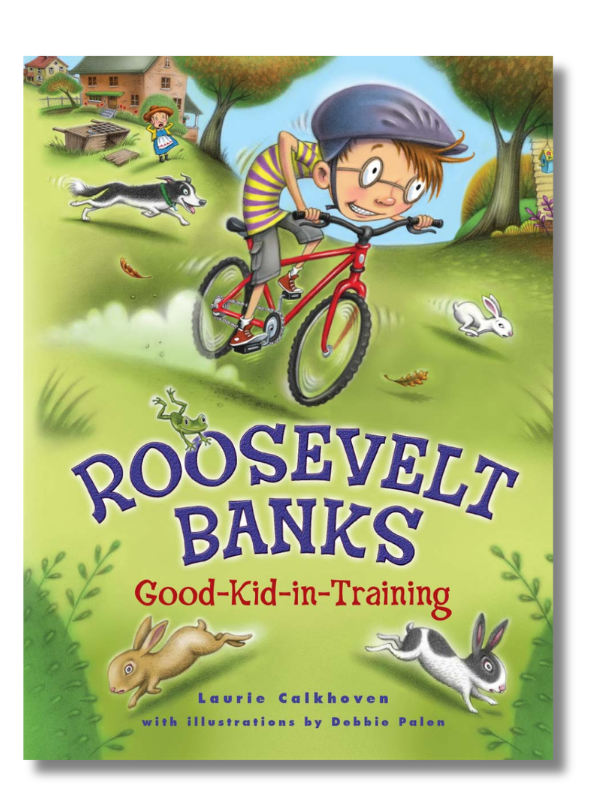
Some kids try to be good. Roosevelt Banks negotiates with the concept like it’s a contract he might be able to loophole.
Laurie Calkhoven’s Roosevelt Banks: Good-Kid-in-Training drops readers straight into the mind of a fourth grader whose moral compass works—but only after a lively internal debate.
Roosevelt isn’t a “bad” kid in the traditional sense; he’s impulsive, imaginative, a little chaotic, and deeply attached to his friendships. When those friendships are threatened by something as simple and devastating as not having a bike, the stakes feel enormous in a way that is both funny and emotionally precise.
The premise is clean and effective: Roosevelt’s two best friends are training for a bike-camping trip, and he’s left out.
His parents offer a deal, stay out of trouble for two weeks, and he can earn a replacement bike after destroying his previous one in a wildly ill-advised science experiment. It sounds achievable. It is, of course, not. What follows is a steady unraveling of what it actually means to “be good,” especially for a kid whose personality runs on curiosity, humor, and a mild disregard for authority.
Calkhoven’s greatest strength is her control of voice. Roosevelt narrates with a blunt, observant honesty that never feels manufactured for adults looking in. He’s self-aware but only to a point; reflective, but still very much a kid. When he admits, “Let me tell you, being good is H-A-R-D hard,” it lands because the book has already shown us exactly why. Goodness, in Roosevelt’s world, isn’t just about behavior; it’s about suppressing the very instincts that make him fun, social, and himself.
The humor works because it’s rooted in character, not gimmick. Roosevelt’s running commentary on adults is both ridiculous and completely believable. His logic is often flawed, occasionally brilliant, and always entertaining. Even his worst decisions, like the infamous gum “booger” incident, are driven by a very real desire: to prove he’s still interesting, still funny, still worth choosing.
Underneath the comedy, the book is quietly doing more serious work around friendship dynamics and childhood insecurity. Roosevelt’s fear isn’t just missing a trip; it’s being replaced. That anxiety threads through the narrative in small, telling ways, especially when he wonders if his friends might find someone “more fun” than him. The introduction of Eddie Spaghetti as a potential replacement isn’t heavy-handed, but it sharpens the emotional stakes. Kids will recognize this immediately; adults will recognize it with a wince.
What’s particularly effective is that the book never turns Roosevelt into a moral poster child. He doesn’t suddenly become disciplined, patient, and serene. Instead, he learns in increments, through near-misses, small wins, and a growing awareness of consequences. The message isn’t “be perfect.” It’s closer to: try, fail, adjust, repeat.
The writing is intentionally accessible but never dull. The simplicity is doing real work here; it mirrors Roosevelt’s thought patterns and keeps the pacing tight and engaging for its intended audience. Debbie Palen’s illustrations complement this tone well, adding visual humor and warmth without overwhelming the text.
By the time the story settles, what lingers isn’t a lesson neatly wrapped in a bow, but a character who feels fully alive on the page. Roosevelt is frustrating, funny, vulnerable, and deeply relatable—a kid caught between who he is and who he’s being asked to become.
This is an excellent choice for middle-grade readers who appreciate humor with emotional bite, especially those navigating friendship shifts, fairness (or lack thereof), and the exhausting effort of trying to get it right. Calkhoven doesn’t just tell a story about being good. She makes a compelling case for how hard and how human that effort really is.




What did you think?