

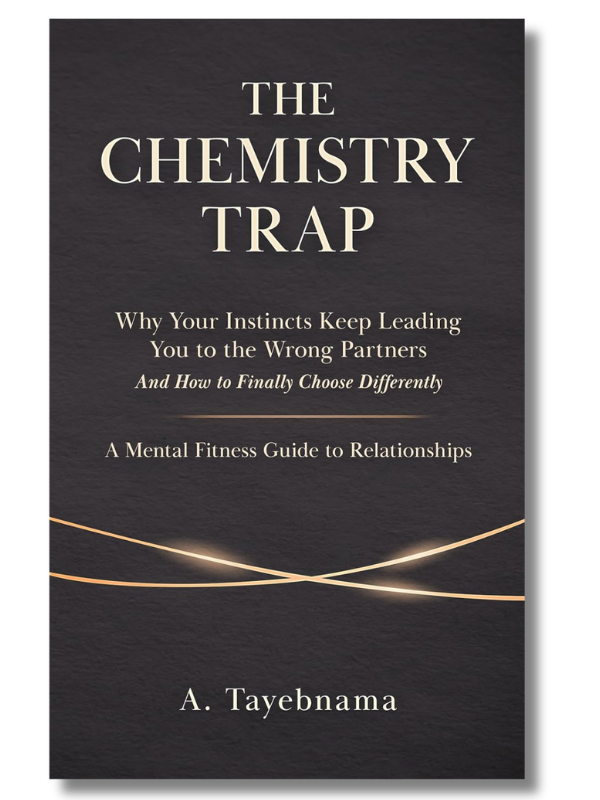
A practical guide that challenges the romance narrative by arguing that intense early attraction often misleads rather than enlightens
Tayebnama’s The Chemistry Trap argues that the electric pull some people feel on the first date or first encounter is often the exact signal we should question most carefully.
Tayebnama, a researcher who traveled across more than eighty cultures studying relationship patterns, presents a thesis that feels counterintuitive in modern romance-saturated culture. The book distinguishes between chemistry (the immediate spark, the overwhelming attraction) and compatibility (shared values, aligned life visions, the ability to navigate conflict constructively). The central claim is stark: fire is not compatibility, and what most people dismiss as “not feeling it” might be precisely what is worth building on.
The framework draws heavily on ancient wisdom traditions. Tayebnama explores the Indian concepts of Kama (desire) and Dharma (duty/righteousness), Greek philosophy on virtue as practice, Daoist teachings on what cannot be forced, and Stoic principles of creating space between impulse and action. These threads weave together to support a modern psychological argument backed by research, including Ted Huston’s PAIR Project, which found that intense early romance does not predict long-term relationship satisfaction.
The book’s greatest strength lies in its practical structure. Each chapter includes “Mental Fitness Check-Ins”—self-assessment questions that build toward a final “Chemistry Trap Score.” This transforms abstract concepts into actionable self-awareness.
Tayebnama writes with clarity and precision, avoiding the breathless tone of some relationship advice talk. The prose maintains philosophical weight while remaining accessible: “Chemistry tells you something is happening. It does not tell you what it means.” The distinction between information and interpretation runs throughout, creating a useful cognitive framework.
The personal narrative adds credibility. Tayebnama positions himself not as a therapist dispensing prescriptions but as a researcher sharing patterns observed across cultures. This anthropological lens gives the work breadth beyond typical relationship literature. The chapter on building attraction with someone who “doesn’t light you on fire” offers particularly valuable guidance for readers trapped between intellectual understanding and emotional conditioning.
The main limitation emerges from the book’s brevity. At just over 100 pages, it functions more as manifesto than comprehensive guide. Some readers may find the chemistry-versus-compatibility dichotomy oversimplified, missing the nuance of relationships where both elements coexist. Additionally, while Tayebnama acknowledges and explores cultural diversity in his research, the actual analysis remains fairly Western in its assumptions about individual choice in partner selection.
The Chemistry Trap succeeds as an entry point for readers recognizing destructive patterns in their relationship choices. It offers no quick fixes—Tayebnama explicitly states that “patterns built over years do not dissolve overnight”—but it provides a vocabulary for understanding why certain attractions feel so compelling yet lead to disappointment.
For anyone who has ever confused intensity with intimacy or mistaken nervous system activation for destiny, this book offers a framework for choosing an enlightened path. The wisdom here is not that passion is wrong but that it makes a poor foundation when mistaken for the entire structure.




What did you think?