

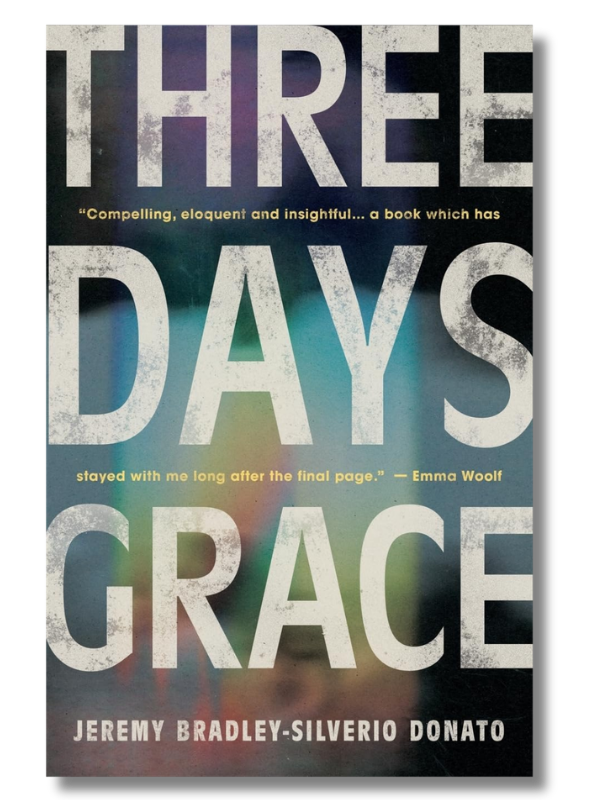
A quiet novel on trauma, loss, and the way secrets both kept and shared have long-lasting ripple effects
Three Days Grace is an intimate glimpse into the life of Nick, his mother Lynne, her wife Susan, and the tangentially connected Laslo and Marco.
When the story begins, Nick is summoning the courage to meet all four for dinner while Lynne and Susan are in town just before they fly to South Africa. During their temporary stay, they invite Nick, Laslo, and Marco to dinner.
But Lynne has a secret—something she’s keeping even from her wife. Her ex-husband, Nick’s father, died that morning and she’s the only one who knows. This secret holds the weight of more than just grief but years of abuse for Nick, the absence of Nick’s brother Jason who committed suicide, and the weight of silence.
Before dinner, the group is awkward, tense, feeling the distance between Lynne and Nick as a physical presence in their hotel room. At dinner, they perform a complicated dance between the members, Laslo and Marco trying to cut the tension that Lynne, Susan, and Nick carry.
Then, suddenly, Lynne lets the secret out at the dinner table, creating a chaotic scene that ends with Nick storming out of the restaurant and the others going their separate ways. What follows is glimpses into each character, mostly Nick, in the aftermath of finding out his father died. More secrets are soon revealed that bring new pain to layer on top of the pain already there.
Three Days Grace is a slow-burn, internally turbulent novel about familial trauma and its lasting impact, illustrated effectively through character dynamics over the span of only three days. The writing style drips with meaning and emotion, with a distinct and sharp pain that reflects exactly what the protagonist is feeling. Nick is reeling from finding out his father died, not feeling the closure or relief he thought he would, but instead stuck further in the past as he re-lives his childhood with his abusive father. He is still hurting over the fact that after years of abuse, his mother sent him to live with his aunt without acknowledging the abuse at all.
The character dynamics are complicated, shifting each minute as each person performs, hides, or opens up to the other. Nick is hurt by his past and how his mother failed him, hiding behind the imagery of sophistication and disinterest while simultaneously craving love, seeking it out in his mostly cold mother or in men who don’t treat him kindly. Lynne has no idea how to talk to or care for her son and regrets the past but also won’t bow to admitting she was wrong. She wants a relationship with him but can’t work out how to create one in light of the history between them.
As Nick comments in the book, they are buried under years of layers of “filtered truth” until they can’t find the reality beneath it. Those orbiting them, Susan, Laslo, and Marco, serve as counterpoints, as ways to expose more truth in the past, but also as people further complicating an already impossible to untangle situation. The characters are fleshed out, with details of even their individual apartments or hotel rooms speaking back to their character. They’re complex and in a pain so real that it bleeds from the prose.
Because the narrative only covers three days, it’s more of a glimpse into the characters’ lives than a full picture. A lot of the novel is composed of the internal thoughts, reflections, and reactions of Nick and Lynne. It’s slowly paced with the tension coming from the shifting character dynamics rather than outside forces. There’s also little in terms of resolution, no clear-eyed look into the future to see how the characters end up. It’s a story of how much you can learn and infer on a fleeting glance.
The version of Paris in the book is beautiful, often a touchpoint or a reflection of what Nick is feeling. The streetlights glow against a smothering fog, the Seine’s black water glows in the rising sun, the city sparkles with indifference. The prose is full of metaphor, sometimes distractingly so. At times, nearly every sentence has a metaphor or a simile in it. Often these metaphors and similes are beautiful and sharp, but the pure frequency of them can be distracting and make them feel less impactful.
Three Days Grace is a heartrending glimpse into the lives of a son and his mother reckoning with their past in just three days’ time. It’s complex, internal, and imperfect, much like relationships in the real world. Their story is heavy with trauma, abuse, and loss, making it at times a difficult read. Topics of abuse and suicide are prominent. However, for those who seek out emotional, character-focused stories, this is a moving introspective on the lives of some excellently interwoven characters haunted by the past and desperate to find a way forward.





What did you think?