

A life defined not by answers, but by the persistence of questions
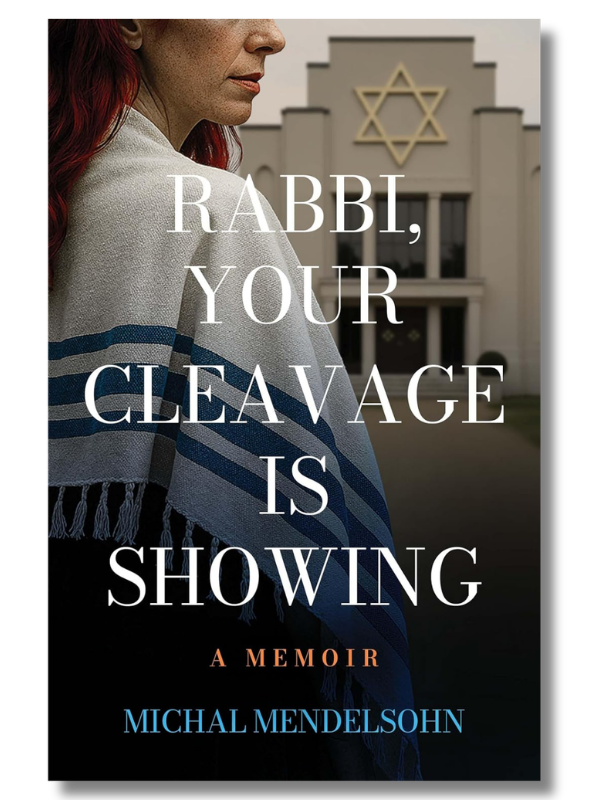
Michal Mendelsohn’s Rabbi, Your Cleavage Is Showing is at first glance an amusing religious memoir. Yet what emerges is something far more intimate than amusement: a life shaped by isolation, where faith isn’t a starting point, but something that comes to define her. With a voice that is blunt and deeply reflective, Mendelsohn writes about the difficult, often unconventional choices that shape her life, many of them entwined with her Jewish identity.
The memoir follows Mendelsohn from her childhood in Manhattan through her service in Israel and, eventually, her path into the Reform rabbinate as one of the first women to enter the field. Raised in an unstable and distant family, her childhood is marked by loneliness and forced independence. Her decision to travel to Israel during the Six-Day War becomes a turning point, offering a sense of connection and purpose that she hasn’t found in New York. When she returns to the United States, that feeling of belonging proves difficult to recover, and her path toward the rabbinate unfolds alongside the resistance—and cost—of entering a space that never intended to include her.
Growing up in the Governor Clinton Hotel, Mendelsohn’s childhood world feels both glamorous and hollow. She accompanies her father in duets to entertain figures like Robert Merrill and Jan Peerce, while her mother spends hours preparing herself only to leave the house once a week, disappearing into manic shopping sprees and trips to the hairdresser. Often referred to as a mistake, Mendelsohn grows up fearing she will become like her older sister, Sybil, who is cast as the problem child. The abuse follows them as they move from the hotel to smaller and smaller apartments, its violence described with a stark casualness that makes it too easy to imagine. At one point, Mendelsohn hides from her father behind a locked bathroom door, distracting herself with War and Peace.
What stands out in these sections is not just what Mendelsohn recounts, but the way she reflects on it. Her voice is unflinching, often turned inward, with a level of self-criticism that feels, at times, undeserved. Rather than blaming her parents, she tries to understand them: her mother’s dependence on her father despite his affairs, as well as his own struggles with his career. It’s a way of looking back that complicates the narrative as much as it clarifies it.
That search for understanding extends beyond her family, shaping the choices that take her to Israel. Her decision to go during a time of war feels less like defiance than a calling to find her identity. In Israel, that belonging comes into focus as Mendelsohn bonds with her host family while volunteering in a village, later becoming a dual citizen and serving in the Israel Defense Forces’ entertainment troupe. For the first time, she begins to understand what it means to belong. Yet it isn’t something she is able to financially hold onto. When she returns to the United States, that sense of purpose proves difficult to sustain, and her path into the rabbinate feels like a continuation of that search.
And it’s something you want Mendelsohn to find. Her struggles with identity, abuse, and diaspora after returning to New York carry the same openness as her reflections on her childhood. From working as a go-go dancer and delivering telegrams to taking a position at the Israeli Consulate, she moves through a series of roles in search of a place in a city that feels less like home than a stranger. That same search continues as she enters the rabbinate and later leads a congregation, where she reflects on the demands placed upon rabbis to be everything to everyone. It’s an impossible expectation; something that she recognizes is a challenge that rabbis continue to face today; one that contributed to her leaving her first congregation. Yet her life doesn’t feel directionless; each decision is made with intention, even as that sense of belonging remains just out of reach.
At the center of all of this is Mendelsohn’s relationship to Judaism, which shapes not only her decisions but the way she understands her life. It is not presented as something fixed or inherited, but as something she continually returns to, questions, and redefines for herself. Whether in her childhood, her time in Israel, or her work as a rabbi, Judaism becomes a framework through which she makes sense of her experiences. Faith doesn’t resolve the tensions of the memoir; instead, it gives them shape, offering a way for Mendelsohn to move through a life filled with difficulties.
Rabbi, Your Cleavage Is Showing is a thoughtful and, at times, deeply affecting memoir. Mendelsohn’s honesty, particularly in the way she turns her scrutiny inward, gives the narrative a complexity that resists easy resolution. What stays with the reader isn’t the structure of her career, but the ongoing search for belonging and the role faith plays in shaping it. It is in this tension that the memoir finds its greatest strength.



What did you think?