

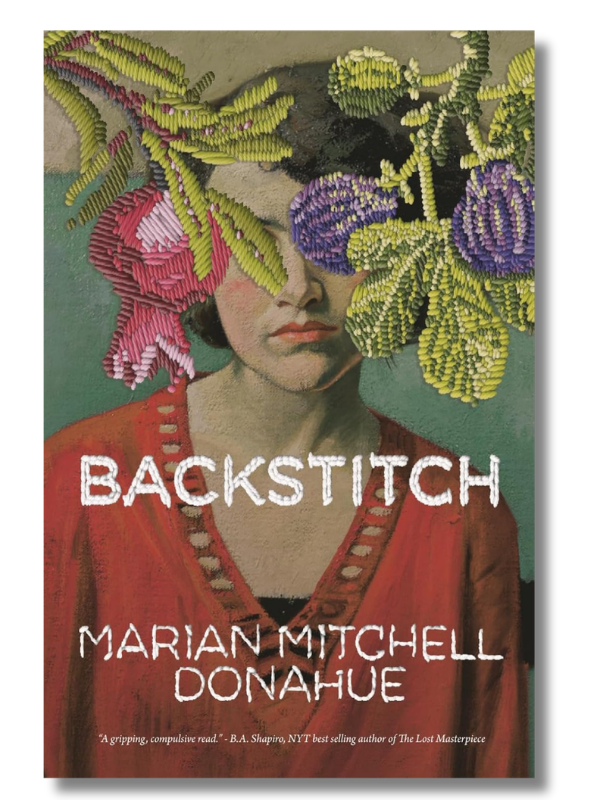
A genre-defining artist novel grounded in the generational consequences of artistic inheritance
Novels that take an artist’s coming-of-age as their subject often dwell on volatility—the passionate struggle to establish an original voice while keeping ego and ambition in check. Marian Mitchell Donahue’s stunning debut, Backstitch, refreshes the künstlerroman by shifting attention away from the stale myths of the suffering, solitary genius and toward the messy familial structures that, for better and for worse, inspire and complicate artistic creation.
The novel begins with a resurrection: Alice Snyder has been rescued by feminist art historians and granted a retrospective at the National Museum of Women in the Arts, seven years after her untimely death in a home-studio fire. Centering yet destabilizing the figure of the mother‑artist, Donahue deploys ekphrasis not merely to bridge the verbal and visual divide and bring her fictional fiber artist to life, but to position the reader alongside Alice Snyder’s adult daughter, Violet, as she revisits the trajectory of her mother’s oeuvre.
As Violet navigates the exhibit, we pace beside her, reading the same carefully curated wall labels she does. Few fictional artists feel so tangible or accessible; Donahue renders Alice’s work with such tactile specificity that it seems possible to reach through the page—or the screen of an e‑reader—and brush against the embroidered tulle veil of her mixed‑media piece Veiled Seascape.
Donahue refuses to romanticize the story of Alice’s artistic evolution. The young painter’s undergraduate education is upended by an accidental pregnancy with a young photographer who is more interested in cosplaying as a member of the Pre-Raphaelite Brotherhood than he is in being a father. Her graduate education, undertaken once her daughters have both entered high school in a prestigious MFA program that delights in cutting its underperformers loose, is no less chaotic.
The thread that connects Alice’s experiences as an undergraduate student and working mother is the plight of the artist’s model. Alice is coerced into masquerading as Lizzie Siddal—remembered more for her posing than her own artwork—for her boyfriend, who quite literally renames himself Gabriel after his idol, the artist-poet Dante Gabriel Rossetti. Her performance as Siddal feels claustrophobic; even when Alice wishes to play into Gabriel’s Victorian fantasies in a way that is more authentic to her own experience, he forcefully shuts her down.
Despite the pain associated with the unacknowledged assistance she provided him, she falls into her own traps, conscripting her own daughters into serving as her models, even if it means waking them in the middle of the night to pose well before they are of an age to understand consent. What Backstich ultimately invites us to consider is the aftermath of how partners and children become unacknowledged collaborators who lack the agency to determine how their bodies are displayed, criticized, and, ultimately, sold.
Beyond its compelling depictions of a woman artist who dies before she can reconcile her past with the emotional needs of her daughters, Backstitch offers bracing meditations on memory, legacy, and parenthood. Through Alice and her astronomer husband Arthur, Donahue unpacks in lucid detail what it means to become a parent unexpectedly while attempting to correct the sins of their fathers.





What did you think?