

A meaningful portrait of the distance between conviction and consequence
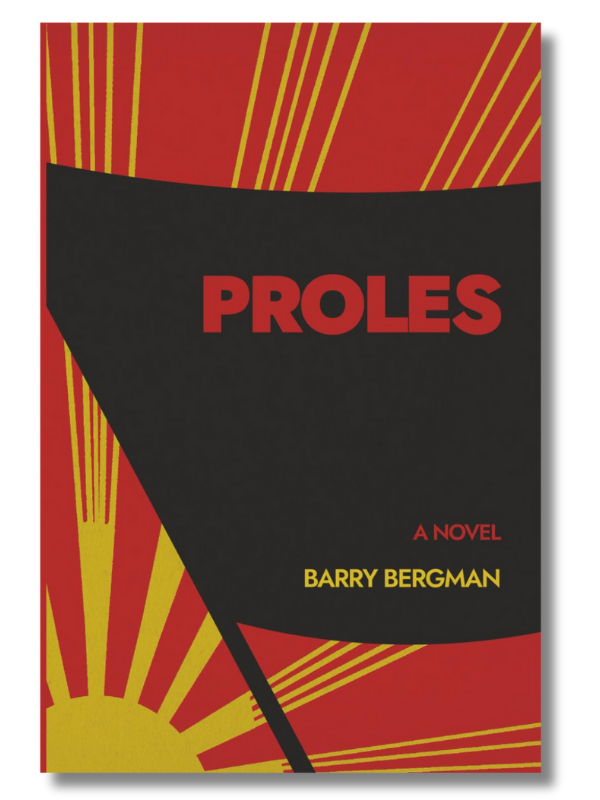
In Proles, Barry Bergman traces a world attentive to labor, place, and the quiet desire for meaning. Simon “Sy” Bussbaum moves through this world with the sense that something is missing, a purpose glimpsed and then deferred. The novel follows him through landscapes of heat, industry, and endurance, rendering atmosphere with remarkable care. From its opening pages, Proles suggests the possibility of transformation, even as it remains uncertain how, or whether, that possibility might take shape.
With Nixon in the White House and the draft shaping the horizon of young men’s lives, Simon Bussbaum moves through college with an uneasy awareness of politics pressing in on the personal. The film City of Emeralds becomes a catalyst, its portrait of labor struggle, and of Naldo Galvan as its emblem, offering Simon an image of purpose tied to collective action and political resolve. Drawn by these ideals, Simon leaves home for Tucson, Arizona, where he takes a job with a metal manufacturing company known among its workers as “Freako,” testing whether those ideas can be lived rather than merely admired.
In Tucson, the factory quickly asserts itself as a world unto its own, an enclosed system governed by heat, noise, and repetition. The blistering desert presses inward, and Simon’s body answers in kind: skin scorched, hands raw, fatigue settling deep into muscle. As Simon settles into factory life, the novel begins to move in loops rather than lines. Days blur into one another; labor becomes rhythm, then habit, then suspension. This sense of inertia feels intentional at first, even fitting, a reflection of a man shaped by endurance. The factory does not merely employ Simon; it encloses him.
He gravitates toward a small group of politically minded workers led by Harold, whose rhetoric and organizing ambitions suggest a framework for meaning. Yet the factory absorbs even these gestures. Ideas circulate, meetings recur, but movement remains largely theoretical. The work no longer sharpens Simon’s awareness; it dulls it, and the narrative follows suit.
Within this environment, endurance becomes a masculine virtue, and vulnerability—emotional or ideological—has little room to surface. The novel lives in the external rather than the internal, a choice Bergman renders with remarkable control, often allowing literal actions to replace interior monologue so that doing, rather than thinking, carries the weight of meaning.
The introduction of Samantha Tanager, the factory’s only female employee, deepens the atmosphere of unease without offering release. Within this closed ecosystem, both management and the organizing group view her less as a person than as a symbol, a potential figurehead onto whom competing visions of progress and solidarity can be projected. There is tension here, something withheld and unspoken, but it never quite gathers momentum. Instead, the story hovers, lingering in discomfort without allowing it to transform. Simon continues to drift even as the novel suggests he no longer needs to. Others recognize his intelligence and potential, yet he remains curiously absent from his own development.
Aside from moments of wry observation or strategic silence, Simon’s interior life stays largely out of reach. His emotions register through action rather than reflection, a choice that initially feels restrained but gradually becomes distancing. The effect is not emptiness, but absence, a sense that the world of the novel is pressing in while its central figure recedes.
At the same time, this absence feels purposeful rather than careless. Bergman appears less interested in charting transformation than in examining the conditions that prevent it, how ideology, labor, and myth can offer the appearance of direction without demanding inward reckoning. In this sense, Proles reads as a novel about proximity rather than arrival: proximity to political ideals, to working-class struggle, to figures of meaning like Naldo Galvan, without the clarifying pressure of consequence. The restraint is disciplined, even admirable, but it is also a risk, one that asks the reader to sit with unresolved longing longer than some may wish.
Proles is at its strongest when it allows place to speak: in the heat of the desert, the weight of labor, the quiet accumulation of unease. Its wandering quality feels deliberate and disciplined, even as it begins to tip toward constrictiveness. Readers drawn to meditative, austere fiction will find much to admire here, particularly in Bergman’s ability to evoke a world that presses so vividly upon those who inhabit it.




What did you think?