

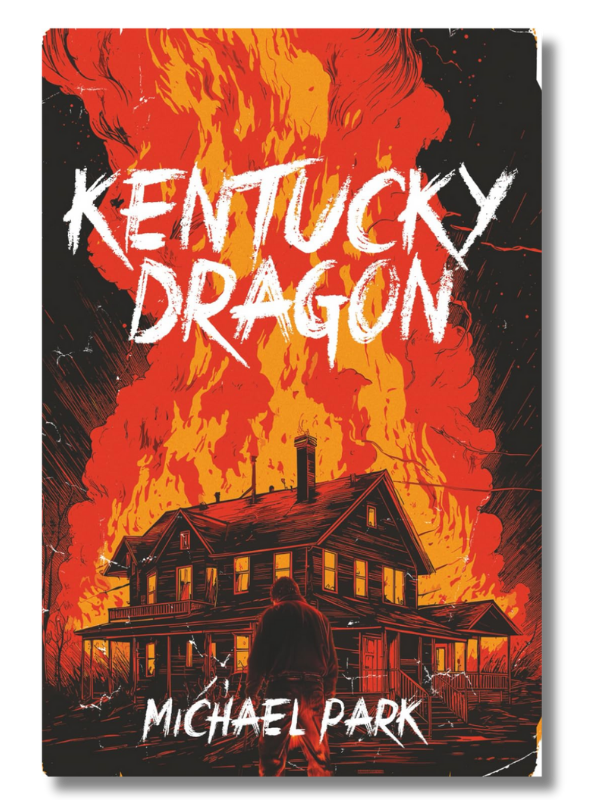
A gruesomely compelling, well-paced portrayal of a family hounded by a traumatizing intergenerational debt
At the start of Kentucky Dragon, Mark Morris is a an eleven-year-old boy—the youngest child in a loving family with a terrible, secret debt. By the end of the novel, he’s an adult and his family’s relatably flawed protector. Mark witnesses terrible violence as he struggles to uncover the truth of his family’s debt, violence that author Michael Park treats as both specific to the Morris family and indicative of the social debt left by cultural atrocities like slavery and the Holocaust.
The first chapter lands a big hook with the introduction of the “chicken man,” a supernatural debt collector carrying a sinister duffel bag.
“I had the strangest feeling he was an animal walking upright, not a man. Nothing specific was wrong about the way he walked, but it was as if those weren’t legs—or he wasn’t accustomed to using them this way.”
The “chicken man” introduces high stakes and violent implications. “Do you see this, Don?” the man asked. “Do you know who that is? Do you know how many parts of her there are?” He reappears just often enough to propel the novel forward with compelling dread. By the time you rejoin Mark in adulthood, you understand his struggle with alcohol and PTSD.
The mystery of the chicken man’s connection to Mark’s family remains only partially solved until the debt becomes Mark’s to pay. In his quest for answers, he is forced to grapple with acts of terrible violence. There is his father’s death and the mutilation of his brother, (which Mark witnesses as a child), the atrocities committed by his Nazi grandfather during WWII, the skinning of his grandmother’s ghost, and his older sister’s abduction and death, all framed within the context of a antagonist willing to disembowel, mutilate and behead. The chicken man does it all in service to his boss.
The violence is graphic and, at times, a bit overwhelming, but it is also to a point. Park uses it effectively, if not sparingly, to communicate the horrors of intergenerational trauma. He does not linger unnecessarily. That said, I would caution readers to respect their own limitations regarding violence implied and, on the page, and encourage them to read mindfully.
Kentucky Dragon is paced to near perfection—a fantastically readable book. Park’s prose is frank and direct with an underlying humor. (The chicken man is weirdly charming in a terrible-person kind of way). Park also makes good use of dread and suspense by deploying the chicken man and similar threats with care. Danger hums in the background, constant and uncomfortable, relentlessly driving the plot.
Park also uses the mystery of the family’s debt to great effect in the pacing. Who is the chicken man? Who is he collecting for? What does it have to do with Nazis and German folklore? Park drip-feeds lore in a way that keeps the curiosity alive.
The only point where Kentucky Dragon lags is in Mark’s POV. He spends a lot of time second-guessing, denying or rationalizing well established events. “Never speak or think of this again.” Denial is a relatable response to trauma, but Mark’s impulse to deny and rationalize tends to undermine the severity of his situation. But this is a small quibble in an otherwise terrific read.
The ending teases the possibility of a sequel wherein Mark takes on the chicken man’s employer, and I hope it happens. Kentucky Dragon is a whippingly intelligent take on contemporary horror, and readers would be happy to pick up a part two.





What did you think?