

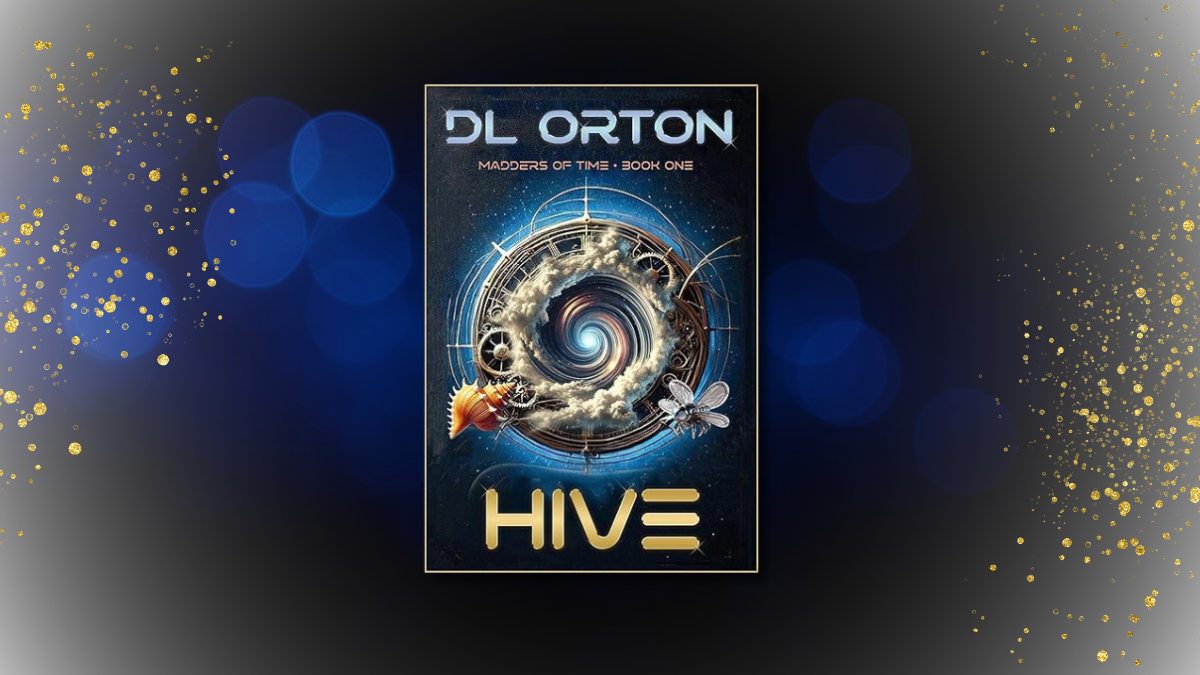
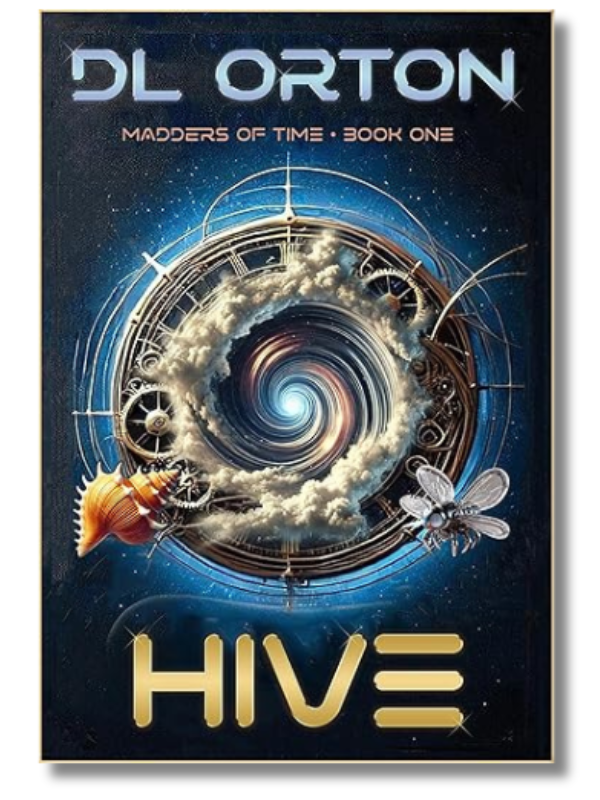
Hive (Madders of Time)
by D.L. Orton
Genre: Science Fiction / Time Travel
ISBN: 9781941368329
Print Length: 350 pages
Publisher: Rocky Mountain Press
Reviewed by Andrea Marks-Joseph
D.L. Orton goes all in on science in this sci-fi adventure replete with multiverse problem-solving thrills.
Hive is a story that plays with time and dives deep into our human capacity for both good and evil. The novel asks: How far can ambitious determination take you? If the fate of the world depends on it, could you find the love of your life and have her fall in love with you a second, third, fourth time? How far ahead should we be preparing for a potential “end of the world as we know it” situation, and how long will those resources last? And how far would you go to stop a billionaire tech CEO from selling a weaponized version of technology that you designed (with good, moral, pure intentions) to villainous regimes?
Set in the “not-too-distant future,” Hive follows Isabel and Diego, who are racing against time to find their way back to each other, save the world from Isabel’s boss (and ex-husband) Dave, a tech CEO high on his own supply and marketing his company’s tech to hostile governments for nefarious use.
Dave’s “biodomes” were built to help humanity survive on Mars by creating an environment that replicates what earth used to be—“an engineering wonder” filled with thriving botanical life, clean air, healthy animals, and enough food for all the humans it holds.
The healthy crops are achieved by bee-inspired drones that Isabel designed to pollinate plants, but she suddenly learns that Dave has turned her life-giving bee army into weapons that can be sent out to poison and kill en masse. Dave can’t stop himself from making outrageous promises to high-profile potential clients, and he repeatedly takes whatever savage and cruel action is necessary to get what he wants out of this technology—safe or not, tested or not, morally sound or the exact opposite. And he’s more than happy for the biodomes to be populated only with those wealthy and influential enough to afford his exorbitant prices. “We should have tried harder,” Isabel tells their AI companion in the future-set prologue, “to save all life on Earth—not just a handful of billionaires and their trophy wives.”
When we first meet Isabel and Diego, they are in a biodome in the future, burying their longtime friend who died by suicide. This moment of immense grief and shock is when we learn that Isabel is terminally ill, uses a wheelchair, and has devised a plan for Diego to leave her behind and time-travel slash multiverse-travel into a crucial moment in their past, preventing Dave from completing the destruction he designed.
Diego and Isabel’s love story is the heart of Hive, a romance on its second, third, and fourth chance, provided by the scientific miracle that is time-traveling and multiverse-infiltrating. Their romance is a satisfying and sweet emotional pull through the winding, often dark (in tone, and sometimes literally, when systems lose power) road to saving their corner of the world. Once she’s convinced him to follow her plan, Diego is devastated to leave Isabel behind in the biosphere but aches with hope that he’ll find a way to reunite with her before she dies, making all their past mistakes into a physics-powered miracle in time.
Author D.L. Orton writes vividly, bringing us right into the scenes with lines like “The sodden earth makes a wretched sucking sound each time Diego’s shovel cuts into it,” and lines that will make your heart beat faster in fascination: “Why did the ‘savior of humanity’ kill himself?” While digging his friend’s grave, Diego notes that “in the end, he couldn’t even save himself.”
Diego (looking much older, after aging for years in the biodome) arriving in the past is a riveting read, his reality complicated and energized by scenes where he must warn his past-self and past-Isabel about where they need to be and what they need to do so that history changes for the better.
In typical time-travel fashion, he can’t change things too much or all of history will be unpredictably ruined in ways he can’t yet imagine. Some of the scenes in this part are a little long, dragging crucial parts of the story out into extensive blow-by-blow accounts. Author D.L. Orton’s writing is so evocative, though, that I still enjoyed reading it and was swept up in the hold-your-breath drama. One or two scenes near the beginning falter under the length issue as well, but trust me—it is incredibly worth pushing through.
Hive is told from three different perspectives: Diego, present and future, both versions of himself on a mission to change the future and reunite with Isabel; Isabel, trying to free herself and her life’s work from Dave’s evil clutches; and physicist Matt, who has been kidnapped and forced to work on a government project seeking to understand and urgently replicate recently discovered time-traveling objects. Each chapter opens with the AI companion’s notes on where they are and at what stage this person is, in correlation to the next Doomsday or stage of planetary collapse. Near the 50% mark of the novel, the AI’s facts become chilling, must-read updates, estimating how much (or how little) destruction Diego’s time-traveling plan has actually prevented. The wording in some of these updates gave me full-body shivers with the chilling realizations.
The most exciting Hive storyline? It’s got to be Matt’s! Set in an underground bunker, the top-secret research and development facility is run by government agents and filled with world-renowned scientists who specialize in niche multiverse-relevant sciences. These scientists were kidnapped from their homes and brought in by the government to work on what is essentially a time-traveling, multiverse expanding project. It’s a big guessing game, as they’re kept in isolated areas with no knowledge of who else is there and what they’re working on, and they’re forced to work under immense pressure with limited tools, but they succeed in fascinating ways. If you enjoyed stories like the TV series Manhattan or any depiction of Alan Turing inventing his codebreaker, you’ll love this aspect of Hive, too.
Hive includes multiple kidnappings; a friend’s suicide; a terror attack; a brief mention of family members killed in a car crash; grief; cancer; an unexpected pregnancy; a miscarriage; and a tsunami. I will also note, for my fellow Does the Dog Die users, that there are many animals in this novel, including pets, but no matter how close to the action they get, no pet dies in Hive.
Readers who enjoy engineering-focused sci-fi stories and tales where impossibly slow government bureaucracy and rapidly growing corporate greed intertwine should go get a copy of Hive immediately. This novel scratched the itch that drives so many of my favorite sci-fi stories—the interns building and innovating surveillance bots in the Netflix series Omniscient; a malfunction of so-called world class, indestructible machinery that we urgently need a very specific mastermind engineer to repair à la the TV series Snowpiercer; the “this is above you, don’t ask questions, do what you’re told” answers that curious, talented engineer Juliette disobeys in AppleTV+ series Silo —and to my delight, Hive does this all at once!
I would definitely recommend Hive to sci-fi lovers. It’s well worth pushing through the slower parts for the thrilling, twisty, highly engaging story that comes after. I will for sure be looking out for the sequel, for three main reasons: Firstly: I loved the in-depth science discussions and problem solving in the research bunker; Second: I am crossing my fingers for a queer romance between a scientist and the government official assigned to him; and, finally: Because of my fears about climate change and infrastructure collapse, I found the real-world measures Diego and his neighbors take and live with after grid collapse very informative. This book is listed as “Madders of Time: Book One” so readers who share my anticipation can look forward to a sequel!
I’m so impressed with the depth and diverse insights into multiple industries that author Orton has built into this story. She deserves praise for how much emotion is packed into each character’s experiences, true to the unruliness of human emotion even within a bland, bureaucratic system or a harrowing situation where survival is all we can risk thinking about.
Most remarkable about reading Hive is that my disinterest in ever putting this book down wasn’t motivated by a need to find out what happened next or whether they got the multiverse-machine working, but instead a longing to continue spending time with each of Hive’s characters, witnessing how they react to each dramatic change in their lives and how they interact with each other.
If you’re looking for your next sci-fi read, you can’t go wrong with this engineer-led, tech CEO-hating, near-future experience of dystopian daily life. You’ll meet people who are experts in their fields and discover how much can go wrong (and occasionally right, if our heroes are able to intervene) if we allow our planet to be ravaged by dangerously ambitious billionaires and greedy, oppressive governments who hoard resources for the elite.
Thank you for reading Andrea Marks-Joseph’s book review of Hive by D.L. Orton! If you liked what you read, please spend some more time with us at the links below.


What did you think?