


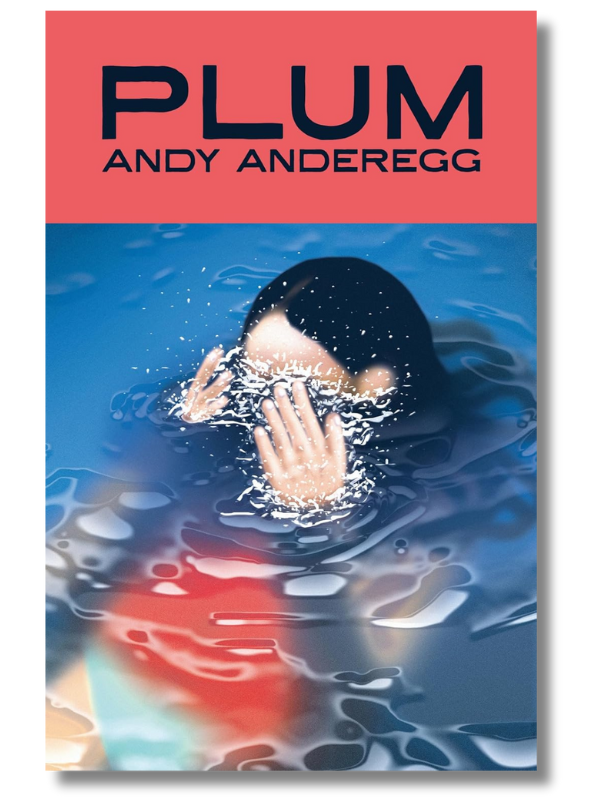
Plum
by Andy Anderegg
Genre: Literary Fiction / Coming of Age
ISBN: 9798885740463
Print Length: 232 pages
Publisher: Hub City Press
Reviewed by Lola Lee
A second-person marvel—coming of age and the lasting impact of trauma on the path of healing
Plum by Andy Anderegg is written in the second person, immersing “you” in J’s journey from childhood to adulthood. With an alcoholic father and a mother who mostly stands by as a silent witness, her brother emerges as her only true companion. Their relationship—sometimes supportive, sometimes distant—is the only family bond the protagonist really values, even if she struggles to fully appreciate its significance in her life.
When the protagonist’s brother abruptly leaves after years of being the main subject of her father’s violence, the impact on J is profound. Her feeling of abandonment deepens, intensifying her sense of isolation.
In this pivotal moment, she turns to the internet for distraction and validation. There, she gets caught in a cycle of superficial interactions with online strangers, unable to forge meaningful connections. This pattern persists as she steps into adulthood alone, burdened by the weight of her traumatic past and without a clear view of how to move forward.
“Your brother gone, however much you hated him then, you miss him now. All the blows he took for you both. All the spotlight he got.”
The sibling bond is the heart of the story, establishing the complexities of reliance and emotional conflict in a shared violent household. J’s feelings toward her brother seem to be constantly changing, which illustrates the difficulties of trusting those closest to us when they are also part of our painful environment.
For J, accepting and understanding her past proves challenging. She uses deflection as a kind of protective mechanism to help her divert the violence at home and carry on. As the abusive actions are rarely directed at her, she retreats into daydreaming, music, and eventually the online world to escape her reality. Yet, as she becomes a woman, the trauma she tries to silence remains a persistent shadow, influencing her interactions and relationships in adulthood.
“OK cool, if you think there’s any extra way you can abandon me, try. You hope they do try—you love the feeling of knowing again that you are the only person you can rely on…It’s like a pulsating radiating thing. You don’t have to wonder about anything. You already know. They’re good for nothing. You don’t even have to hope.”
The second-person narrative may initially disorient readers, but once you get comfortable in it, this perspective ultimately succeeds—a direct path to connecting with J’s thoughts and experiences. It’s easy to get invested in her introspective journey, and the well-written perspective definitely impacts that. As the story unfolds, the you-narrator enhances our comprehension of the protagonist’s internal conflict, and we’re drawn deeper into her world. The brevity of the chapters also adds greatly to the pace.
Plum is an intimate exploration of abuse and the winding path toward healing. It captures the struggle of growing up in a hostile environment and the painful process of self-discovery and acceptance. As J starts to confront her past rather than evade it, the narrative evolves into a reflection on survival, the complexities of human connections, and the long road to recovery.
Thank you for reading Lola Lee’s book review of Plum by Andy Anderegg! If you liked what you read, please spend some more time with us at the links below.


What did you think?