

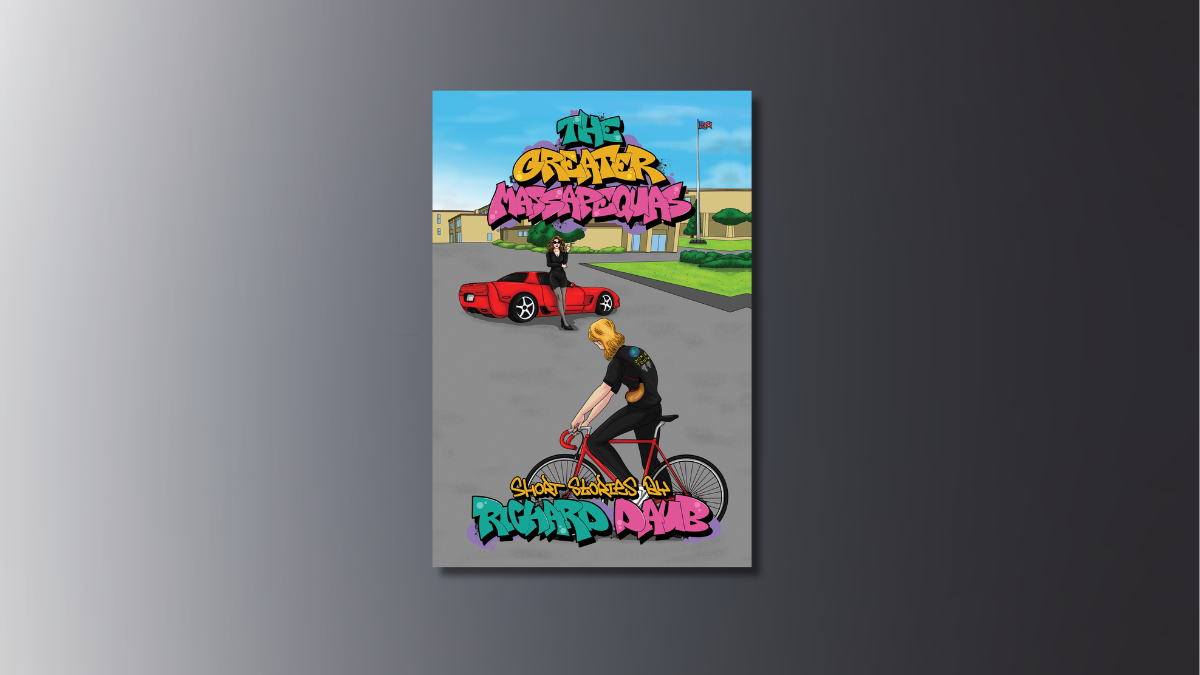

The Greater Massapequas
by Richard Daub
Genre: Literary Fiction / Short Stories
ISBN: 9781946094087
Print Length: 294 pages
Reviewed by Erin Britton
Eccentric, funny, and real—explore Massapequa in this wide-ranging collection of linked short stories.
All human life is here in Richard Daub’s The Greater Massapequas, a collection of 49 short stories set in and around Massapequa on Long Island, New York.
Spanning the period from the mid-1980s to the early 1990s, the included stories focus on the eccentric people and places of the (in)famous hamlet, delving into their oddities, shenanigans, and shames as viewed from the perspective of a singular observer—that is, an outsider who was unceremoniously relocated to the burg at an impressionable age.
The first story in The Greater Massapequas, “Birch Lane,” introduces Carl, at the time a fifth grader, who goes on to be the central character around whom all of the subsequent stories weave. In this opening gambit, Carl is settling in for his first day at Birch Lane Elementary in Massapequa, having moved to the hamlet after his mother left his father to shack up with her affair partner, the aptly named Rick the Dick, “the suburban cowboy with Burt Reynolds mustache, custom van, and country music.”
It’s 1983 and Carl sadly comes to realize that he is grossly underdressed compared to his classmates. “Carl had never been a ‘new kid’, and he’d always felt bad for them, outsiders for at least a couple of grades before the ‘new kid’ label finally started to wear off.” The reality turns out to be even worse than he imagined and not just from a fashion point of view; he even gets labeled with a “KICK ME” sign. However, a meeting with fellow newbie/outcast Eric suggests that the new school might not be a total loss.
In “Birch Lane,” Daub sets the tone for the entire collection by focusing the story on a life event that is relatable to many: the disorientating experience of being the new kid, especially in a place where everyone seems to have known everyone else forever. This universality of theme renders Carl’s early experiences in Massapequa hugely relatable and triggers a sense of understanding or, maybe, camaraderie, leading to the hope that things will quickly improve for him.
“Till Death Do They Part, Pt. II” sheds further light on Carl’s amusingly troubled backstory in the lead-up to the move to Massapequa. For instance, one evening, heading downstairs in his pajamas to retrieve a Hardy Boys book, he is startled by the presence of Buck in the living room. “Carl screamed and ran out of the room yelling, ‘Intruder! Intruder! Call 9-1-1!’” This flair for the dramatic is evident in many of the later stories too, but so is the casual disregard for Carl’s thoughts and feelings by the adults in his life. He can be a bit taxing, but there are often good reasons why he is so.
Such disregard likely explains another key theme running through The Greater Massapequas: Carl’s painfully deep-rooted desire to fit in and be accepted. Whether it’s stealing a Star Wars figure in “Zaxxon and the Emperor’s Royal Guard,” or allowing Eric to destroy his new bike in “The Huffy,” or one of the numerous other instances of self-sabotage, Carl is very often his own worse enemy, which can sometimes make rooting for him difficult. Still, his lack of self-confidence and obvious desire for friendship render him a very real and sympathetic character. He often ends up doing exactly the embarrassing thing that everyone prays they don’t do.
In fact, Carl’s far from the only resident of Massapequa with issues. In “Big Chief Lewis,” Ethel and Charles argue over whether the new advertising gimmick for their insurance company is offensive: “the just-delivered two-story fiberglass statue depicting Big Chief Lewis, Native American warrior, adorned with feather headdress and peace pipe ready to be torched, standing on a square of AstroTurfed concrete, flanked by disproportionately smaller statues of a horse and bison.” Good judgement is clearly in short supply in the hamlet. Despite their cartoonish worries, the antics of Ethel and Charles, like those of many other residents, are simultaneously sad and mad, highlighting the often absurd nature of life.
There are also occasional visits from out-of-towners in The Greater Massapequas. For example, in “Saturdays,” Carl’s father makes an appearance. “At exactly 10:00 am on Saturday morning, Carl Sr. pulled into the driveway of ‘The Mansion’ belonging to his ex-wife and her new husband, the man who’d cuckolded him.” The cringe-worthy post-divorce experience and the almost excruciating attempts by Carl and his siblings to seem pleased that their cheapskate dad is visiting are yet more universal themes. Daub has a keen eye for the everyday and for the mundane things that yield unexpected power.
As the collection progresses and Carl grows toward adulthood, these kinds of experiences become less frequent, but they are replaced with other—equally lugubrious—events and encounters. Whether skipping the junior prom in search of a cooler Hamptons party in “More Than A Woman,” which includes a startling revelation about the potential (emotional dangers) of a glow-up, or seeking to purchase a socially acceptable first car in “The Rabbit,” or serving as a willing rebound guy in “Girlfriend II,” Carl’s life doesn’t seem to get any easier or less complicated with age. Indeed, there seems to be a real danger that he will become a long-term Massapequa loser unless he shakes things up somehow.
Finally, The Greater Massapequas concludes with “Waitresses of the Northern Tier,” which sees a now grown Carl traveling on I-94 in Beach, North Dakota, heading toward Seattle and the promise of a new life, an escape from being “born in the wrong place. To the wrong family.” Breaking his journey at a truck stop, he gets talking to a waitress named Dinah, who reminds him of his first crush, Maggie. “Speaking softly, she said, ‘If you’re willin’ to stick around for a little while, my shift ends at three, and I’ll have an hour before I have to start getting dinner ready for the kids.’”
Despite the tempting offer, he hits the road, but there’s “something nagging at him, that this was not yet a ‘memory’ but an active thought buried alive, and that there was still time to go back and turn that nice little moment into the ultimate Kerouac road experience.” He turns back to Beach and is there to meet Dinah when she finishes. They head to her house, where her ex-husband also still lives, and then her mother turns up too… Making a quick escape, Carl continues his journey, visiting other truck stops and meeting other waitresses who remind him of girls he once knew.
“Waitresses of the Northern Tier” is both amusing and strangely melancholic. Each encounter that he has with a new waitress reminds him of something, however painful, from the past that can never be recaptured. He’s traveling to Seattle in search of a new life and a new him. Despite the prompting from an almost preternatural waitress named Maggie, will he ever be able to break the cycle of a lifetime and actually let love in?
Despite collecting 49 stories, The Greater Massapequas is a surprisingly quick read, with Daub linking each of the vignettes in such a way that there is always a pull to see what happens to Carl and those around him next. Indeed, many of the stories end on the kind of mundane cliffhanger—Will a new friendship form? Will the truth behind a bike theft be discovered? Will racist distant relatives ever improve?—that has so much importance in daily life, particularly for growing children and/or those seeking their place in the world.
As a collection, Daub’s stories present Carl’s growing pains in all their perplexing and embarrassing glory, meaning that they weave together to form a unique, episodic coming-of-age novel about a frequently troubled young man growing up in the 1980s and 1990s surrounded by those who don’t or won’t understand him. Still, as each story is ultimately self-contained, they can be read as individual tales, perhaps even in a random order depending on what takes the reader’s fancy, providing a satisfying and surprising reading experience each time.
The Greater Massapequas is an evocative collection of stories that offers a window into another time and place, with Carl serving as a kind of everyman who must go through the trials and tribulations of growing up in order to illustrate the universal nature of such experiences and reassure readers that their own lives are only averagely peculiar. Taken together, the stories are entertaining, sometimes troubling, often hilarious, and always engaging.
Thank you for reading Erin Britton’s book review of The Greater Massapequas by Richard Daub! If you liked what you read, please spend some more time with us at the links below.




What did you think?