

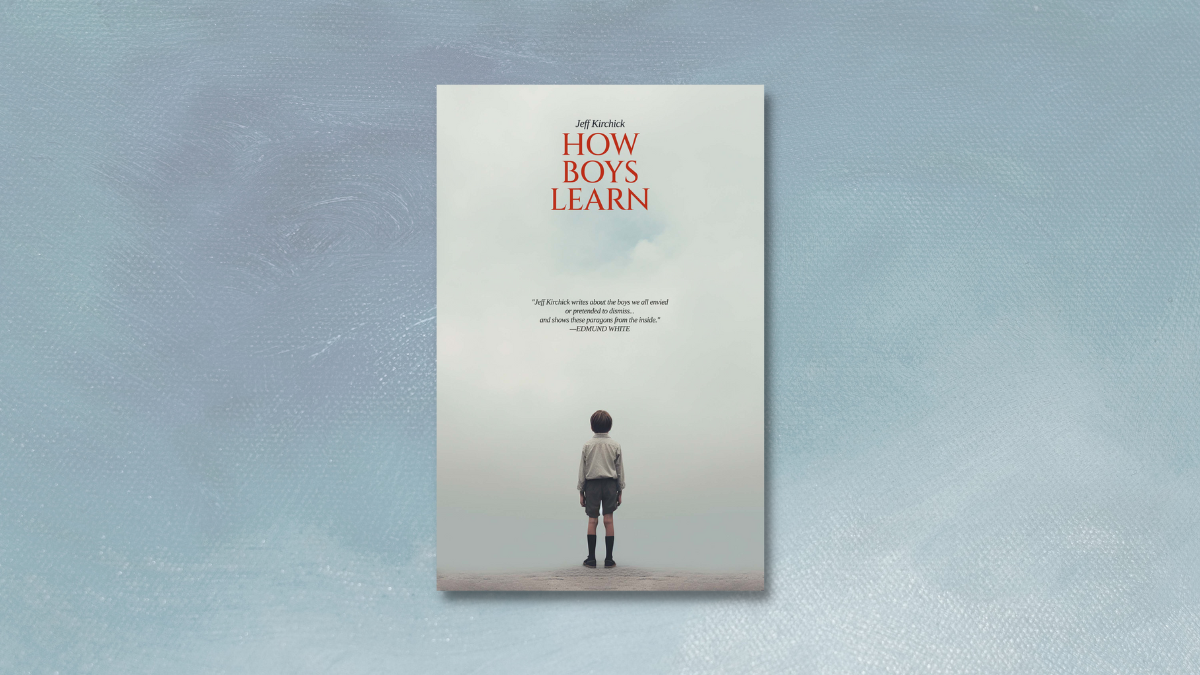

How Boys Learn
by Jeff Kirchick
Genre: Literary Fiction / Short Stories
ISBN: 9798891320963
Print Length: 180 pages
Publisher: Atmosphere Press
Reviewed by Warren Maxwell
Melancholy and the endless pursuit of maturity, or at least self improvement, permeate this collection about boys, men, and the inchoate stages in between.
“After all, we were four boys from the Midwest, and we couldn’t have known much about feelings. We threw pebbles. We kicked stones. We ran around. We played with things. We looked at the trains.”
The seven stories collected here reflect on growing up in small, post-industrial towns, on broken families, friends left behind, and the absurdities of cloistered liberal arts colleges. Their links are manifold, with each story driven by a first person narrator, a boy or a man looking back on their childhood or braving the gauntlet of present adversities.
The first piece, “The Boy Who Always Cried,”takes the form of a diary, offering snapshots in the collapsing life of a successful doctor. Having theorized the existence of postpartum depression not only in mothers but in infants as well, the birth of a boy who cries incessantly for years on end throws a wrench into the narrator’s theory, obsessing him and accelerating the deterioration of his personal life. “Kicking Stones”takes a traditional conceit, the discovery of an old friend’s death, as a catalyst for the narrator to reminisce about the last, long summer he spent in his hometown before leaping into a new, more privileged life.
Redolent of Raymond Carver’s gritty realism and Breece D’J Pancake’s desolate American landscapes, there is little humor or formal innovation in these stories. Rather, they target slices of raw life in which seriousness and tragedy rein. The one exception, “This is the Story That I Wrote for This Week,” satirizes creative writing workshops and political correctness with a narrator who writes a story about “a character who is a gay, black, female Jew who is also Muslim. Unless someone is willing to go against the sexuality, race, sex, or religion card, I feel like she is pretty much untouchable.” Nestled into its provocative jokes is a casual cynicism—the protagonist systematically mocks and stereotypes every person in his workshop while fantasizing about his future literary career—that goes unquestioned, and is even rewarded in passages that stretch the suspension of disbelief. Along with a tidy ending that is more a reflection of undergraduate workshop fiction than a comment on it, this feels like the weakest story in the collection.
“I actually started to look at her for once. Of course, I’d seen her around, but I didn’t really know what she looked like up close. She had beautiful green eyes, long dark hair, and a bony frame. Her narrow jawline and wrinkles made her look kind of like a witch, but a beautiful witch, I thought to myself. Yes, maybe I loved my mother after all.”
Elsewhere, heavy emotional honesty is refreshing. As they cycle through classrooms, dingy bars, train tracks, and run down homes, the six other narrators display an acute attention toward their feelings, to the way events subtly resound in their hearts, and a desire to learn about themselves. On the macro-level, this introspection pays off—events and scenes are woven into enigmatic structures. Conclusions are satisfying though rarely happy. There’s a poignance and bitter logic to the way locations repeat and overlap, constructing visions of dislocations and community in simple strokes.
Still, at the level of dialogue and narration, characters can appear stilted and erratic, shifting between extremes without clear motivation or authenticity. Occasionally this is a question of behavior—in the first story the narrator announces one major life event after another without giving attention to any, foregoing any possible character development.
Tropes about class and race are used as crutches and the knotty reality of diverse relationships is skipped over. At one point, a white narrator describes the experience of loneliness when his group of black and hispanic friends mock him for his whiteness. However, the story quickly pivots into a rote acknowledgment of his friend’s racial struggles, leaving the complex and provocative question of his own diminishment unexplored. In general, there’s a romanticization of certain aspects of male-specific traumas that keeps these stories in, if not safe, comfortable and well trodden territory.
Piety-busting tales of masculinity and the many paths toward manhood, How Boys Learn is an engaging debut collection that looks toward the tradition of harsh minimalism in American fiction.
Thank you for reading Warren Maxwell’s book review of How Boys Learn by Jeff Kirchick! If you liked what you read, please spend some more time with us at the links below.




What did you think?