

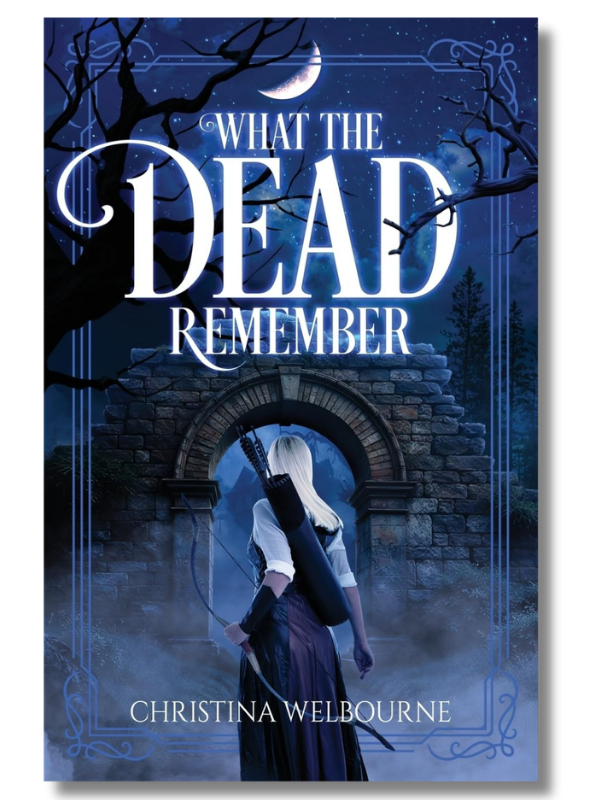
A propulsive gothic fantasy where inheritance is both key and curse
What the Dead Remember is a story about inheritance in its many forms: a house, a bloodline, and the gate they keep opening.
If you like your gothic haunted by old money, old ghosts, and older bargains, Christina Welbourne delivers with this novel structured in parallel timelines. In the present, Olive Fairwater arrives in the fog-laced Ozarks to visit the last surviving member of her family, her grandfather Deacon, at Ravenswood Mental Institution. In the past, Olive’s great-great-grandmother, Vivian Stonehall, witnesses something profane and impossible. Olive reads Vivian’s 1858 journals as the two timelines begin to echo and then lock together.
The central pleasure of the book is the way those strands escalate, turning a family curse into substructure: origins, wards, gates, bargains, consequences. The logistics are dizzying but propulsive.
The novel opens with a prologue drawn from Vivian’s journal after she watches her husband and his collaborators try to pierce the veil between worlds by harnessing an electrical storm. Vivian observes from hiding, terrified, skeptical, and already regretting the marriage that financed the experiment. When the gateway opens, there is no gentle ambiguity: “the sound of a thousand screams…pierced the night.” Later, writing in bed, Vivian records that the experience “stole hope from my heart, joy from my soul, and reasoning from my brain.”
This isn’t horror as a jump scare. It’s horror as genealogical atmosphere.
Olive has the tight, prickly realism of someone who has been disappointed by ordinary life and would like to stop being surprised. She is grieving, worn down, and trying to salvage a future back in Tulsa that is already slipping. She is not in the market for destiny. Unfortunately for her, destiny is a creditor, not a customer service agent.
Olive is Vivian’s heir whether she wants the title or not, and the novel is clear this is not symbolic. The house and land respond to her in ways they do not respond to anyone else. Welbourne starts in the language of classic gothic unease: a house that makes you lower your voice, sounds that travel wrong, a piano in the night. Olive is allowed to be skeptical, and the narrative supports that skepticism until it can’t.
That pivot is swift and final. After Olive suspects a break-in and calls the police, two responding officers head into the woods near the old gate and do not come back intact. It is the novel’s narrative fulcrum. The tension stops being about whether the supernatural is real and becomes about what kind of supernatural this is, and what it wants from Olive.
That is where the dual timeline structure earns its keep. Vivian’s journal entries are not decorative epigraphs but a second narrative engine. They complicate the present by showing the curse as a series of choices, not a lightning-strike misfortune. Her marriage is not a love story but a transaction with generational consequences. Welbourne uses Vivian’s voice to make the past feel immediate rather than museum-glass distant, and to show how easily a “respectable” family can become a machine for producing secrecy.
Once Vivian crosses into Ebonspire, Welbourne’s worldbuilding arrives through sensory dread rather than encyclopedia exposition. Time bends. The dead drip with glamor at night and collapse into rot by day, a reminder that performance can be both survival tactic and prison. In Ebonspire, what you pretend becomes what you are.
Vivian, raised on faith and “proper” expectations, must navigate not only leviathans but the shame and fury of a life built around other people’s compromises. Welbourne is not asking readers to believe that a sensible woman would willingly barter autonomy for power. She is showing the narrowing of choices that makes coercion look like refuge.
A key hinge is Vivian’s encounter with Kallum, the Forsaken King, an immortal ruler who functions less like a love interest and more like a gravity well. He is cold, controlling, and fascinated by Vivian in a way that is explicitly dangerous. When he offers terms, the book is honest about what a bargain with power looks like. Kallum’s proposal is not romance but coercion framed as diplomacy: “I get you for two nights a week, from sundown to sunrise. Wherever I command, you will follow, and whatever you witness, you will speak of to no one.” The line lands because it delivers characterization and theme at once. This is a book about thresholds, and not just magical ones. It is also about the threshold of consent, and what happens when someone treats your no as an opening position.
Back in Olive’s present, that bargain logic reappears in different clothing. The necklace Olive finds, a delicate silver chain with a vivid blue stone, is both family relic and operational tool. Welbourne makes “blood remembers” concrete. The gate does not respond to belief. It responds to lineage. When Olive is pulled toward it later, the moment works because the novel has done the setup. As she approaches, “the glyphs etched into the iron began to glow,” “a seam formed,” and then “the door yawned open. And the world beyond it breathed.” That is Welbourne at full strength: gothic language doing mechanical work. The gate is keyed, and the key has a pulse.
Part II, “Beyond the Gate,” shifts the novel into darker adventure mode and introduces Mr. Sallow, a paranormal investigator who is less Van Helsing and more ruthless field operative. His presence is a tonal signal. This story will not solve its problems with heartfelt speeches or the power of being special. Sallow is practical about violence and blunt about rules, and his methods make the supernatural feel organized rather than random. If Part I is about realizing the haunting is real, Part II is about realizing the haunting has procedures.
Welbourne’s main strength is escalation. She starts with vibe, earns dread, then pays it off with consequence. The dual timeline structure tightens the plot by turning Vivian’s history into Olive’s instruction manual. The settings are vivid without bloat, and the strongest images keep the supernatural from feeling generic: fog that behaves like a living presence, music that functions as lure, a gate that breathes like a creature.
The novel’s thematic spine is inheritance as both gift and trap. Olive inherits not only a house but unfinished business, old bargains, and a family legacy repeatedly mislabeled as madness because that is what outsiders call knowledge that threatens a town’s normalcy. At its sharpest, the novel asks who benefits from calling women hysterical or unwell when they are perceiving something real, and how institutions become convenient storage closets for inconvenient truths.
There are moments when Welbourne leans on familiar genre machinery: the unsettling institution leadership, the cold gatekeeper figure, the town that knows more than it says. Some dialogue edges close to announcing the theme. But the narrative engine is strong enough that these choices read as genre confidence more than failure, and the book moves with enough momentum to carry the occasional familiar beat.
What the Dead Remember should land especially well with readers who want both manor-house dread and a portal world with rules and consequences. It is also a fit for romantasy readers who like morally gray immortals but want the romance edged with menace rather than softened into easy redemption. If your favorite stories are the ones where a town’s “secret” is less folklore than operating system, Welbourne is building exactly that kind of machine.
This book sits near Silvia Moreno-Garcia’s Mexican Gothic in its inheritance horror and its pressure to dismiss a woman’s perceptions as instability. It also shares DNA with T. Kingfisher’s The Hollow Places in its portal-horror momentum, where crossing over is not escapism so much as a confrontation with something hungry on the other side.
Bottom line: Welbourne delivers a gate story in the oldest sense. You go through, and you do not come back unchanged.



What did you think?