

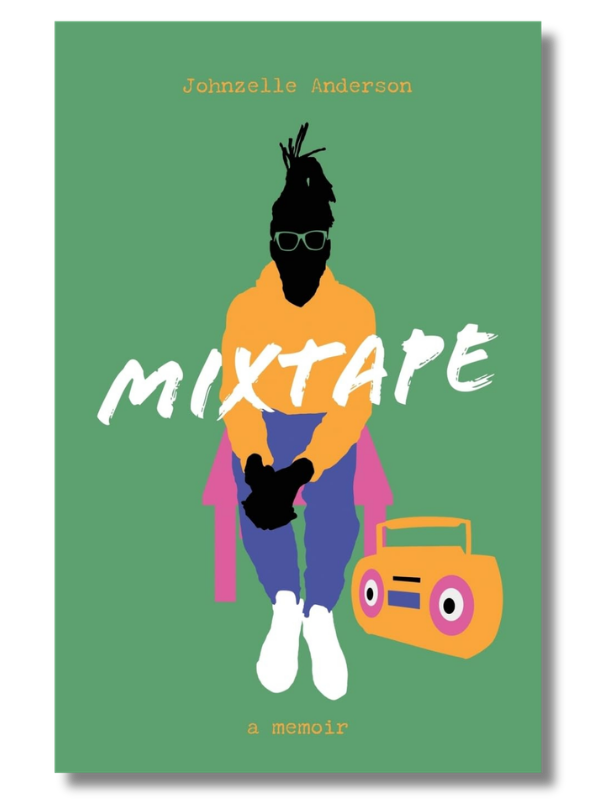
Finding the rhythm of resilience
In his debut memoir, Mixtape, therapist and storyteller Johnzelle Anderson presents a lyrical, track-by-track account of a life composed of the “sound and silence of survival.”
Growing up mixed-race in 1990s Roanoke, Virginia, Anderson faced the complex dissonance of a disengaged West African father and a volatile white mother. Feeling like an outsider in nearly every room he entered, he navigated a childhood marked by neglect and racism, eventually finding his footing through the grounding love of his grandmother and a transformative journey to Ghana. This is the moving story of a boy learning to rewrite the soundtrack of his life.
In a clever and creative spin, Anderson organizes his memories not into traditional chapters, but into “tracks,” a stylistic choice that mirrors the well-documented connection between memory, mental health, and music, and gives the book a unique, pulsing energy. This framing allows the narrative to move fluidly through time, much like a curated playlist that captures specific moods and eras.
Anderson’s writing is remarkably inviting; through a conversational tone, fluid cadence, and voicey humor, he makes the reader feel less like an observer and more like a confidante. Casual interludes interrupt the story in the way of natural conversation, and rather than drawing the reader out of the story, they break down the barrier between storyteller and listener.
Anderson has a particular gift for capturing the primal perspective of a child, even through his adulthood memories—the raw, no-nonsense way a young person experiences the world before they have the words to intellectualize their pain. It is vivid, visceral, and despite the heavy subject matter, surprisingly humorous.
As with many memoirs that deal with deep-seated generational trauma, Mixtape is a deeply personal exercise in catharsis. Anderson is unflinching in his assessment of those who failed him, even in his gentler memories of them. Though there is a time for nuance when assessing those who have, in their own way, become villains in an individual’s life, in this memoir Anderson prioritizes the reclamation of his own voice.
Ultimately, Mixtape succeeds because it is overwhelmingly human. Even for those who haven’t walked in Anderson’s specific shoes, the themes of seeking belonging and unlearning old patterns are universal and remind readers of the importance of honoring one’s inner child. Anderson’s journey from a silenced youth to a mental health professional is an inspiring reminder that while we cannot choose the songs we are born into, we absolutely have the power to remix the ending.




What did you think?