

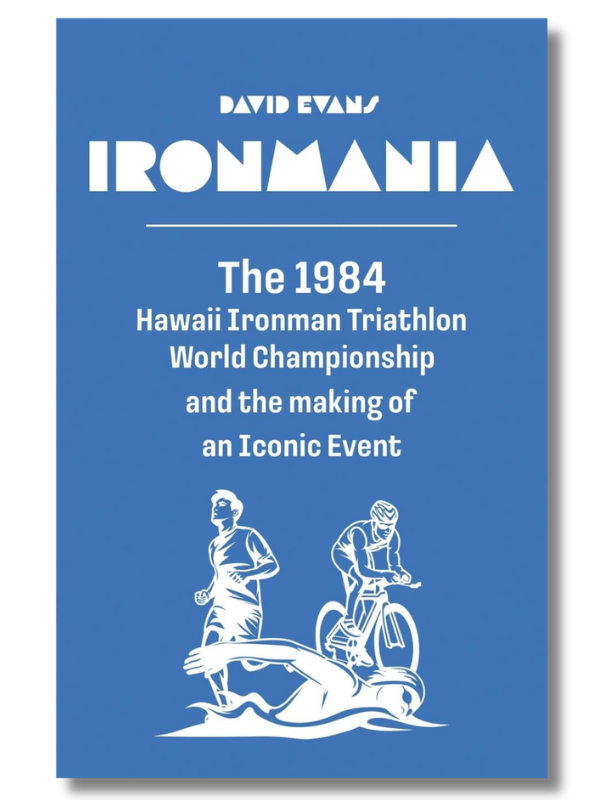
A personal, loving look at some of the pivotal moments that launched a global phenomenon
David Evans successfully participated in one of the early Ironman triathlons, and now, after a decades’ long absence and eventual return to the sport, he has produced an entertaining and informative historical portrait of Hawaii’s Ironman event, explaining its cultural significance and continued appeal.
In 1984, only a handful of years into its existence, the Ironman World Championship was on a threshold. Wide media coverage, prize money, improved bike technology, world-class athletes as well as international participants were all starting to make their way into the event. David Evans placed seventh in 1984 and so might be a little biased toward that particular event’s significance, but he makes a compelling case for it, while delivering an insider’s look at all things Ironman.
The book starts off autobiographically, chronicling Evans’ early life with his ever-moving family owing to his father’s job. The son was always moving too, leading to a childhood filled with sport but also with accidents. Serious injuries abounded; remarkably, the author has been hit by a car all of ten times.
The now-global phenomenon that is Ironman was born in and is intimately tied to Hawaii. The islands’ temperate shores gladly accommodate the aquatic part of the triathlon, while its heat and humidity make for the fearsome conditions necessary for any great athletic drama to take place. Evans ably brings the setting to life and makes clear its role in shaping the race. Even the event’s name, we learn, comes from the moniker of a local Hawaiian endurance athlete.
Evans describes the race and its surrounding circumstances in not just vivid but lived-through detail. We are acquainted with perennial frontrunners Dave Scott, Mark Allen, and Scott Tinley just as thoroughly as we are informed about Ironman’s change of ownership and process of receiving nationwide TV coverage. “Ironman may not have been made for television,” as Evans says, “but in some sense it was made by television.”
Evans acknowledges in the beginning of the book that Ironmania tells a male-centric story, which is understandable since the author is basing it on his own first-hand experience. But a moment that at least partially steals the book is the amazing imagery of Julie Moss finishing the 1982 Ironman crawling, which epitomized the competition’s spirit and did as much for its growth as any single athlete’s win.
It is believed that Pele, the creator goddess in Hawaiian mythology, puts a curse on anything that is taken away from its native Hawaii. In the case of the Ironman triathlon, however, one of Hawaii’s great modern exports, the Pele curse doesn’t seem to apply. The competition has spread throughout the globe with immense success, and the enthusiasm of participants like David Evans shows us why. His writing screams his love for this event, and it is sure to spark the interest of anyone who reads it.





What did you think?